If you’ve ever wanted to talk about the things you love doing in Japanese, 〜のが好きです (no ga suki desu) is one of the most useful grammar points you’ll pick up at the N5 level. 〜のが好きです (~no ga sukidesu) means “to like to do something.” It is used for expressing activities you like to do by simply attaching any action to the phrase. It works by taking any action verb and turning it into something you can talk about — almost like turning “to run” into “running” in English.
In this guide, we’ll break down exactly what this grammar point means, how to build sentences with it, and walk through plenty of example sentences so it really sticks. By the end, you’ll be ready to use it naturally in conversation.
Make Sure to Watch Coto Academy’s YouTube Video About 〜のが好きです (~no ga sukidesu)
Before you continue reading, why not take a moment to watch a quick YouTube lesson with our Japanese teacher, Nami-sensei.
Meaning of 〜のが好きです (~no ga suki desu)
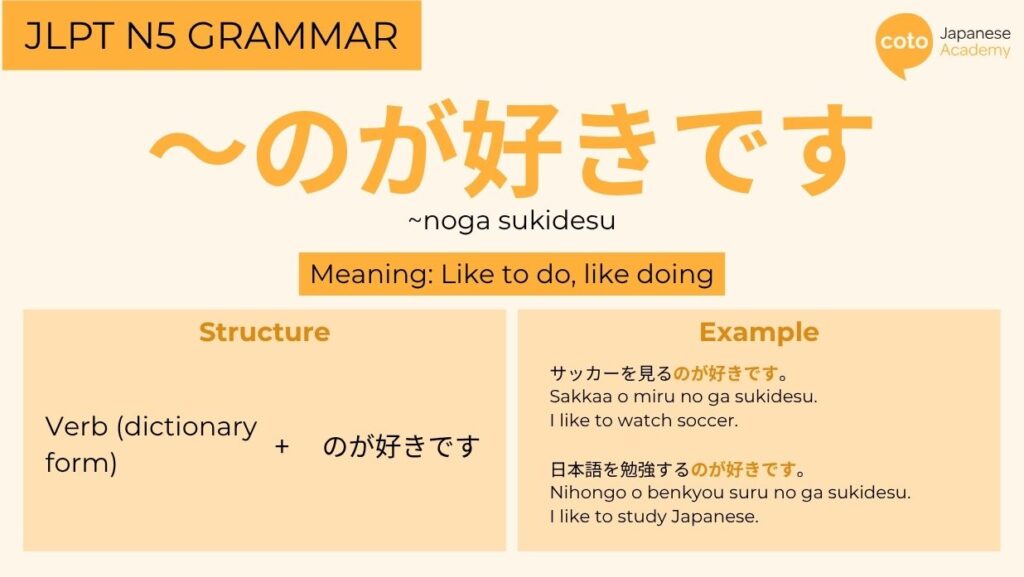
The grammar form 〜のが好きです directly translates to “like to (do something).” It is basically used to describe an action you like or enjoy doing. It consists of the phrase 好き (suki), which means “to like,” and the particles のが (no ga), which attaches to the verb. For example, if you want to say “I like to speak Japanese,” you can say:
日本語を話すのが好きです。
Nihongo o hanasu no ga sukidesu.
I like to speak Japanese.
It’s one of those patterns that feels simple on the surface but is actually doing something quite clever: it takes an action (a verb) and transforms it into a thing you can then have feelings about.
That particle の (no) is the key. In Japanese, の can work as a nominalizer, which is a fancy way of saying it turns a verb phrase into a noun. So 話す (hanasu) means “to speak,” but 話すの (hanasu no) becomes something closer to “the act of speaking” or just “speaking.” Once you’ve got a noun, が (ga) marks it as the subject, and 好きです (suki desu) expresses that you like it. Put it all together, and the sentence is literally closer to “speaking Japanese is liked,” but in natural English, we’d say “I like speaking Japanese.”
In the example we provided, 日本語を話す (Nihongo o hanasu) is the full verb phrase. The の turns that whole phrase into a noun, が marks it as the subject, and 好きです tells us it’s something you like.
Want to study Japanese with us?
Sentence Structure of 〜のが好きです (~no ga suki desu)
Whenever you use the phrase, 〜のが好きです, you must attach a verb in dictionary form to the beginning. The verb must attach the particles のが, which essentially transforms it into a noun or the object of the sentence. You need to include the particle の to attach a verb instead of a noun since が is used to mark the object. If you only use が, you must use a noun.
So, let’s take a look at the difference between using 好きです with a noun and a verb:
クッキーが好きです。
Kukkii ga sukidesu.
I lie cookies.
To say you like cookies, which is a noun, you just need to attach the particle が before 好きです to express something that you like. But how would you say “I like to eat cookies?”
クッキーを食べるのがすきです。
Kukkii wo taberu no ga sukidesu.
I like to eat cookies
So, in this example, “like” is the verb and “to eat cookies” is the object; the particle の is necessary for attaching a verb instead of a noun.
Here is how it works:
| Type | Structure |
| Verb (dictionary form) | Verb (る form) + のが好きです |
Why が (ga) instead of を (o)?
Although を is often associated with marking the direct object of the sentence, in the for 〜のが好きです, we must use the particle が instead. It may seem that the thing attached to the front of 〜のが好きです is the object, which isn’t exactly wrong, but it’s not the same as a direct object that is being affected by the verb. For example, in this sentence:
りんごを食べる
Ringo o taberu
I eat an apple
The direct object, apple, is being acted upon by the verb, eat. However, in Japanese, the word “like” or 好きです (sukidesu) operates differently from a verb in English. 好きです literally translates to “is liked” since〜です operates like a linking verb (i.e., is). So, 好き in Japanese is more like an adjective rather than a verb, and が just marks what the adjective is describing.
りんごが好きです
Ringo ga sukidesu
Apples is liked (by me)
Obviously, a more intuitive translation would be “I like apples” since that’s how we actually speak in English. But this just demonstrates how sentences are inherently structured differently in Japanese.
Negative Conjugation of 〜のがすきです (~no ga sukidesu)
In order to say that you don’t like something with the phrase 〜のが好きです (~noga sukidesu), you must conjugate 好きです into negative form. For example:
泳ぐのがすきじゃないです。
Oyogunoga sukijanai desu.
I do not like to swim.
Note, you do not conjugate the verb itself; you instead conjugate 好きです (sukidesu) into 好きじゃないです(suki janai desu) to make the phrase negative. Take a look at the table below that demonstrates how it works:
| Verb Form | Example | English |
| Positive | 食べるのが好きです Taberu no ga suki desu |
I like to eat |
| Negative | 食べるのが好きじゃないです Taberu no ga suki janai desu |
I do not like to eat |
| Negative (formal) | 食べるのが好きではありません Taberu suki de wa arimasen |
I do not like to eat |
Past Conjugation 〜のが好きです (~no ga sukidesu)
To change 〜のが好きです into the past tense, just like the negative form, you must conjugate the phrase 好きです to 好きでした (sukideshita). For example:
走るのが好きでした。
Hashiru no ga sukideshita
I used to like to run.
You cannot conjugate the verb, 走る (hashiru), to express how you used to like running. It would be like saying “I used to like to ran” which doesn’t make sense in English either. Let’s take a look at a table to demonstrate how to conjugate between past and present:
| Verb Form | Example | English |
| Present | 食べるのが好きです Taberu no ga suki deshita |
I like to eat |
| Past | 食べるのが好きでした Taberu no ga suki deshita |
I used to like to eat |
| Past Negative | 食べるのが好きじゃなかったです Taberu noga suki janakatta desu |
I did not like to eat. |
Difference Between 〜ことが好きです (~koto ga sukidesu) & 〜のが好きです (~no ga sukidesu)
If you’ve been studying Japanese for a little while, you’ve probably come across both 〜のが好きです and 〜ことが好きです
Essentially, the 〜のがすきです and 〜ことが好きです both mean “to like to do something” and can be used interchangeably. However, there might be a slight difference in nuance.
〜のが好きです has a more personal feel and is used more conversationally to describe something you like to do or experience. On the other hand, 〜ことが好きです is used to make more general statements and discuss broader contexts. It has a slightly more formal tone compared to 〜のが好きです.
Let’s take a look at an example to demonstrate how the 2 phrases have slightly different nuances.
音楽を聞くのが好きです。
Ongaku o kiku no ga sukidesu.
I like to listen to music.
Using 〜のが好きです feels personal and casual, like describing something you do often.
音楽を聞くことが好きです。
Ongaku o kiku koto ga sukidesu.
I like to listen to music.
The same phrase with 〜ことが好きです sounds a bit more formal and somewhat as if you’re giving a general statement.
In practice, especially at the N5 level, don’t stress too much about choosing the “right” one. Native speakers use both naturally, and getting the nuance perfectly takes time and exposure. For casual conversation, 〜のが好きです will almost always feel the most natural. Save 〜ことが好きです for when you want to sound a little more composed or are making a broader statement about your interests.
Example Sentences Using 〜のが好きです (~noga sukidesu)
Example 1:
サッカーを見るのが好きです。
Sakkaa o miru no ga sukidesu.
I like to watch soccer.
Example 2:
運動をするのが好きです。
Undou o suru no ga sukidesu.
I like to exercise.
Example 3:
日本語を勉強するのが好きです。
Nihongo o benkyou suru no ga sukidesu.
I like to study Japanese.
Example 4:
絵を書くのが好きじゃないです。
E o kaku no ga sukijanaidesu.
I do not like to draw.
| Kanji / Writing | Furigana | Romaji | English |
| サッカー | サッカー | sakkaa | soccer |
| 見る | みる | miru | to watch; to see |
| 運動 | うんどう | undou | exercise |
| する | する | suru | to do |
| 日本語 | にほんご | nihongo | Japanese (language) |
| 勉強する | べんきょうする | benkyou suru | to study |
| 絵 | え | e | picture; drawing |
| 書く | かく | kaku | to draw; to write |
| 好き | すき | suki | to like |
| 好きじゃない | すきじゃない | suki janai | do not like |
Learn More JLPT Grammar with Coto Academy!
If you want to practice using this JLPT grammar and many others in actual Japanese conversations, nothing beats practicing with a teacher who can offer practical guidance. So, consider signing up with us at Coto Academy!
Why Study at Coto Academy?
Coto Academy has been offering Japanese classes for over 25 years, with campuses in Shibuya, Yokohama, Iidabashi, Minato, Shinjuku, and online. Our courses focus on practical Japanese, so the grammar you learn is designed for real-life use.
We offer part-time, intensive, and fully online lessons to suit your schedule. Start learning Japanese effectively and confidently with Coto Academy today! Fill out the form below for a free level check.
FAQ
What does 〜のが好きです (~noga sukidesu) mean?
〜のが好きです means “I like doing ~” or “I like to do~.” So, you can use this phrase to express activities or actions that you like to do. The particle の turns a verb into a noun-like phrase, and 好きです expresses liking.
Why is が (ga) used instead of を(o) in 〜のが好きです (noga sukidesu)?
In this structure, the verb phrase plus の becomes similar to the subject of 好き (suki) rather than the direct object. This is because 好き is more like an adjective that describes what you like, rather than a verb that directly acts upon an object.
Can I use 〜のが好きです in casual conversation?
Yes, this phrase is very common in everyday Japanese. Using です at the end makes the expression more formal, but changing it to だ instead or just dropping です completely will make the phrase more casual.
How do I make 〜のが好きです (~noga sukidesu) negative?
To conjugate this phrase into negative form, you can say, 好きじゃないです (suki janai desu), which is a casual, formal way of expressing you don’t like something. To be even more formal, you can say 好きではありません (suki de wa arimasen).
What’s the difference between 〜のが好きです (~noga sukidesu) and 〜ことが好きです (~koto ga sukidesu)?
They both express almost the same thing; however, there are slight differences in nuance. 〜のが好きです is more natural or conversational, whereas 〜ことが好きです is considered a bit more formal, abstract, and somewhat general.
Read more:
What Does でしょう (Deshou) Mean? JLPT N5 Grammar Guide
JLPT N5 〜方がいい (~Hou ga ii): Meaning, Structure & Example
JLPT N5 〜ので (~Node) Grammar: Because in Japanese
JLPT N5 Grammar 〜という (To Iu) Meaning, Use & Examples
The post JLPT N5 〜のが好きです (~no ga suki desu) Meaning & Examples appeared first on Coto Japanese Academy.
Article source: https://cotoacademy.com/jlpt-grammar-noga-suki-desu-meaning-structure-examples/