Want to learn Japanese hiragana? In this blog, we share our own PDF learning hiragana practice sheets and links to some popular apps for learning Japanese. Just started learning Japanese? Head to our main article about the Japanese writing system for a more comprehensive guide!
What is hiragana?
Hiragana (平仮名) is one of three writing systems used in Japanese, and it’s the one everything else builds on. Where English uses an alphabet where each letter represents a sound, hiragana uses a syllabary. Each character represents a whole syllable, like ka, mi, or su. There are 46 base characters in total, and once you know them, you can read and write any native Japanese word phonetically.The characters are soft and rounded in shape, making them visually easy to distinguish from other Japanese scripts. That roundedness isn’t random: hiragana developed as a simplified, cursive form of Chinese characters (kanji), created during the Heian period around the 9th century. Back then, it was associated with women’s writing, since men were expected to write in formal kanji. That social divide didn’t last, and today hiragana is just… Japanese.
Hiragana Learning Chart: Wri
ting Practice PDFs
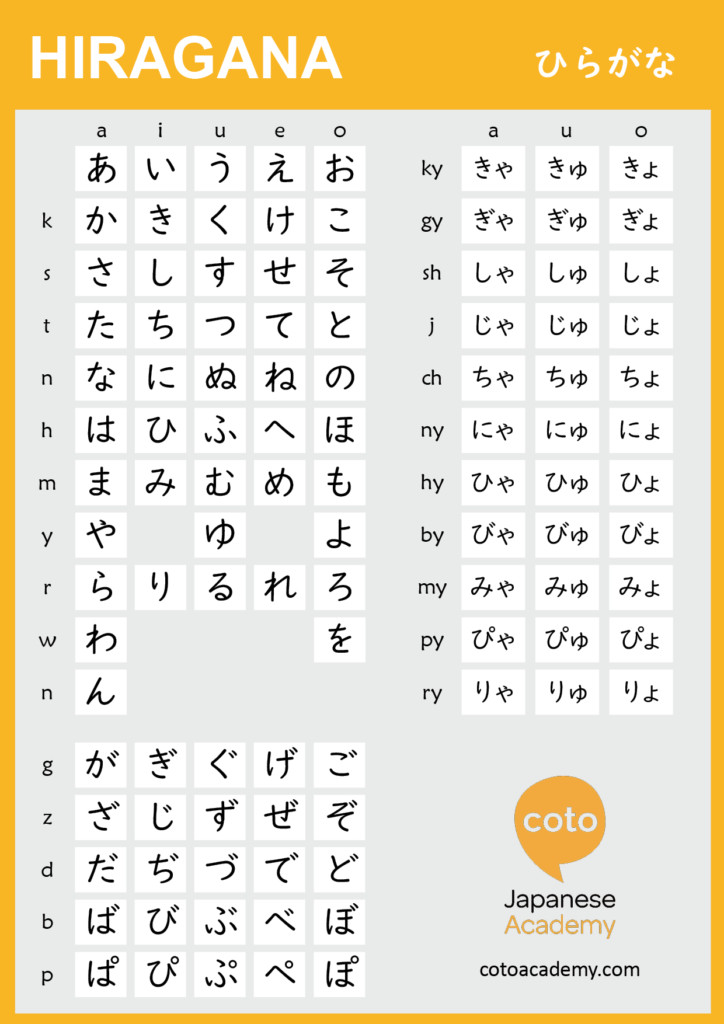
If you are looking for a more analog way to practice and learn hiragana, you’re in a good place. Coto Academy actually created our very own hiragana chart and practice sheet, which includes example sentences and exercises. Open the image in a new tab by clicking on it, and you can print it!
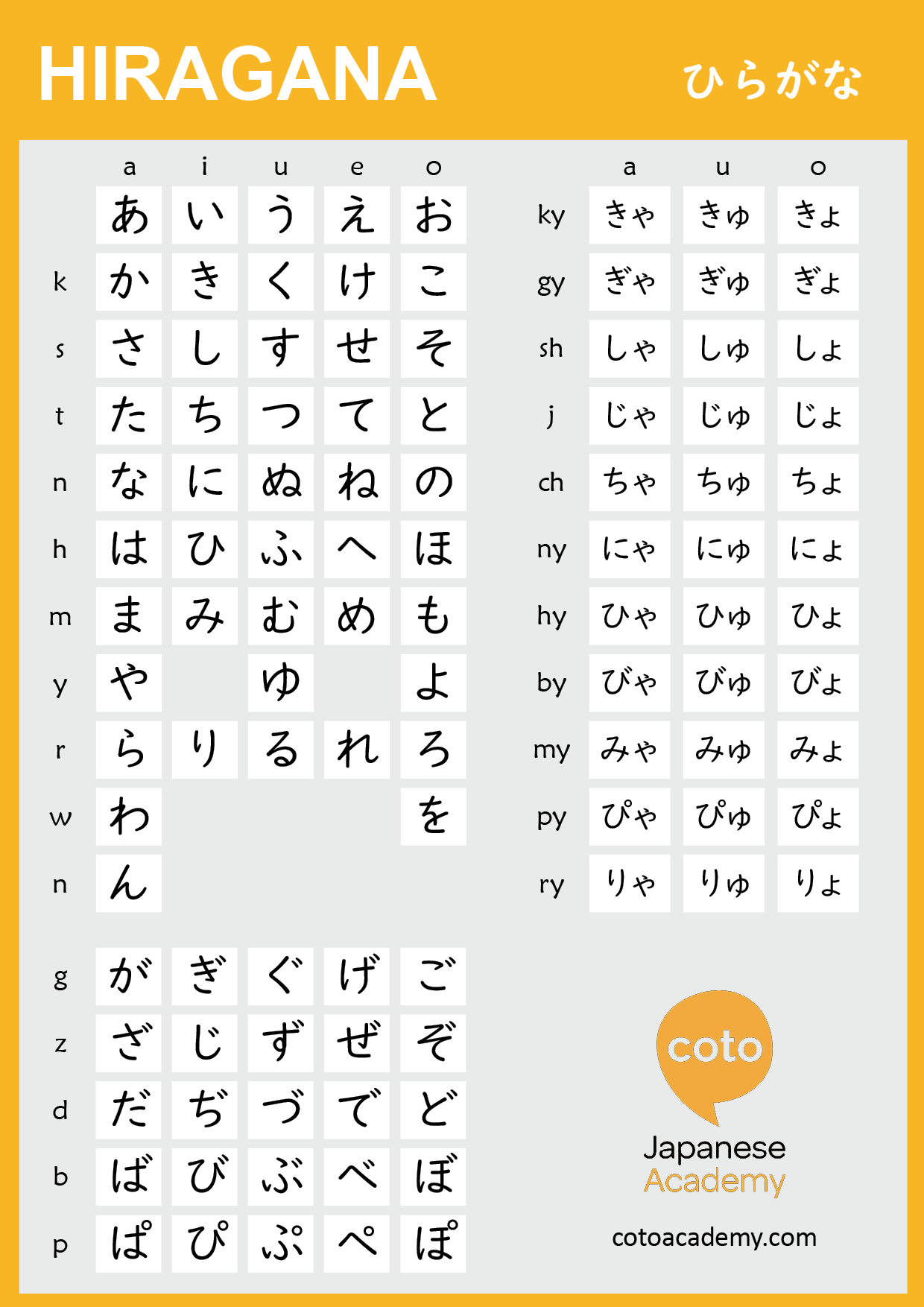
Hiragana syllabels
There are 46 base characters, and the system is almost perfectly consistent: once you learn the five vowel sounds (a, i, u, e, o), every other character is simply a consonant placed in front of one of those five vowels. So か is “ka”, き is “ki”, く is “ku”, け is “ke”, こ is “ko”. This structure means that, with some practice, you can learn to read and write all of hiragana in a matter of days.
1. あ: A-row (vowels)
These five characters are the foundation of the entire hiragana system. Every syllable in Japanese ends in one of these five vowel sounds, so once you know them, you already know how every other character ends. Japanese vowels are pure and consistent: they never shift sound based on context the way English vowels do. あ is always “ah”, い is always “ee”, and so on.
| Hiragana | Romaji | Sound hint |
|---|---|---|
| あ | a | like “ah” — open mouth, relaxed |
| い | i | like “ee” in “feet” — short and crisp |
| う | u | short “oo” but lips are not rounded — unique to Japanese |
| え | e | like “e” in “bed” |
| お | o | like “oh” — round and clear |
2. か: Ka-row
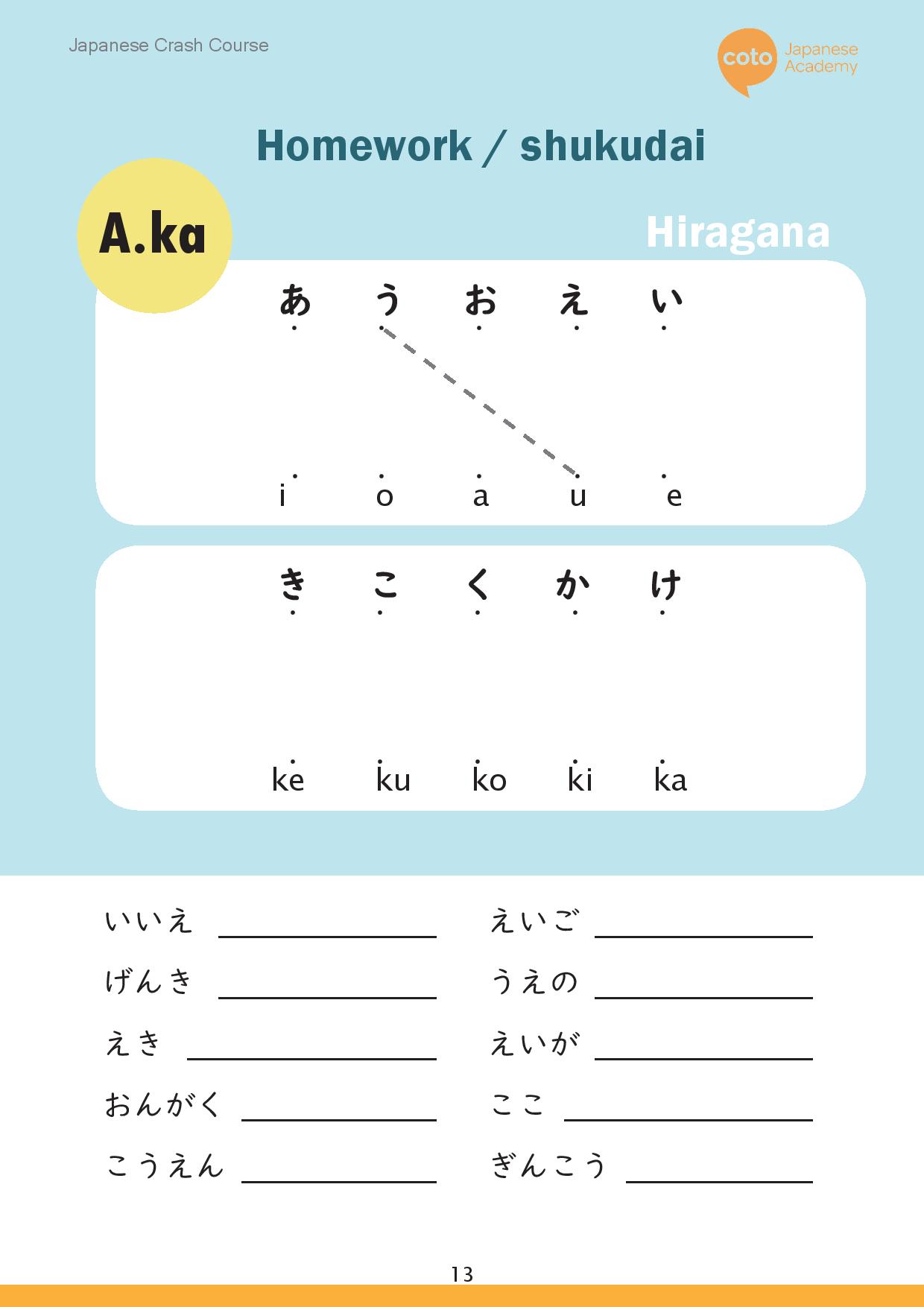
The ka-row is the first consonant row and one of the most common in Japanese. The “k” sound here is unaspirated — meaning there’s no puff of air the way English “k” has. It’s a cleaner, crisper stop. This row is also the base for the voiced が-row, where the same shapes gain two small marks.
| Hiragana | Romaji | Sound hint |
|---|---|---|
| か | ka | like “ka” in “karate” |
| き | ki | like “key” |
| く | ku | like “coo” — short u |
| け | ke | like “keh” |
| こ | ko | like “co” in “cold” |
3. さ: Sa-row
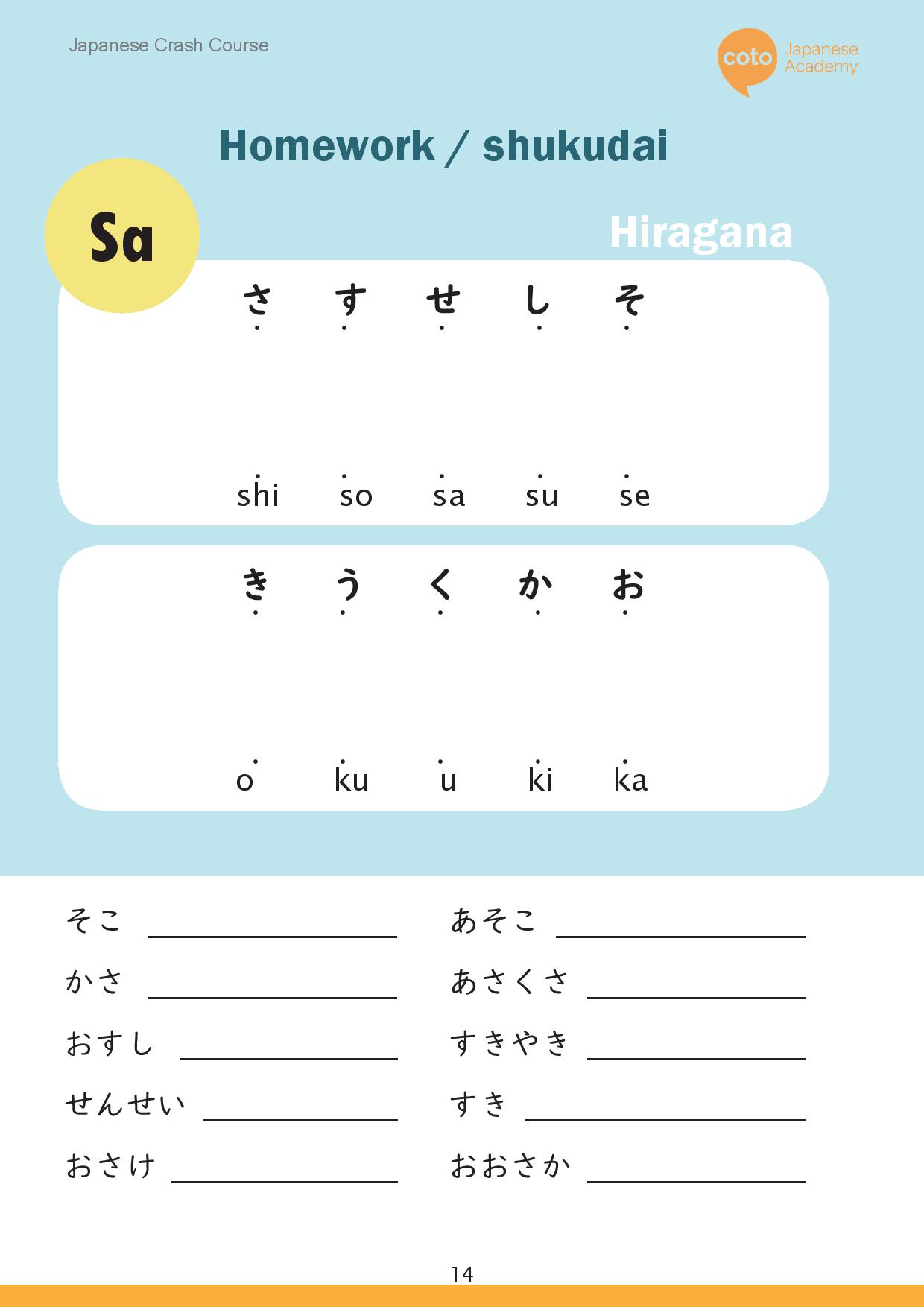
The sa-row has one notable exception: し is pronounced “shi”, not “si”. The rest of the row follows the standard pattern. す also tends to have a nearly silent “u” in natural speech, especially in word-final positions.
| Hiragana | Romaji | Sound hint |
|---|---|---|
| さ | sa | like “sa” in “safari” |
| し | shi | like “she” — not “si” |
| す | su | the “u” is almost silent in casual speech |
| せ | se | like “seh” |
| そ | so | like “so” |
4. た: Ta-row
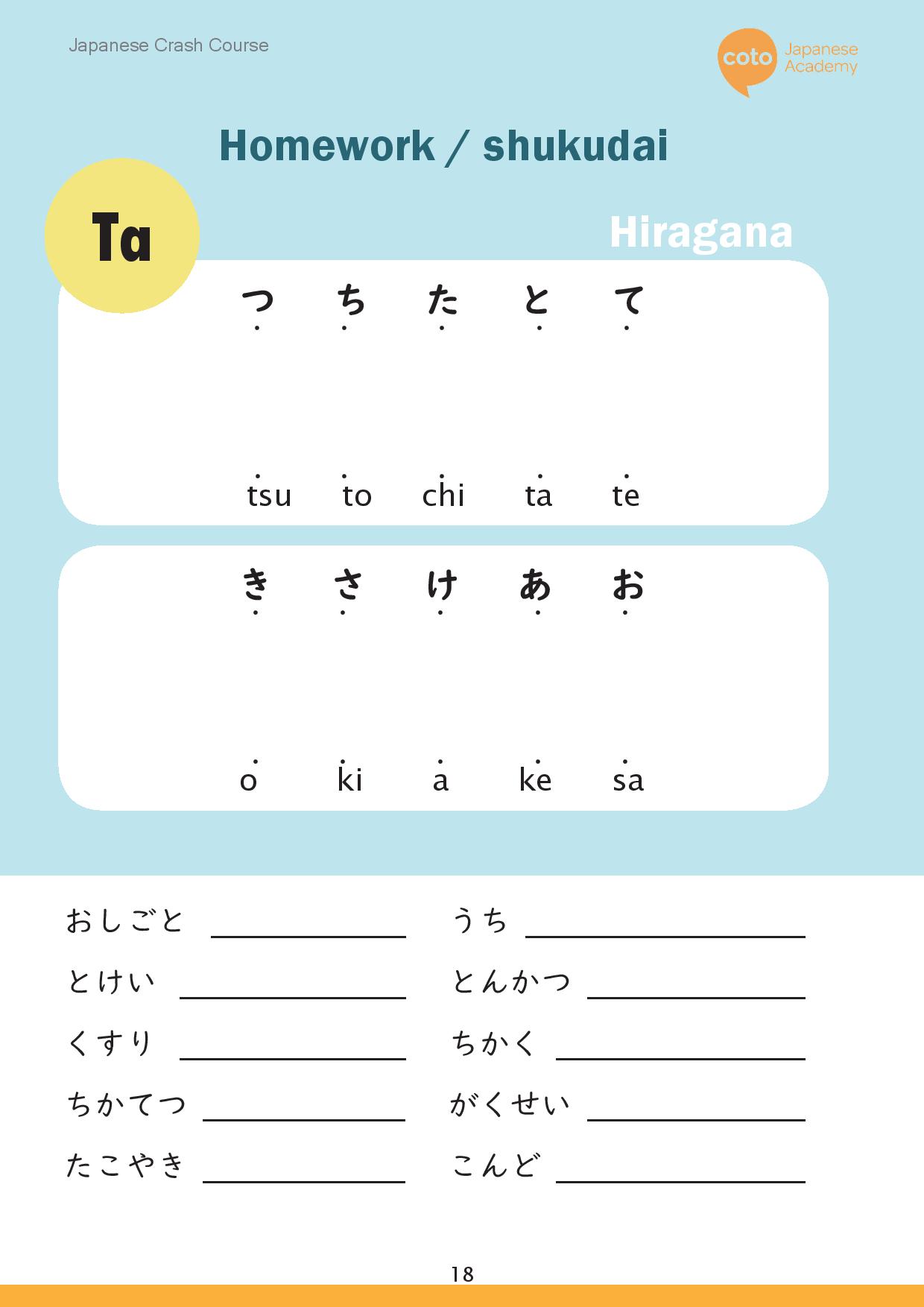
The ta-row contains two of the most surprising sounds in hiragana for learners: ち is “chi” and つ is “tsu”. Neither follows the expected “ti” or “tu” pattern. These are not exceptions but natural phonological rules in Japanese. The row’s voiced counterpart is the だ-row.
| Hiragana | Romaji | Sound hint |
|---|---|---|
| た | ta | like “ta” in “taco” |
| ち | chi | like “chee” — not “ti” |
| つ | tsu | one quick sound, like “tsu” in “tsunami” |
| て | te | like “teh” |
| と | to | like “toe” |
5. な: Na-row
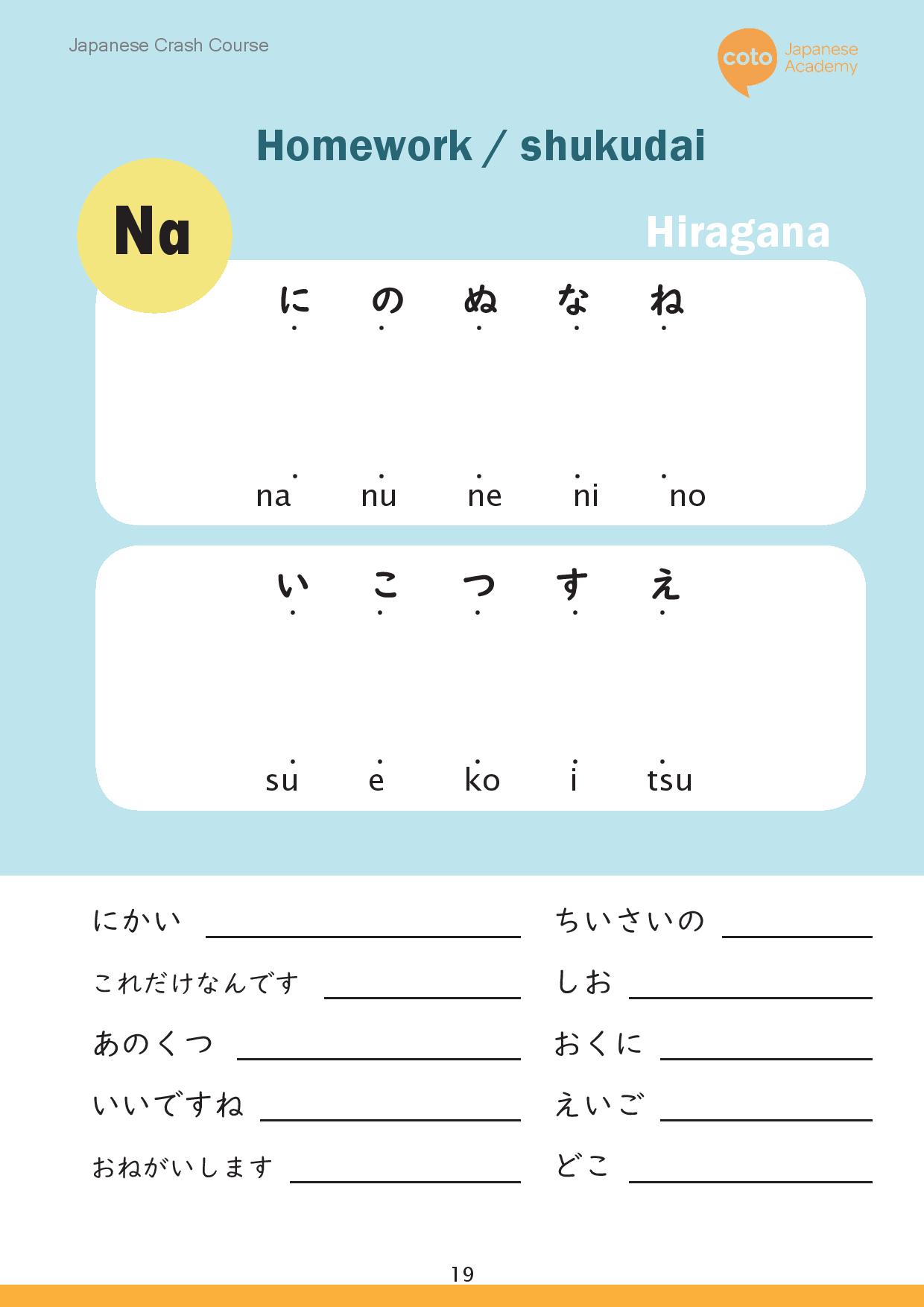
This hiragana row is a straightforward row with no surprises. The “n” sound stays consistent throughout. の (no) is especially worth remembering early: it’s one of the most common particles in Japanese, used to show possession (similar to “of” or “‘s”). に (ni) is another essential particle indicating direction or location.
| Hiragana | Romaji | Sound hint |
|---|---|---|
| な | na | like “na” in “nature” |
| に | ni | like “knee” |
| ぬ | nu | like “new” |
| ね | ne | like “neh” |
| の | no | like “no” — also the possessive particle |
6. は: Ha-row
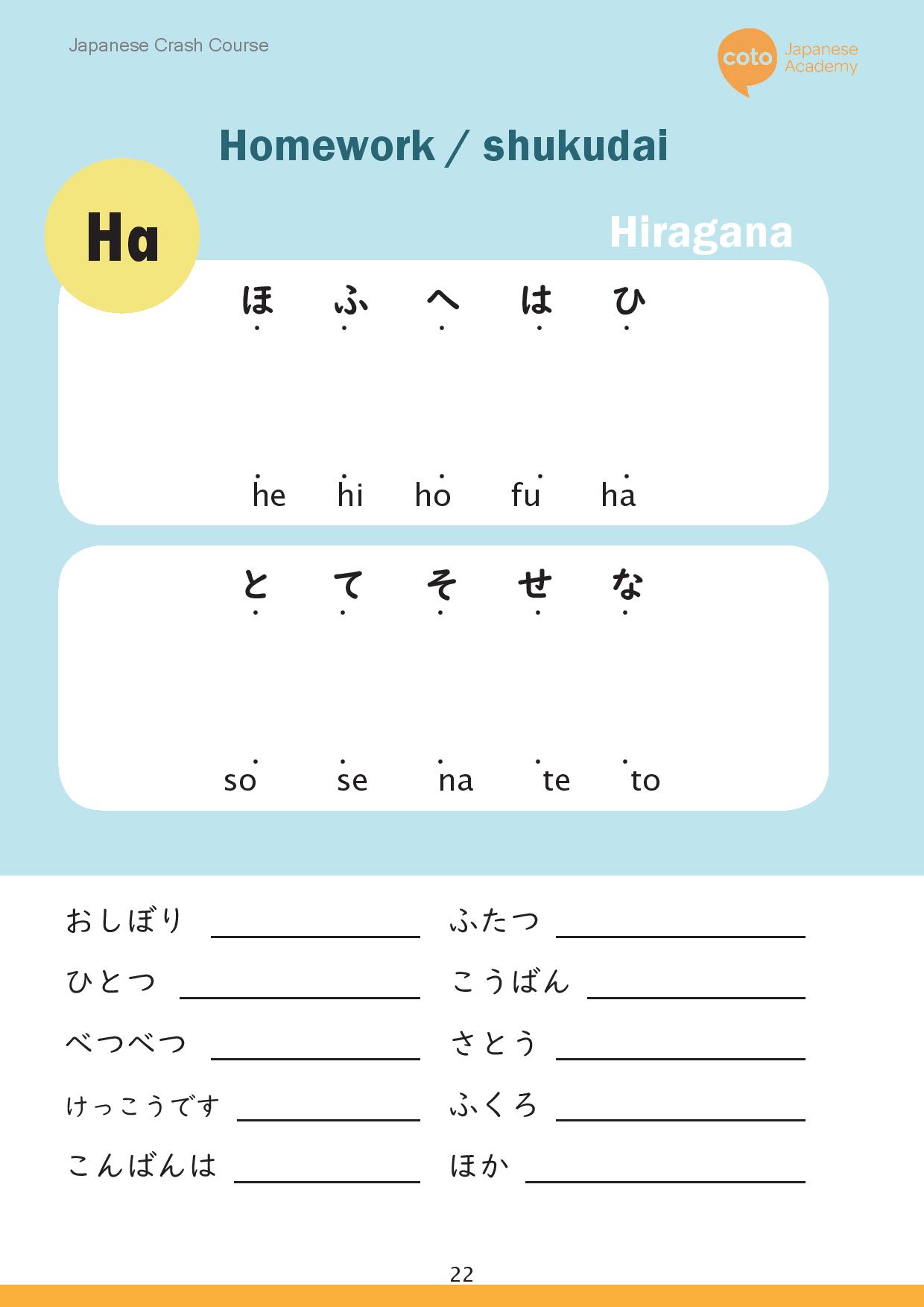
The ha-row is mostly regular, with two notable quirks. First, ふ is not “hu”. The sound is a soft bilabial fricative made with both lips gently together, producing something between “f” and “h”. Second, when は and へ function as grammatical particles, their pronunciation changes: は becomes “wa” and へ becomes “e”. This is a historical spelling preserved from older Japanese.
| Hiragana | Romaji | Sound hint |
|---|---|---|
| は | ha | like “ha” — reads “wa” as topic particle |
| ひ | hi | like “hee” |
| ふ | fu | soft bilabial — lips barely touching, not “hoo” |
| へ | he | like “heh” — reads “e” as direction particle |
| ほ | ho | like “ho” in “hotel” |
7. ま: Ma-row
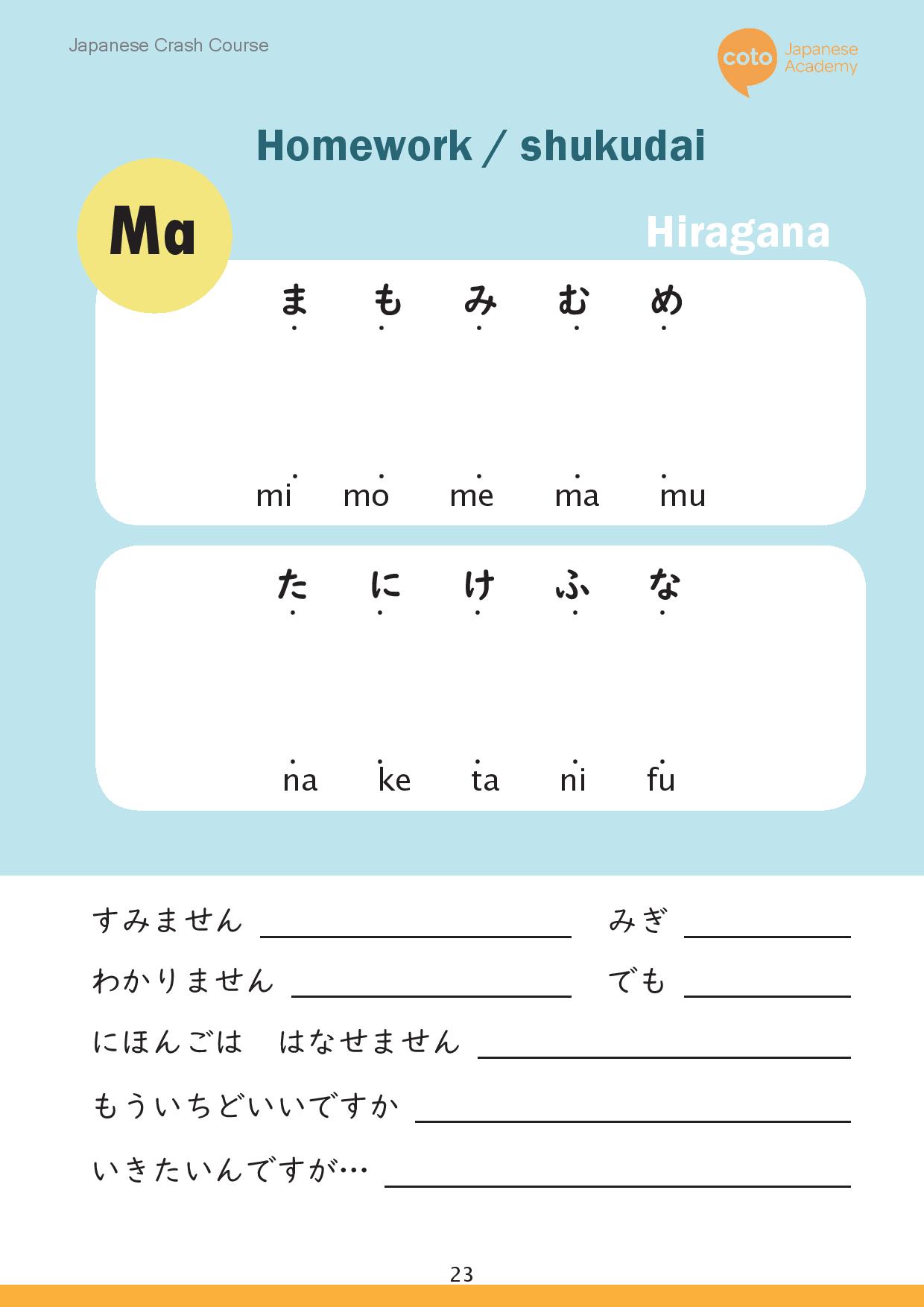
The “m” sound is consistent and behaves the same as in English. も (mo) is another high-frequency particle meaning “also” or “too”. ます (masu) is the polite verb ending you will encounter in almost every beginner Japanese sentence.
| Hiragana | Romaji | Sound hint |
|---|---|---|
| ま | ma | like “ma” |
| み | mi | like “me” |
| む | mu | like “moo” |
| め | me | like “meh” |
| も | mo | like “mo” — also the “too/also” particle |
8. や: Ya-row
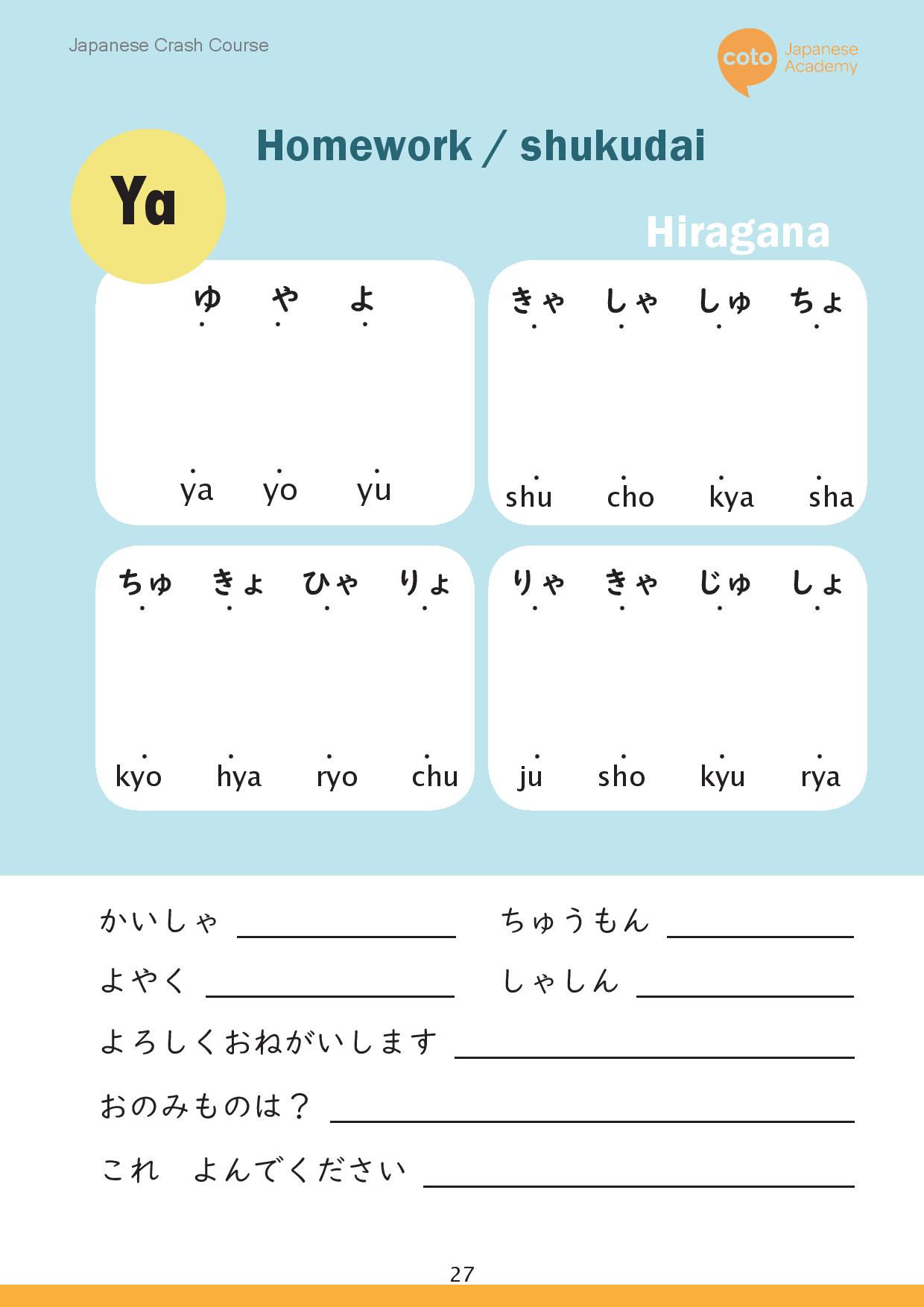
The ya-row has only three characters because “yi” and “ye” don’t exist as sounds in modern Japanese. These three characters also serve a second role: written small (ゃ ゅ ょ), they combine with other characters to create compound sounds called youon. In that role they aren’t pronounced as full syllables.
| Hiragana | Romaji | Sound hint |
|---|---|---|
| や | ya | like “ya” in “yard” |
| ゆ | yu | like “you” |
| よ | yo | like “yo” in “yoga” |
9. ら: Ra-row
The Japanese “r” is one of the hardest sounds for English speakers to reproduce. It is a lateral flap: the tip of the tongue briefly taps the ridge just behind the upper teeth and immediately releases, similar to the quick “d” sound in the American English word “ladder” or “butter”.
| Hiragana | Romaji | Sound hint |
|---|---|---|
| ら | ra | tongue flap — like the “d” in “ladder” |
| り | ri | flap + ee |
| る | ru | flap + u |
| れ | re | flap + e |
| ろ | ro | flap + o |
10. わ: Wa-row
The wa-row originally had five characters (wa, wi, wu, we, wo) but three fell out of use in modern Japanese. Only わ and を remain in regular writing. を is now almost exclusively used as the direct object particle and is pronounced identically to お in everyday speech. Attempting to distinguish the two sounds in conversation will sound unnatural.
| Hiragana | Romaji | Sound hint |
|---|---|---|
| わ | wa | like “wa” in “water” |
| を | wo / o | object particle — pronounced like お in practice |
11. ん: N (nasal)
ん is the only hiragana character that stands alone as a pure consonant. It has no vowel attached. Its exact sound shifts depending on what follows: it sounds like “n” before n/t/d sounds, like “m” before p/b/m sounds, and like “ng” (as in “sing”) before k/g sounds or at the end of a word. Japanese speakers do this naturally without thinking about it.
| Hiragana | Romaji | Sound hint |
|---|---|---|
| ん | n | shifts between n / m / ng depending on context |
How long does it take to learn hiragana?
This is the good news: for a motivated adult learner, a few weeks is realistic. The pronunciation is consistent. Unlike English, every hiragana character is always pronounced the same way, with no exceptions. Once you crack the grid (5 vowels × consonant rows), the logic clicks fast. Most Japanese language learners tackle hiragana in their first month, often before starting kanji.
It’s genuinely one of the more approachable parts of the language, and getting through it gives you a real foothold. You can start sounding out menus, station signs, and packaging almost immediately.
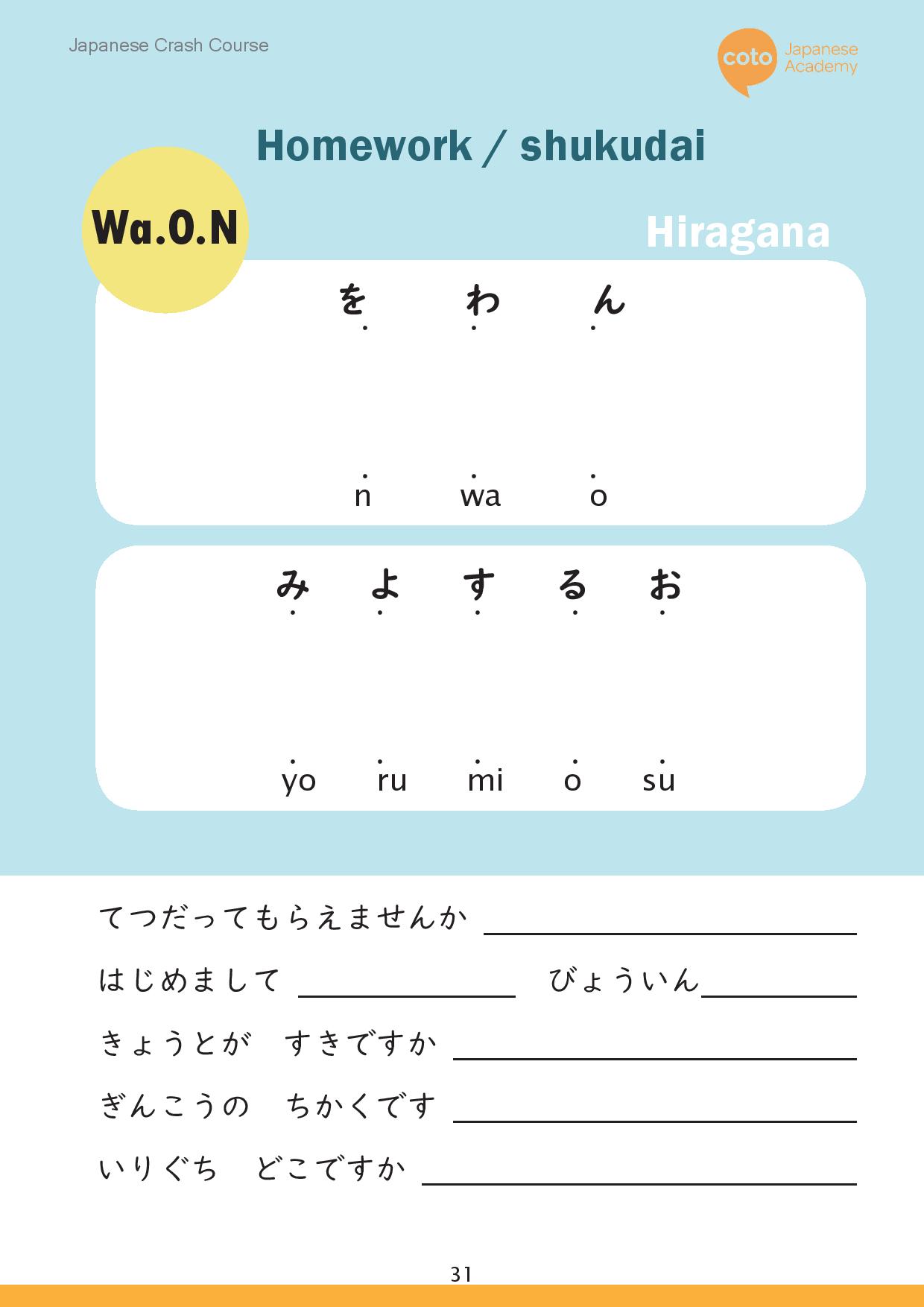
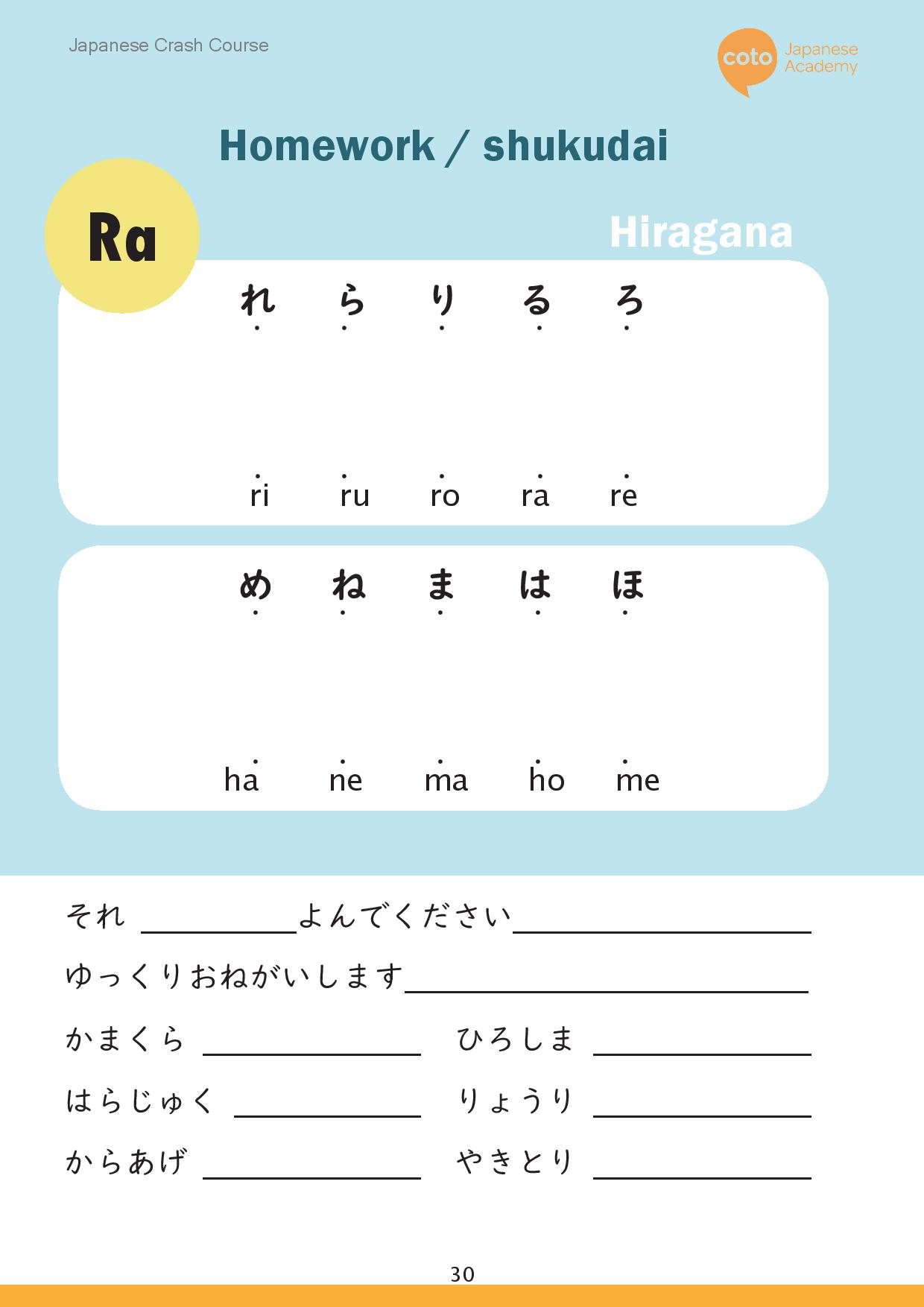
How to use the hiragana homework sheets
Below are a few sample homework sheets specifically for hiragana. To answer them, you draw the line to the corresponding hiragana character and connect them.
Apps for Learning Hiragana
If you are just getting started with learning hiragana, you may think that it is easier to learn with an app. Apps are convenient and easy to take with you to practice using while you are out and about. However, we also suggest that you take some time to physically write the characters, as it will cement them in your brain.
That being said, we recommend several apps that are fun and easy to use.
1. Learn Hiragana & Katakana with Dr. Moku
Dr. Moku’s Hiragana and Katakana Mnemonics are 2 separate apps. One for Hiragana and one for Katakana. In each app, they associate all the kana with pictures, making it easy for you to remember them.
It also uses mnemonic hacks (tying each character to a visual story-based meaning) rather than just rote memorization.
2. Mindsnacks – Limited Free Version
Mindsnacks has a visually appealing interface, and the limited free version allows you to practice learning Hiragana and Katakana characters.
It is the closest thing to a learning video game that we have found.
Start learning Japanese with Coto Academy!
Coto Academy offers expert-led Japanese lessons for all levels. Study in Tokyo, Yokohama, or online. Choose from part-time, intensive, or private lessons that fit your busy lifestyle. Start speaking real, practical Japanese today!
Looking for something more advanced? Check out our JLPT Kanji Workbook PDFs!
Hiragana FAQ
What is Hiragana used for?
Hiragana is a fundamental script in Japanese, used for writing sentences, grammatical particles (like は, が, を), and parts of words. It is also used for words that don’t have kanji or for furigana (small hiragana above kanji to show pronunciation).
How many Hiragana characters are there?
There are 46 basic Hiragana characters. Some characters can change their sounds when small marks (゛or ゜) are added, like か (ka) → が (ga) or は (ha) → ぱ (pa).
What’s the easiest way to learn Hiragana?
The best ways to learn Hiragana are:
- Learn mnemonics (e.g., し (shi) looks like a smiling face)
- Practice writing daily
- Use flashcards to memorize characters
- Listen to Hiragana songs or use learning apps
What’s the difference between Hiragana and Katakana?
Hiragana is mainly used for native Japanese words and grammar, while Katakana is used for foreign words (like “coffee” → コーヒー), onomatopoeia, and emphasis.
Can I write everything in Hiragana?
Yes, but it’s not ideal. Japanese writing combines Hiragana, Katakana, and Kanji, so writing everything in Hiragana can be hard to read and understand.
Want to study Japanese with us?
The post Hiragana Chart & Quiz Online: Free Japanese Resource appeared first on Coto Japanese Academy.
Article source: https://cotoacademy.com/learning-hiragana-hiragana-chart-practice-sheets-apps-online-quiz/