When you become a Japanese language student, you might wonder what common Japanese classroom words and phrases you will hear when you go to school. Of course, you will learn new vocabulary as you go, but in this case, we are talking about phrases you should know so you can understand your teacher’s directions, ask if you can leave the class, and learn different words for school facilities.
Since the Coto Academy team is a language school itself, we are well placed to discuss this, as we often hear the familiar phrases teachers use with their students. Whether you are entering high school, university, or a Japanese language class, let’s take a look at some standard classroom terms and phrases that will help make your student life much smoother.
If you want to study Japanese, join Coto Academy for flexible, beginner-friendly lessons in Tokyo. Contact us today!
Basic Classroom Phrases & Vocabulary in Japanese
Let’s start with the basic classroom phrases and vocabulary that you will likely use every day. Below is a list of basic Japanese language, followed by common classroom phrases.
You can learn more basic Japanese words and phrases that will be useful for both the classroom and daily life in Japan: 100 Basic Japanese Words for Greetings, Food, Adjectives, More!
| Japanese (romaji) | Kanji | English |
|---|---|---|
| jugyou | 授業 | lesson |
| kyoushitsu | 教室 | classroom |
| sensei | 先生 | teacher |
| gakusei | 学生 | student |
| gakuseki bangou | 学籍番号 | student number |
| seito | 生徒 | student (junior high to high school) |
| Kougi | 講義 | lecture |
| zagaku | 座学 | classroom learning |
| kougishitsu | 講義室 | lecture hall |
| kyouin | 教員 | teacher, instructor |
| kyoushi | 教師 | lecturer |
| junkyouju | 准教授 | associate professor |
| kyouju | 教授 | professor |
| kadai | 課題 | assignment |
| shukudai | 宿題 | homework |
You may be familiar with jugyou (授業), kyoushitsu (教室), sensei (先生), and gakusei (学生), the general terms for the lesson, classroom, teacher, and student in Japanese, but other terms may be used depending on the circumstance. Sensei (先生) is the most common way to refer to any teacher of any kind. Until high school, the terms kyouin (教員) and kyoushi (教師) were commonly used to refer to a teaching position or title. On the other hand, university teachers have different titles depending on their rank: koushi (講師), junkyouju (准教授), and kyouju (教授), which mean lecturer, associate professor, and professor, respectively.
Students are generally referred to as either gakusei (学生) or seito (生徒). In legal terms, the former is used for students receiving higher education, such as in universities or vocational schools, whereas the latter is used for junior high to high school students. The two are used interchangeably in everyday conversation; however, there is a tendency to use gakusei (学生) when referring to students in general, and seito (生徒) when referring to students at a specific institution or under a specific teacher.
1. 出席しています (Shusseki Shiteimasu): I’m Present
Attendance is one of the most important things in a Japanese language school, so teachers typically do daily roll calls. For this, they might say:
出席を取ります。
Shusseki o torimasu.
I will take attendance.
To say you’re present, you can say the following:
出席しています。
Shusseki shiteimasu.
I’m here.
The phrase 出席しています (shusseki shiteimasu) is made up of 出席 (shusseki), which means attendance or being present. The nuance is slightly different from 出席します (shusseki shimasu), which means “I will attend” (future or planned attendance), whereas 出席しています emphasizes that you are currently present.
2. 欠席しています/します (Kesseki Shiteimasu/Shimasu): Absent
We use 欠席します (kesseki shimasu) when you or someone else will be absent. For example, if you are requesting that your teacher know that you will not make it to class the following day due to personal reasons, you can say:
明日欠席します。
Ashita kesseki shimasu.
I will be absent tomorrow.
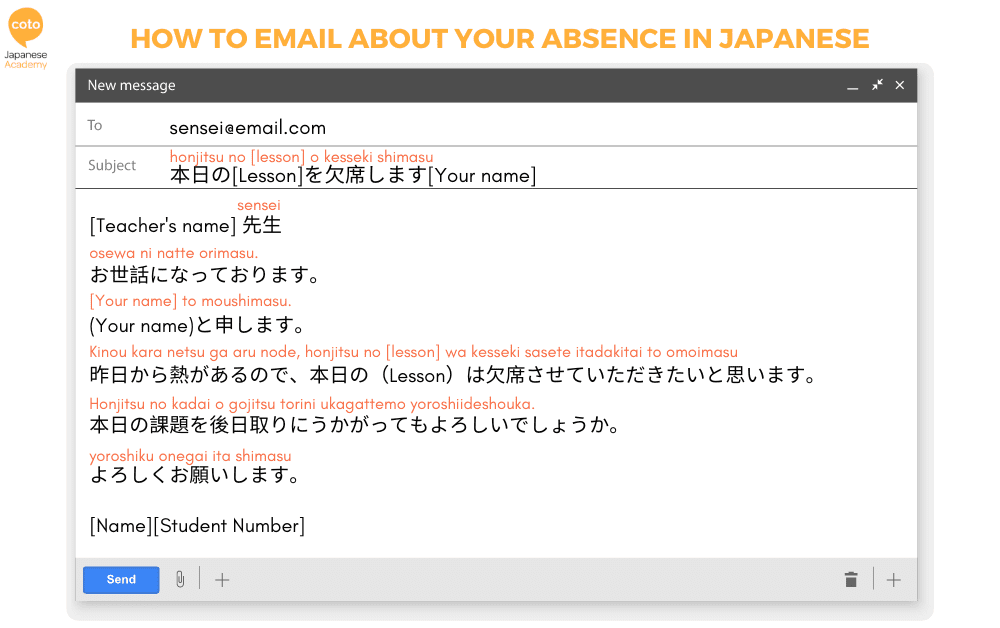
On the other hand, we use 欠席しています when someone is currently absent. If you will be absent, it’s best to notify the teacher or staff by email beforehand for it to be an excused absence or kounin kesseki (公認欠席). Unexcused absences, or mudan kesseki (無断欠席), are commonly frowned upon and may even lead to consequences. Here is an example of how to notify your absence through email.
3. 遅刻します (Chikoku Shimasu): I Will Be Late
One of the most common ways to say you will be late. It’s a formal Japanese expression you can use when messaging or emailing your teacher to let them know you’ll be late.
Example:
すみません、クラスに少し遅刻します。
Sumimasen, kurasu ni sukoshi chikoku shimasu.
I’m sorry, I’ll be a bit late for class.
4. もう一度お願いします (Mou Ichido Onegaishimasu): One More Time Please
Studying Japanese often means hearing words or phrases you don’t understand, and you may want to ask your teacher to repeat them. This is one of the most useful phrases to know, both in and outside the classroom. It translates to “One more time, please” and is commonly used when asking someone—usually your teacher—to repeat what they just said.
Example:
もう一度お願いします。
Mou ichido onegaishimasu.
One more time, please.
Want to study Japanese with us?
Japanese Expressions for Greeting in a Class
| Japanese (romaji) | Kanji | English |
|---|---|---|
| ohayou gozaimasu | おはようございます | Good morning |
| konnichiwa | こんにちは | Good afternoon |
| konbanwa | こんばんは | Good evening |
| yoroshikuonegaiitashimasu | よろしくお願いします | “Treat me well today” |
| arigatou gozaimashita | ありがとうございました | Thank you |
| goseichou arigatougozaimashita | ご清聴ありがとうございました | Thank you for your attention |
| otsukare sama deshita | お疲れ様でした | Thank you for your hard work |
As with all other interactions, classes start and end with greetings. Students may greet each other formally in keigo (敬語) or informally in tameguchi (タメ口), but interactions between students and teachers are almost always in keigo (敬語).
At the start of the class, the sensei (先生) usually greets students using the greeting appropriate for the time of the day, with either ohayougozaimasu (おはようございます): good morning, konnichiwa (こんにちは): hello, or konbanwa (こんばんは): good evening. Some may even follow this with yoroshikuonegaishimasu (よろしくお願いします), which is loosely translated to ‘please treat me favorably’ in English. Check out our guide on basic Japanese greetings and phrases.
The class usually ends with arigatougozaimashita (ありがとうございました) to thank the students, and sometimes with otsukare sama deshita (お疲れ様でした) to acknowledge the students’ hard work during the class. Some teachers may also use goseichou arigatougozaimashita (ご清聴ありがとうございました), which takes a step further to thank students for listening quietly. This phrase is often used after student presentations as well.
General Teacher Instructions And Requests
Now, let’s get into the first things you will hear when you enter a classroom in Japan, which are directions and requests from your teacher. Here are some standard terms and phrases they may use with you.
If you want to expand your vocabulary for different actions in Japanese, read our blog: 100 Basic Japanese Verbs For Beginners
| Vocabulary | Furigana | Romaji | Meaning |
|---|---|---|---|
| 静か | しずか | shizuka | quiet |
| 手を上げる | てをあげる | te o ageru | to raise a hand |
| 繰り返す | くりかえす | kurikaesu | to repeat |
| 質問 | しつもん | shitsumon | question |
| 答える | こたえる | kotaeru | to answer |
| チーム | ちーむ | chiimu | team |
| 問題 | もんだい | mondai | problem |
| 解く | とく | toku | to solve |
| 宿題 | しゅくだい | shukudai | homework |
| 提出する | ていしゅつする | teishutsu suru | to submit |
| ください | ください | kudasai | please (request form) |
1. 静かにしてください (Shizuka ni Shite Kudasai): Please be Quiet
One common request you will hear from teachers is to ask students to be quiet. The term 静か means quiet, and してください means “please do.” So, the whole translates closely to “please be quiet.”
Example:
隣のクラスは試験をしているので、静かにしてください。
Tonari no kurasu wa shiken o shiteiru node, shizuka ni shite kudasai.
The class next door is taking an exam, so please be quiet.
Don’t forget to watch Coto Academy&s teacher, Nami-sensei, explain how to use てください (te kudasai) properly!
2. 手を上げてください (Te o Agete Kudasai): Please Raise Your Hand
One of the first things your teacher will ask you to do is raise your hand. They will probably use this phrase: 手を上げて下さい (Te o agete kudasai) with 手 (te) meaning hand and 上げてください (agete kudasai) meaning “please raise.”
Example:
質問があれば、手を上げて下さい。
Shitsumon ga areba, te o agete kudasai.
Please raise your hand if you have a question.
3. 繰り返してください (Kuri Kaeshite Kudasai): Please Repeat After Me
This is another common expression you will hear from your teacher, especially to drill new material. The term 繰り返す (kurikaesu) means “to repeat,” while ください (kudasai) means please.
Example:
皆さん、私のあとを繰り返してください。
Minasan, watashi no ato o kurikaeshitekudasai.
Everyone, please repeat after me.
4. 質問に答えてください (Shitsumon ni Kotaete Kudasai): Please Answer the Questions
This is one of the most common phrases you will hear and read in the classroom, often from the teacher or just on quizzes and school assignments. The term 質問 (shitsumon) means question, and 答えてください (kotaete kudasai) means please answer.
Example:
黒板の質問に答えてください。
Kokuban no shitsumon o kotaete kudasai.
Please answer the questions on the blackboard.
5. 宿題を提出してください (Shukudai o Teishutsushitekudasai): Submit Your Homework
Another common expression you will often hear when you are requested to turn in assignments, such as homework. The term 宿題 (shukudai) means homework, and 提出 (teishutsu) means to submit.
Example:
来週の金曜日に宿題を提出してください。
Raishuu no kinyoubi ni shukudai o teishutsu shite kudasai.
Please submit your homework by Friday, next week.
6. グループになってください
In a classroom setting, the teacher may ask you to form teams for group activities. So, teachers will often use this expression to tell students to create a group.
Example:
5人グループになってください。
Go nin group ni natte kudasai.
Please make a team of 5 people.
7. 問題を解いてください (Mondai o Toite Kudasai): Please Solve the Problem(s)
This is a widespread instruction you’ll hear from teachers when it’s time to work on exercises or tests. 問題 (mondai) means “problem” or “question,” and 解いてください (toite kudasai) means “please solve.” Together, the phrase politely asks students to work through the assigned problems.
Example:
このページの問題を解いてください。
Kono peeji no mondai o toite kudasai.
Please solve the problems on this page
Want to study Japanese with us?
Japanese Phrases for Classroom/School Facilities
Now, let’s go through some essential terms and phrases you may need to know regarding classroom or school facilities.
| Japanese | Furigana | Romaji | Meaning |
|---|---|---|---|
| 教室 | きょうしつ | kyoushitsu | Classroom |
| 職員室 | しょくいんしつ | shokuinshitsu | Teachers’ room |
| 図書館 | としょかん | toshokan | Library |
| トイレ | といれ | toire | Restroom |
| 保健室 | ほけんしつ | hokenshitsu | Nurse’s office |
| 体育館 | たいいくかん | taiikukan | Gymnasium |
| 校庭 | こうてい | koutei | School yard |
| 自動販売機 | じどうはんばいき | jidouhanbaiki | Vending machine |
| ロッカー | ろっかー | rokkaa | Locker |
| 食堂 | しょくどう | shokudou | Cafeteria |
| 受付 | うけつけ | uketsuke | Reception desk |
| 放送室 | 放送室 | Housoushitsu | Broadcast Room |
1. トイレに行ってもいいですか? (Toire ni ittemo iidesuka?): May I Go to the Bathroom
This is an excellent Japanese classroom phrase for asking permission, using the 〜てもいいですか (~temo iidesuka) form, similar to saying “is it okay if…” This expression is a respectful way to ask permission to use the restroom.
Example:
すみません、ちょっとトイレに行ってもいいですか?
Sumimasen, chotto toire ni ittemo iidesuka?
Excuse me, may I go to the restroom for a bit?
2. 受付はどこにありますか? (Uketsuke wa doko ni arimasuka): Where is the Reception Desk?
Every school has a reception desk, so this is a great expression to use when you first enter and need to know how to find it to check in. Especially on large campuses, such as universities, the reception might be hard to find.
Example:
受付はどこにありますか?
Uketsuke wa dokoni arimasuka?
3. 放送室よりアナウンスをします (Housoushitsu yori Anaunsu o Shimashisu): Announcement from Broadcast Room
Many schools have a broadcast room, especially if they are larger, and they often make announcements through it that can be heard throughout the school.
Example:
放送室よりイベントのアナウンスをしました。
Housoushitsu yori ibento no anaunsu o shimashita.
The broadcast room announced an event.
Japanese Words and Phrases for School Personnel
Knowing words for school or the classroom will also be essential for understanding how to ask someone for help or, in some instances, how to address them.
| Japanese | Furigana | Romaji | Meaning |
|---|---|---|---|
| 先生 | せんせい | sensei | Teacher |
| 校長先生 | こうちょうせんせい | kouchou sensei | Principal |
| 教頭先生 | きょうとうせんせい | kyoutou sensei | Vice principal |
| 担任 | たんにん | tannin | Homeroom teacher |
| 職員 | しょくいん | shokuin | School staff |
| 学生 | がくせい | gakusei | Student (college+) |
| 生徒 | せいと | seito | Student (middle/high school) |
| 先輩 | せんぱい | senpai | Upperclassman |
| 後輩 | こうはい | kouhai | Underclassman |
| クラスメート | くらすめーと | kurasumeeto | Classmate |
1. 先生に質問があります
If you want to get your teacher’s attention to ask something politely, this phrase is handy. 先生 (sensei) means “teacher,” 質問 (shitsumon) means “question,” and あります (arimasu) means “to have.” It’s a natural and respectful way to ask a question.
Example:
先生に質問があります。
Sensei ni shitsumon ga arimasu.
I have a question for the teacher.
2. 校長先生が挨拶をします
Every school has a principal who runs the school. This is a common expression you might hear whenever the principal gives a speech, which is common in Japan.
Example:
校長先生が挨拶をします。
Kouchou sensei ga aisatsu o shimasu.
The principal will give a speech.
3. 先輩から教えてもらいました (Senpai Kara Oshiete Moraimashita): Taught From My Senpai
In Japan, senpai are known for helping out their juniors, so you will often learn different things from them. This expression is a great way to explain what your senpai taught you.
Example:
先輩から数学を教えてもらいました。
Senpai kara suugaku o oshiete moraimashita.
My senpai taught me math.
Japanese Classroom Phrases for Supplies
Let’s explore some common words and phrases regarding classroom supplies and materials that you will often use and hear.
| Japanese | Furigana | Romaji | Meaning |
|---|---|---|---|
| 教科書 | きょうかしょ | kyoukasho | Textbook |
| ノート | のーと | nooto | Notebook |
| 筆記用具 | ひっきようぐ | hikkiyougu | Writing utensils |
| ペン | ぺん | pen | Pen |
| 消しゴム | けしごむ | keshigomu | Eraser |
| 黒板 | こくばん | kokuban | Blackboard |
| ホワイトボード | ほわいとぼーど | howaitoboodo | Whiteboard |
| プリント | ぷりんと | purinto | Handout |
| 宿題 | しゅくだい | shukudai | Homework |
| 名札 | なふだ | nafuda | Name tag |
1. 教科書を開ける (Kyoukasho o Akeru): Open the Textbook
Textbooks are among the most crucial classroom resources. To describe opening your textbook, you can use this phrase, 教科書を開ける (Kyoukasho o akeru), which almost directly translates to “to open a textbook.”
Example:
教科書の40ページを開けてください。
Kyoukasho no yon-ju-ppeeji o aketekudasai.
Please open your textbook to page 40.
2. ペンを忘れました (Pen o Wasuremashita): I forgot my pen
This phrase is helpful when you forget to bring a school supply to class. ペン (pen) means “pen,” and 忘れました (wasuremashita) is the past polite form of “to forget.” You can swap ペン with other items like ノート (notebook) or 教科書 (textbook).
Example:
すみません、ペンを忘れました。
Sumimasen, pen o wasuremashita.
Sorry, I forgot my pen.
Japanese Words and Phrases for School Activities/Routines
| Japanese | Furigana | Romaji | English |
|---|---|---|---|
| 休み時間 | やすみじかん | yasumijikan | Break time |
| 昼休み | ひるやすみ | hiruyasumi | Lunch break |
| 休憩 | きゅうけい | kyuukee | Break |
| 給食 | きゅうしょく | kyuushoku | School lunch |
| 掃除 | そうじ | souji | Cleaning |
| 朝礼 | ちょうれい | chourei | Morning assembly |
| 終礼 | しゅうれい | shuurei | Closing assembly |
1. 掃除をします (Souji o Shimasu): To Clean
Most Japanese schools have students or participants clean the whole school or classroom together. This helps reduce, or even eliminate, the need to hire janitors. Even outside school, it is common in Japanese society to help clean your workplace, dojo, or any area you use.
Example:
放課後に掃除をします。
Houkago ni souji o shimasu.
We clean after school.
2. 休み時間です (Yasumi no Jikan Desu): It Is Breaktime
When classes pause for a short rest, teachers often announce this phrase. 休み (yasumi) means “break” or “rest,” and 時間 (jikan) means “time.” This expression signals to students that it’s time for a break between lessons.
Example:
今から10分、休み時間です。
Ima kara juppun, yasumi jikan desu.
From now on, it’s a 10-minute break.
Use These Common Japanese Classroom Phrases in an Actual Japanese Class!
These phrases are handy for any class that you will take in Japan, and there is no better place to start practicing these phrases than at a Japanese language class. The earlier you start using Japanese in everyday routines, even at school, the more likely it is to stick.
If you’re looking for a place to start engaging in practical Japanese conversation right away, we highly recommend our courses at Coto Japanese Academy. Our courses focus on essential Japanese language that you can start using for daily life, from reading signs, asking for directions, and much more.
We keep classes small — just 8 students per group — so you get plenty of speaking practice and personalized attention, whether it’s online or at one of our campuses in Tokyo and Yokohama. Many of our students have just moved to Japan or have never been there and have no Japanese experience. But with Coto Academy, they were able to start speaking and navigating their life or travels in Japan more smoothly.
Fill out the form below for a free level check! You can also schedule a free consultation or chat with our team to find the best learning path tailored to your goals.
FAQ
What are some common Japanese classroom phrases I should know?
Some of the most common classroom phrases include 出席しています (I’m present), 欠席します (I will be absent), 遅刻します (I’ll be late), 静かにしてください (Please be quiet), and 問題を解いてください (Please solve the problems). These expressions are used daily in Japanese classrooms, from elementary school to language schools.
How do you say “I have a question” in Japanese class?
You can say 先生に質問があります (Sensei ni shitsumon ga arimasu). This is a polite and natural way to let the teacher know you’d like to ask something. Many students also raise their hands when they say this.
What should I say if I’m late or absent from class?
You can say 先生に質問があります (Sensei ni shitsumon ga arimasu). This is a polite and natural way to let the teacher know you’d like to ask something. Many students also raise their hands when they say this.
What should I say if I’m late or absent from class?
If you will be late, a common expression to use is “遅刻します” (Chikoku shimasu). And, if you will be absent, you can use 明日欠席します (I will be absent tomorrow). These phrases are commonly written in messages or emails to teachers.
What should I say if I forgot something, like a pen or a notebook?
You can use the phrase 忘れました (wasuremashita), for example ペンを忘れました (Pen o wasuremashita) for “I forgot my pen.” You can replace ペン with other items like ノート (notebook) or 教科書 (textbook).
Is classroom Japanese different from casual Japanese?
Generally, you should use more formal, polite Japanese, especially when speaking to teachers or other school staff. Even students often use polite or 敬語 (keigo) forms, such as です・ます, to show respect
The post Common Japanese Classroom Phrases and Words for Students appeared first on Coto Japanese Academy.
Article source: https://cotoacademy.com/common-japanese-words-and-phrases-used-in-classroom/