The JLPT N5 grammar 〜方がいい (~hou ga ii) is often used to give advice to someone, usually expressing what they should do. It is similar to saying “you should do…” or “it’d be better…” in English. This phrase is great for giving general recommendations or your opinion of what or how to do something.
Let’s learn how to use this JLPT N5 grammar point by breaking down its meaning, structure, and example sentences.
Make Sure to Watch Coto Academy’s YouTube Video About 〜方がいい (~Hou ga ii)
Before you continue reading, why not take a moment to watch a quick YouTube lesson with our Japanese teacher, Nami-sensei.
Meaning of 〜ほうがいい (~Hou ga ii)
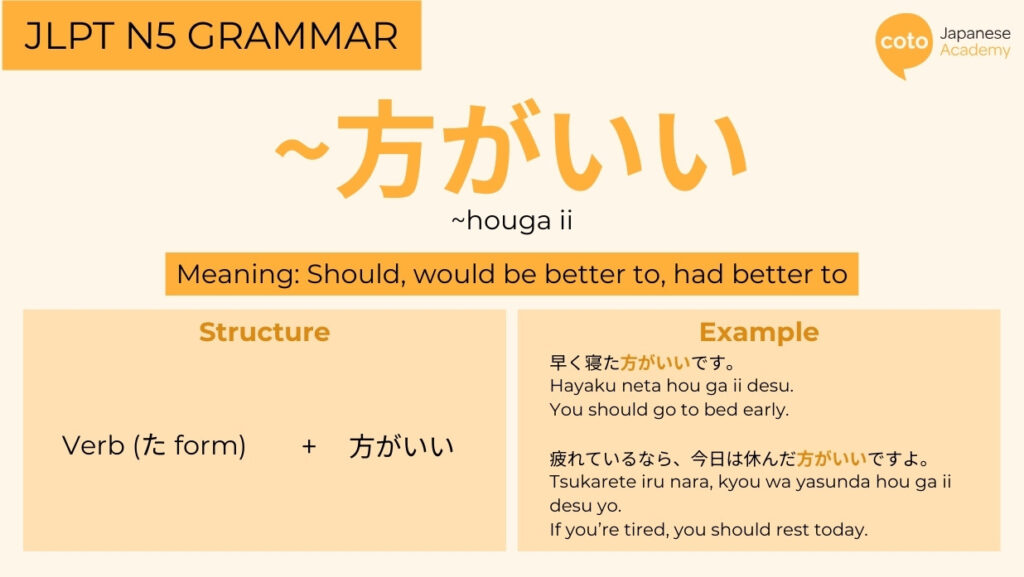
Let’s break down the phrase, 〜方がいい (~hou ga ii), consisting of 方 (hou) meaning “direction” or “way” and いい (ii) meaning good. So, the literal translation of the phrase is “it’s good to do (something) in this direction/way.”
The phrase is used to express advice or an opinion, telling someone they should do something, often with the nuance that not doing so might have negative consequences. It’s often used with a sense of urgency or necessity.
Thus, 〜方がいい (~hou ga ii) most closely means the following in English:
- Would be better to…
- Should do…
- It is better to…
- Had better to…
Japanese people often use this phrase to give advice, as they tend to avoid sounding too direct. Instead of using expressions like ないでください to tell someone what they shouldn’t do, they prefer softer alternatives.
〜方がいい (~Houga ii) Sentence Structure
〜方がいい attaches to verbs, commonly in the past tense, to transform the verb into an advice expression. For example, by attaching “ate” or 食べた (tabeta) to 〜方がいい, you create an expression that means something like “you should eat.” However, even though the verb is in the past tense, the expression itself is more hypothetical, or even future-tense, similar to saying “would” as in “it would be good to eat.”
食べた方がいい
Tabeta houga ii
Should eat / would be good to eat.
| Type | Structure |
|---|---|
| Verb (past form) | Verb (たform) + 方がいい |
Negative verb conjugation
〜方がいい can also be used with negative verb conjugations, in which case you do not conjugate into the past tense. For example, you would simply need to conjugate as 食べない方がいい (tabenai hougaii), meaning “should not eat.” Below is a table showing how to conjugate 〜方がいい between different positive and negative verb conjugations.
| Verb Form | Example | English |
|---|---|---|
| Positive | 食べた方がいい (tabetahou ga ii) | Should eat |
| Negative | 食べない方がいい (tabenaihou ga ii) | Should not eat |
You can also use this with the standard dictionary form of the verb, but it’s used more in casual speech and sounds more like expressing an opinion than giving advice, especially serious advice.
食べる方がいい
Taberu hou ga ii
It is better to eat
Past tense
Additionally, you can also conjugate the last word いい (ii), meaning “good”, to make the expression into past or present form. However, you would rarely conjugate いい into negative form since that would sound unnatural, and you would instead conjugate the verb to make the expression negative. So, let’s explore how 〜方がいい is conjugated into the past or present tense.
| Form | Verb + 方がいい | Meaning |
|---|---|---|
| Present | 食べた方がいい | Should eat / would be good to eat |
| Past | 食べた方良かった | Should have eaten / would be good to have eaten |
Difference Between 〜方がいい (~Hou ga ii), ばいい (~Ba ii) & たらいい (~Tara ii)
| Expression | Strength | Tone | Feeling |
|---|---|---|---|
| 〜た方がいい | Strong | Direct | Advice/recommendation |
| 〜ばいい | Medium | Casual | Suggestion/sometimes blunt |
| 〜たらいい | Soft | Gentle | Indirect advice |
〜方がいい can often be confused with 〜ばいい (~ba ii) and 〜したらいい (~shitara ii), which can be used in similar situations to suggest something, but they have different nuances and are used in different contexts.
〜方がいい is a bit more direct or even urgent, similar to saying “should.” Take a look at an example below.
早く寝た方がいいよ
Hayaku neta hou ga ii yo.
You should go to bed early.
It carries a sense that the speaker believes this is clearly the better choice. Because of this, it can sound a bit firm, especially if used with people you are not very close to.
On the other hand, 〜ばいい and したらいい offer a more casual suggestion, often focusing on a simple solution. This is because the grammar 〜ばいい and したらいい actually have the verb conjugated into conditional form, like saying “if you do A, that would be good.” So, this has a softer nuance which sounds more like a polite, indirect suggestion than strong advice.
Out of all three, 〜たらいい is the softest and most indirect way to give advice. suggests an option without imposing it on the listener. For example, take a look at the phrase below.
ちょっと休んだらいいよ
Chotto yasundara ii yo
It can be translated as, “Maybe you should take a break,” and sounds gentle and considerate. Because Japanese speakers often prefer to avoid being too direct, 〜たらいい is generally the safest choice when giving advice, especially in situations where you want to sound polite or thoughtful.
Let’s go through an example to illustrate the difference.
勉強した方がいい
Benkyou shita hou ga ii
You should study.
By using 〜方がいい, you are giving strong advice that the listener “should study.”
勉強すればいい
Benkyou sureba ii
It would be good if you studied.
勉強したらいい
Benkyou shitara ii
It would be good if you studied.
Using すればいい or したらいい gives a softer tone, sounding polite and indirect rather than making a strong request.
Example Sentences Using 〜ほうがいい (~Hou ga ii)
To really demonstrate how to use 〜方がいい in actual Japanese, let’s go through some example sentences.
Example 1
早く寝たほうがいいです。
Hayaku neta hou ga ii desu.
You should go to bed early.
Example 2
もっと日本語を勉強したほうがいいです。
Motto nihongo o benkyou shita hou ga ii desu.
You should study Japanese more.
Example 3
疲れているなら、今日は休んだほうがいいですよ。
Tsukarete iru nara, kyou wa yasunda hou ga ii desu yo.
If you’re tired, you should rest today.
Example 4
電車で行ったほうがいいです。
Densha de itta hou ga ii desu.
You should go by train.
Example 5
残業しない方がいいです。
Zangyou shinai hou ga iidesu.
You should not do overtime.
Want to expand your vocabulary? Take a closer look at the keywords used in the examples above and try making your own sentences!
| Japanese | Furigana | Romaji | English |
|---|---|---|---|
| 早く | はやく | hayaku | early / quickly |
| 寝る | ねる | neru | to sleep / to go to bed |
| 日本語 | にほんご | nihongo | Japanese language |
| 勉強する | べんきょうする | benkyou suru | to study |
| もっと | もっと | motto | more |
| 疲れる | つかれる | tsukareru | to get tired |
| 今日 | きょう | kyou | today |
| 休む | やすむ | yasumu | to rest/take a day off |
| 電車 | でんしゃ | densha | train |
| 行く | いく | iku | to go |
| 残業 | ざんぎょう | zangyou | overtime |
| しない | しない | shinai | not to do |
| 行かない | いかない | ikanai | to not go |
Learn More JLPT Grammar with Coto Academy!
If you want to practice using this JLPT grammar and many others in actual Japanese conversations, nothing beats practicing with a teacher who can offer practical guidance. So, consider signing up with us at Coto Academy!
Why Study at Coto Academy?
Coto Academy has been offering Japanese classes for over 25 years, with campuses in Shibuya, Yokohama, Iidabashi, Minato, Shinjuku, and online. Our courses focus on practical Japanese, so the grammar you learn is designed for real-life use.
We offer part-time, intensive, and fully online lessons to suit your schedule. Start learning Japanese effectively and confidently with Coto Academy today! Fill out the form below for a free level check.
FAQ:
What does 〜ほうがいい mean?
The grammar 〜ほうがいい means “you should do something” or “it would be better to do something.” It is commonly used to give advice, suggestions, or recommendations.
Can 〜ほうがいい (~houga ii) be used with negative verbs?
Yes, 〜方がいい is often used to advise against doing something. For example, you can say, そんなにお酒を飲まないほうがいいです (Sonna ni osake o nomanaihouga iidesu), meaning “you shouldn’t drink that much alcohol.”
Is 〜ほうがいい (~houga ii) polite?
The expression can be considered polite, especially when paired with keigo or the です form. However, depending on tone, it can sound a little strong, especially when advising someone of a higher status.
What is the difference between 〜ほうがいい (~hou ga ii) and 〜ばいい/〜たらいい (~ba ii / ~shitara ii)?
They both can be used to give advice, but the nuance is quite different. 〜ほうがいい is more of a stronger recommendation or even a request, which can communicate some urgency. Whereas, 〜ばいい and 〜たらいい are more of a softer suggestion.
Want to keep improving your Japanese grammar? Check out more guides and take your skills to the next level.
- かな (Kana): Meaning, Explanation, Example
- そんなに (Sonna ni): Saying “That Much” in Japanese
- 〜み (~Mi): Turning Adjectives into Nouns in Japanese
- ないでください (Naide kudasai): “Please Don’t” in Japanese (With Examples)
The post JLPT N5 〜方がいい (~Hou ga ii): Meaning, Structure & Example appeared first on Coto Japanese Academy.
Article source: https://cotoacademy.com/jlpt-grammar-hou-gaii-japanese/