How many study hours do you need to pass the JLPT? The Japanese Language Proficiency Test is the benchmark for your knowledge of the Japanese language. One of the first questions that probably comes to mind is: “How long do I need to prepare for the JLPT?”
The answer isn’t the same for everyone. It depends on things like your current level, how you study, and whether you’ve learned the language before. Still, having a rough idea of the time commitment for each level (from N5 to N1) can really help with planning and staying motivated.
In this post, we will show you some interesting comparisons of the number of JLPT study hours it will take you to pass each exam level.
Aiming for the July or December JLPT?
Getting ready for the JLPT? Boost your chances of passing with Coto Academy’s JLPT Prep Course. We have a special 3-month program specifically dedicated to helping you learn and succeed in grammar, vocabulary, kanji, and reading strategies. You’ll learn with native instructors who have years of experience teaching Japanese. Historically, our students have had double the passing rate compared to the global average. We don’t just teach Japanese; we teach you how to beat the test.
Study Hours Needed from JLPT N5 to N1
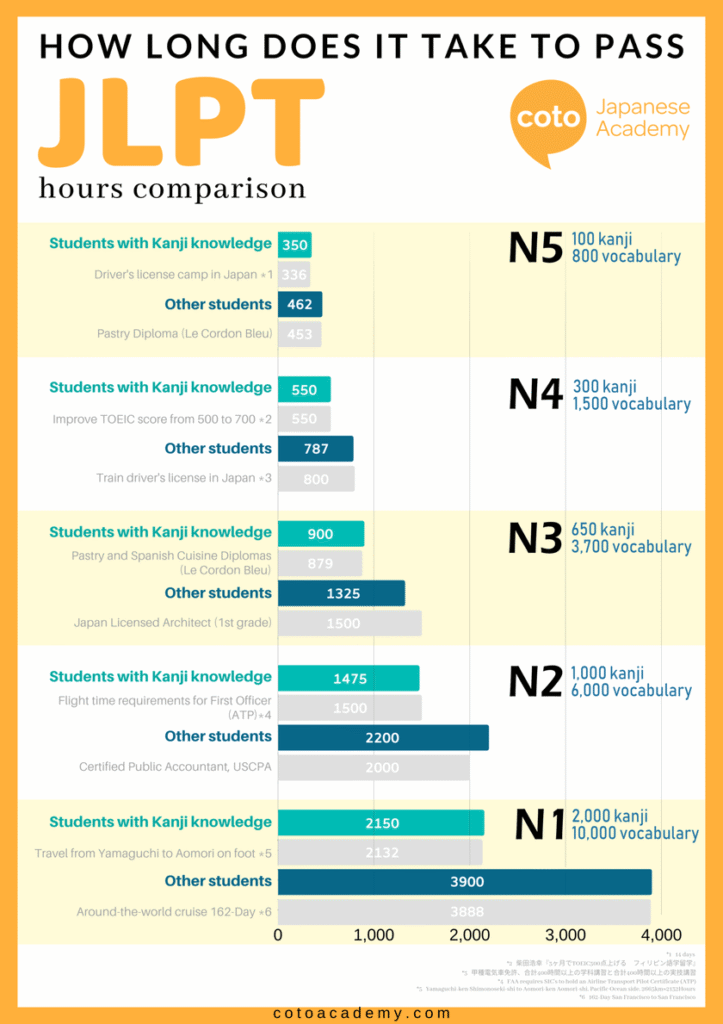
| JLPT level | Hours needed to study | |
| With kanji knowledge | Without kanji knowledge | |
| N5 | 350 hours | 400 – 500 hours |
| N4 | 550 hours | 800 – 1,000 hours |
| N3 | 900 hours | 1,325 hours |
| N2 | 1,500 hours | 2,200 hours |
| N1 | 2,150 hours | 3,900 – 4,500 hours |
The number of study hours needed to pass the JLPT can vary a lot depending on the learner. If you’re living in Japan or regularly exposed to Japanese, especially kanji, you may be able to progress more quickly thanks to daily practice and immersion. Similarly, learners who already know Chinese or Korean often need fewer hours because of shared kanji or grammar patterns.
Note that the numbers above are cumulative totals. For example, to reach JLPT N2, you need about 1,500–2,200 hours total, not just 1,000 hours after passing N3. If you have already passed N4 and are aiming for N3, you’d need around 250–400 more hours, depending on your level.
To help you plan, here’s a breakdown of the estimated total study hours for each JLPT level, along with how many days it might take if you study 1 hour a day. We’ll also include how those numbers change if you study 2 hours daily.
How many days to study for the JLPT?
| JLPT level | Days needed (1 hour/day) | Days needed (2 hours/day) |
|---|---|---|
| N5 | 250 – 400 days | 125 – 200 days |
| N4 | 600 – 750 days | 300 – 375 days |
| N3 | 950 – 1,100 days | 475 – 550 days |
| N2 | 1,600 – 2,200 days | 800 – 1,100 days |
| N1 | 2,150 – 4,500 days | 1,075 – 2,250 days |
What do these numbers mean?
Some learners can reach JLPT N5 in just 6 months, and with intensive study, it’s even possible to pass JLPT N1 within 2 years. But how long it takes depends on how much time you put in consistently. Here’s a general breakdown based on studying 1 hour per day:
- N5: If you study just 1 hour per day, you could be ready in under a year.
- N4: Builds on N5 with more vocabulary and grammar. Studying 1 hour a day means about 1.5 to 2 years of study.
- N3: Intermediate level, with a big jump in vocabulary and kanji. It can take around 3 years at 1 hour per day.
- N2: Upper-intermediate, where you handle complex grammar and real-world materials. This level often takes 4.5 to 6 years at 1 hour per day.
- N1: It may take around 6 years of 2 hours per day study, or up to 12+ years if you’re studying lightly!
Want to study JLPT with the best native tutors?
JLPT N5: Study Hours & Knowledge Needed
Estimated study time: 350 – 500 hours
Passing the JLPT N5 would require knowing around 100 kanji and 800 vocabulary words, so by this level, you will need to know fundamental language skills. You will be tested on your ability to understand and use basic Japanese expressions, such as greetings, in mostly hiragana or katakana. So, for students with kanji knowledge, the estimated time it would take to pass is around 350 hours, around the same amount of time needed to spend prepare for a driver’s license in Japan. But keep in mind, the kanji for this level is rather minimal, so hiragana and katakana knowledge should be prioritized.
For other students who don’t have prior kanji knowledge, it takes 400 – 500 hours. That is about the same as if you were to take a course to obtain a pastry diploma in Le Cordon Bleu, which is around 453 hours! The number of study hours may vary depending on whether you’re starting Japanese completely from scratch, how well you take tests (testing anxiety can really be a hurdle), or just how quickly you can acquire new languages.
JLPT N4: Study Hours Needed & Knowledge Needed
Estimated study time: 550 – 1,000 hours
JLPT N4 builds upon what you learned in N5. You’ll expand your vocabulary to around 1,500 words and know about 300 kanji. The test will consist of Grammar becomes a bit more complex, and you’ll begin to understand more conversational Japanese, such as simple instructions or casual dialogue.
This means for students with kanji knowledge, it could take an estimated 550 hours to pass the test. For comparison, if you are a non-native English speaker, that is about the same as studying to improve your TOEIC score from 500 to 700.
For other students, it can take around 780 hours before you’re ready to pass. With this time, you can become a train driver in Japan!
Study Hours Needed for JLPT N3:
Estimated study time: 900 – 1,325 hours
N3 represents a big jump in difficulty and marks the shift to intermediate Japanese. You’ll need to know around 650 kanji and 3,700 vocabulary words. At this level, you should be able to understand written and spoken content on everyday topics with some abstract language. Therefore, to pass, you will have to be able to understand a variety of different grammar, vocabulary, and be able to comprehend more complicated texts.
For students with kanji knowledge, it takes 900 hours. This amount of hours is the same as getting a Spanish Food Le Cordon Bleu diploma, which requires around 880 hours!
For students with no prior kanji knowledge, it would take around 1,325 hours to study for JLPT N3. With this amount of time, you can become an architect, which is a course that takes 1500 hours.
Study Hours Needed for JLPT N2:
Estimated study time: 1,500 – 2,200 hours
The N2 is often required for working in Japan or entering a Japanese university since its seen as an indicator of decent Japanese proficiency. You’ll be expected to know about 1,000 kanji and 6,000 vocabulary words. The test includes more complex texts, nuanced grammar, and fast-paced spoken Japanese. By this level, you should be able to understand and speak Japanese in a wide variety of contexts, from newspapers and TV shows to business meetings.
So for students with kanji knowledge, it takes approximately 1475 hours to study and pass the JLPT N2. This number is equivalent to becoming a co-pilot of an aircraft! For other students, it’s 2200 hours, which is almost the same time it would take to get a USCPA (Certified Public Accountant).
Study Hours Needed for JLPT N1:
Estimated study time: 2,150 – 4,500 hours
To pass JLPT N1, it generally takes 3,900 – 4,500 hours to study without any prior kanji knowledge. If you already know most of the kanji, it requires around 2,150 hours.
You might notice there’s a big jump between JLPT N2 and N1. The difficulty gap is significant, with N1 requiring a much deeper understanding of grammar, vocabulary, and kanji. The N1 is often seen as the most academic, with passages and materials that include significantly more scholarly language such as scientific terms. Because of this, many learners spend one to three years just moving from N2 to N1, even after years of study to reach N2.
To put that into perspective: 2150 hours is about the same amount of time it would take to walk from the southern tip of Yamaguchi Prefecture to the northern edge of Aomori Prefecture, which is a journey across the length of Japan’s main island, Honshu. And 4,500 hours? That’s roughly the time it would take to travel around the world on a cruise ship!
How to Study Most Efficiently for the JLPT
We’ve been throwing around a lot of numbers, which can vary from person-to-person, but there are ways for anyone to study more efficiently and reduce the amount of time you spend relearning forgotten material. The most important part of studying is not the amount of time you spend, but rather, how you can actually ingrain the knowledge into your long-term memory. So, here are some of our top tips for studying smarter and not harder!
Using Flash Card Apps
Flash card apps are one of the most efficient ways to review new kanji, vocabulary and even new grammar structures, especially ones that use spaced repetition to ensure you keep reviewing new material over different intervals. This prevents you from forgetting material you recently learned, and helps train your brain for better recall. If you use apps like Anki, you can download Anki decks specifically for your JLPT level, so you don’t have to spend time making your deck from scratch!
These apps also offer a convenient way to study and review Japanese anytime or anywhere, so they really can be a powerful tool in studying for the JLPT while reducing time.
Japanese Immersion
Immersion is probably one of the most common tips you’ll hear for picking up Japanese naturally and effectively. Obviously, not everyone can just book a flight to Japan to immerse themselves in Japanese. Additionally, the JLPT mostly focuses on testing your reading comprehension, vocabulary, kanji, and listening, so how would you “immerse” in those areas as well?
Reading will actually help quite a lot! Reading as much as you can in Japanese will expose you to different words, and you naturally start picking up new vocabulary and kanji. Reading manga could actually be one of the best ways to learn Japanese, since the visuals will automatically pair with the new words you’ll be learning, making them easier to remember since the words have more context. And for listening practice, anime works very well for similar reasons as manga! First try with subtitles paired with active listening, then challenge yourself by dropping the subtitles!
NHK news apps and videos are also powerful tools, especially since many JLPT reading passages are based on or read like a news article or headline.
Japanese Lessons
While self-study can be quite effective on its own, learning with a Japanese teacher can provide the structure and training needed to learn more efficiently. Having an actual native Japanese instructor can explain different nuances, support you in areas you struggle most, and coach you to ensure you understand each area of the JLPT sufficiently. Japanese teachers can be invaluable in helping you pass the JLPT since they know the language in and out. Here at Coto Academy, we have classes dedicated to JLPT preparation, including the full-year course and the more intensive 3-month course meant to have you test-ready in, you guessed it, just 3 months! Sign up now if you’re interested!
JLPT Mock Tests & Other Study Materials
Directly practising JLPT mock tests is a very effective way to prepare for the JLPT since you will start to develop an understanding of how the test works and the types of questions you will likely run into. Practising different questions might also help ease the stress and make you more comfortable with the test itself. However, just taking mock tests over and over might lead to the same results, so other materials will also help with mastering each area, such as JLPT textbooks, Japanese learning apps, and websites.
Check out our top JLPT N3 textbook recommendations!
Conclusion: Studying is About Quality Over Quantity
Studying for each level of the JLPT requires lots of hours, but the exact amount can depend on the person, how much prior knowledge you already have, and most importantly, how you study. There’s a famous quote that goes, “Don’t count the days, make the days count.” So, it’s best not to get too worried about the number of hours, and be sure that the hours you do study count. Passing the JLPT is far from impossible, and just studying little by little every day, the hours will accumulate, and before you know it, you will have a JLPT certificate!
Pass the JLPT with Coto Academy!
Now that you know how much time it takes to prepare for the JLPT, it’s time to make a plan! The best way to pass the JLPT is by studying at a top language school like Coto Academy.
Coto Academy offers both online and in-person JLPT preparation courses in Tokyo, led by experienced instructors who will guide you through every section of the exam. Whether you’re aiming for N5 or N1, our focused, supportive environment will help you stay motivated and on track. Ready to pass the JLPT with confidence? Join Coto Academy!
Want more tips on how to pass the JLPT? Check out our other in-depth guides and start preparing smarter today!
- Ultimate Guide to Taking JLPT N5
- Ultimate Guide to Passing JLPT N4
- Ultimate Guide to Taking JLPT N3
- Ultimate Guide to Taking JLPT N2
- Ultimate Guide to Taking JLPT N1
FAQ on JLPT study hours
How many hours does it take to pass the JLPT N5?
It typically takes around 350 to 500 hours of study to pass the JLPT N5. This level covers basic grammar, vocabulary, and hiragana/katakana.
Can I pass the JLPT by studying on my own?
Yes, many learners pass the JLPT through self-study, but joining a structured course like those at Coto Academy can significantly improve your efficiency and chances of success.
Is it possible to become fluent in Japanese in 2 years?
Yes, it’s possible if you study consistently and immerse yourself. To reach conversational fluency, aim for 1.5–3 hours of study per day, practice speaking regularly, and expose yourself to real Japanese (TV, podcasts, books).
Can I pass JLPT N3 in 1 year?
Yes, you can pass JLPT N3 in 1 year if you study around 3 hours per day consistently. It takes around 900 – 1,325 hours to study for JLPT N3.
The post How Many Hours Does it Take to Pass the JLPT? appeared first on Coto Japanese Academy.
Article source: https://cotoacademy.com/study-hours-needed-pass-jlpt-comparison-levels/