The JLPT N3 〜み (~mi) is a suffix that attaches to adjectives (mostly い-adjectives) and turns them into nouns. It’s similar to adding ~ness to an adjective in English (i.e., sweetness). However, there are some differences, the biggest being that nouns with 〜み express a quality or condition that cannot really be measured. They are often used to describe your feelings or what you can feel with your physical senses.
So this grammar is largely used for:
- Expressing subjective ideas or feelings
- Describing what you can feel with your senses, such as taste, hearing, smell, and touch.
- Metaphorical language
Make Sure to Watch Coto Academy’s YouTube Video About 〜み
Before you continue reading, why not take a moment to watch a quick YouTube lesson with our Japanese teacher, Natsumi-sensei:
〜み (~Mi) Meaning
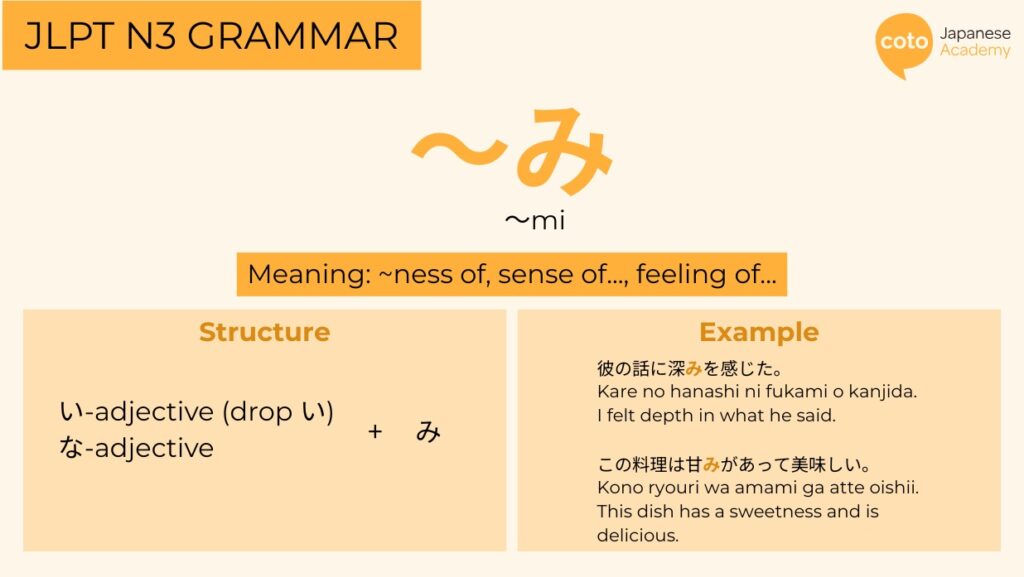
Adding 〜み (~mi) to an adjective expresses a subjective quality or state that can’t be measured objectively. It can describe emotional feelings, physical sensations, or ideas. For instance, adding 〜み to 甘い (amai) to make 甘み would transform the meaning from sweet to sweetness.
Let’s take a look at a few other examples:
- 旨い (umai): savory → 旨み (umami): savoriness
- 悲しい (kanashii): sad → 悲しみ (kanashimi): sadness
- 重い (omoi): heavy → 重み (omomi): weight
- 温かい (atatakai): warm → 温かみ (atatakami): warmth
So, 〜み (~mi) often means something similar to:
- “the feeling of…”
- “the sense of…”
- “the ~ness of..”
Use as a Metaphor:
While you can use 〜み to describe the quality or state of physical things, such as the warmth of coffee, you can also use it figuratively to describe the warmth of a person or the weight of a discussion.
Note that 〜み differs from ~ness in that it cannot be used to highlight varying degrees of something, such as degrees of warmth. 〜み describes felt qualities rather than measurable ones.
If you’re interested in learning more JLPT N3 grammar with native Japanese teachers, join fun, flexible lessons at Coto Academy, Tokyo and Yokohama’s no. 1 Japanese language school. Click the link below to take a free Japanese level check!
JLPT N3 〜み (~mi) Structure
〜み is a suffix that attaches to the end of adjectives, mostly い-adjectives, but there are some な-adjectives it attaches to as well. For example, this is the structure for い-adjectives:
旨い + み → 旨み (umami)
| Type | Structure |
|---|---|
| い-Adjective | い-Adjective (drop い) + み |
| な-Adjective | な-Adjective + み |
In terms of conjugating, since nouns formed with 〜み (~mi) just describe a state or felt qualities, you don’t directly conjugate the phrase. Instead, you can add verbs that you can conjugate, for example:
- 旨みがある (umami ga aru): has savoriness
- 旨みがない (umami ga nai): does not have savoriness
List of Common み Nouns
As mentioned earlier, adjectives that become み nouns are usually subjective and not easily quantifiable, which is why they are often used to express emotions. Many of these emotional adjectives also have corresponding verb forms ending in む. In fact, these み nouns are believed to have originated from the verb forms rather than directly from the adjectives.
| Adjective | ~み noun | Meaning |
|---|---|---|
| 悲しい | 悲しみ | sorrow |
| 嬉しい | 喜び | joy |
| 苦しい | 苦しみ | suffering |
| 楽しい | 楽しみ | pleasure / anticipation |
| 悩ましい | 悩み | worry |
| 憎い | 憎しみ | hatred |
| 恨めしい | 恨み | resentment |
| 痛い | 痛み | pain |
| 深い | 深み | depth |
| 暗い | 暗み | darkness |
| 弱い | 弱み | weakness |
| 強い | 強み | strength |
JLPT N3 〜み (~mi) Example Sentences
Let’s explore a few examples to really get a feel for how the grammar, 〜み, works in actual Japanese conversation.
Example 1:
彼の話に深みを感じた。
Kare no hanashi ni fukami o kanjida.
I felt depth in what he said.
Example 2:
この料理は甘みがあって美味しい。
Kono ryouri wa amami ga atte oishii.
This dish has a sweetness and is delicious.
Example 3:
彼女の声に悲しみがこもっていた。
Kanojono koe ni kanashimi ga komotte ita.
Her voice was filled with sadness.
Example 4:
年を取って、考えに重みが出てきた。
Nen o totte, kangae ni omomi ga dete kita.
As I’ve gotten older, my thinking has gained weight/depth.
Vocabulary List
Check out all the new words in the example sentences above, and try to remember new vocabulary alongside today’s Japanese grammar!
| Kanji / Writing | Furigana | Romaji | English |
|---|---|---|---|
| 話 | はなし | hanashi | story; speech |
| 深い | ふかい | fukai | deep |
| 深み | ふかみ | fukami | depth; profundity |
| 感じる | かんじる | kanjiru | to feel |
| 料理 | りょうり | ryouri | dish; cuisine |
| 甘い | あまい | amai | sweet |
| 甘み | あまみ | amami | sweetness |
| 声 | こえ | koe | voice |
| 悲しい | かなしい | kanashii | sad |
| 悲しみ | かなしみ | kanashimi | sadness |
| 年を取る | としをとる | toshi o toru | to get older |
| 重い | おもい | omoi | heavy |
| 重み | おもみ | omomi | weight; significance |
Learn More JLPT Grammar with Coto Academy!
Next time you speak Japanese, try using 〜み to describe something! This versatile phrase is very useful for everyday discussion. But if you want to practice using this JLPT grammar and many others in actual Japanese conversations, nothing beats practicing with a teacher who can offer practical guidance. So, consider signing up with us at Coto Academy!
Coto Academy has been offering Japanese classes for over 25 years, with campuses in Shibuya, Yokohama, Iidabashi, Minato, Shinjuku, and online. Our courses focus on practical Japanese, so the grammar you learn is designed for real-life use.
We offer part-time, intensive, and fully online lessons to suit your schedule. Start learning Japanese effectively and confidently with Coto Academy today!
Why join Coto Academy?
- Over 60+ different Japanese classes over 18 levels
- Small classroom of only up to 8 students for personalized support
- Professional, native Japanese teachers
- Ready to get started? Fill out the form below to contact us!
FAQ:
What does 〜み mean?
It turns an adjective into a noun expressing a felt quality or emotion, such as sweetness, sadness, or depth.
What is the difference between 〜み (~mi) and 〜さ(~sa)?
〜み (~mi) describes a subjective or emotional quality that you can feel, such as the sweetness you can taste or the depth you can feel. 〜さ (~sa), on the other hand, describes a more objective or measurable quality, such as the level of sweetness or the physical depth of something.
Can 〜み (~mi) be used with all adjectives?
〜み wouldn’t be used with all adjectives; only certain common adjectives naturally take 〜み. Many others may sound unnatural. 〜み is commonly used with い-adjectives compared to な-adjectives.
What are common mistakes learners make?
Some of the most common mistakes learners make when using this grammar include: using 〜み with any adjective, confusing it with 〜さ, and using it to describe numbers or measurements.
The post JLPT N3 〜み (~Mi): Turning Adjectives to Noun in Japanese appeared first on Coto Japanese Academy.
Article source: https://cotoacademy.com/mi-grammar-meaning-explanation/