
Whether it’s in Japanese or in English, family is one of the first things you will talk about when you meet someone. When introducing yourself in Japanese, your immediate family is usually one of the first things you will discuss. But even if your family is not around, conversations often involve them, especially when discussing who you are and where you come from.
In Japan, like many places, family is considered a core part of everyday life and society, so learning how to talk about it will be essential. So, let’s find out how to talk about your family in Japanese, from your parents and siblings to uncles, aunts, and even in-laws.
Basic Terms for Immediate Family in Japanese
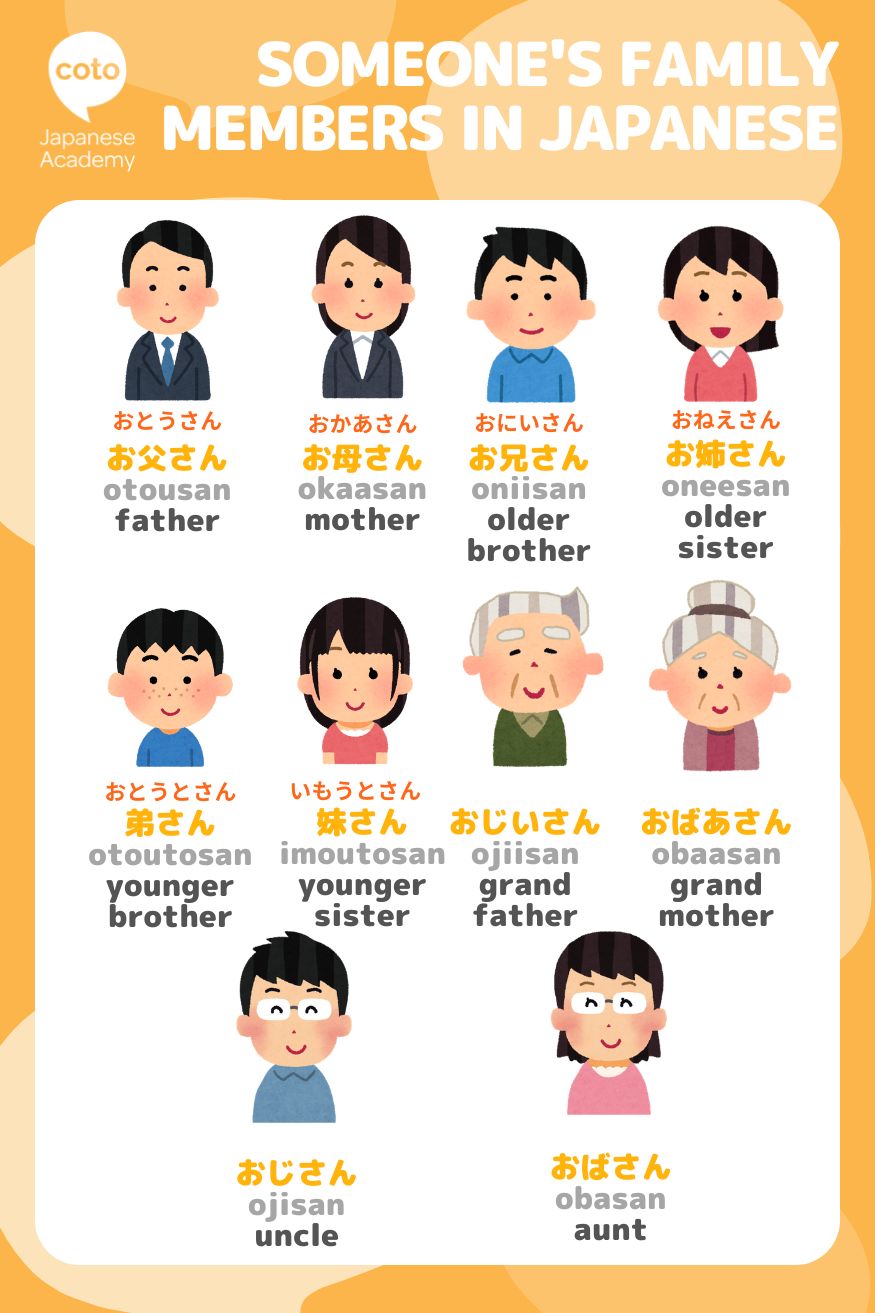
The most common term for family in Japanese is 家族 (kazoku), which generally refers to your immediate family. However, when it comes to discussing family members, the words change based on whether you’re discussing your own family or someone else’s family. In Japanese, there are a couple of terms for within and outside your own family:
- 家 (Uchi/ie): Refers to your own family; generally, the term 家 (ie) refers to your own household or family
- 外 (Soto): 外 literally translates to “outside,” so it’s used to refer to family members outside your own family
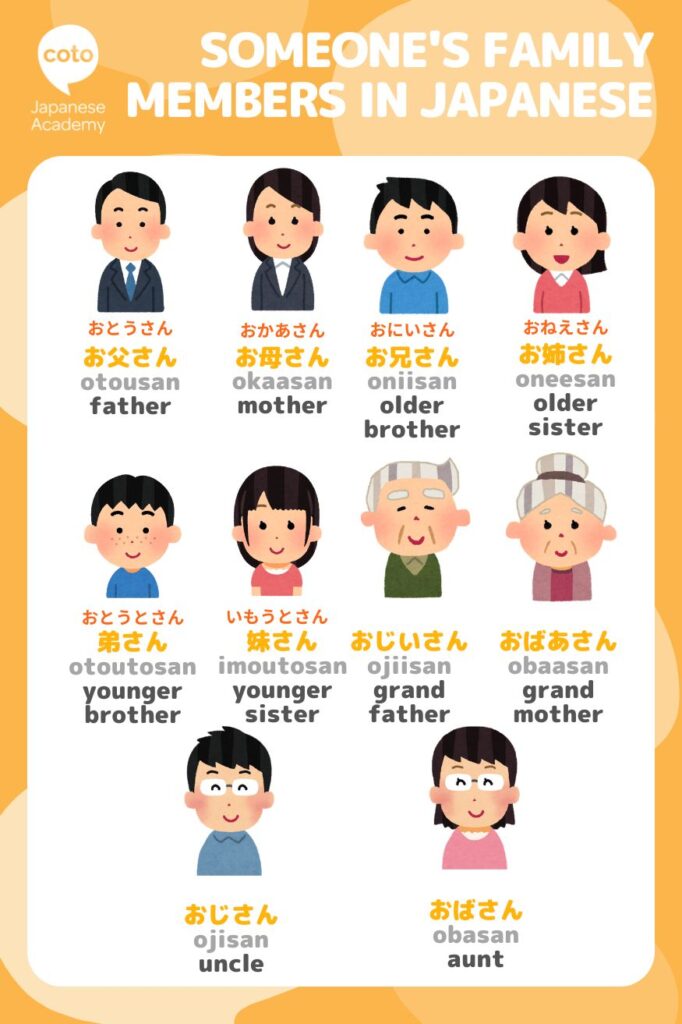
For instance, when referring to your own mother, you would say 母 (haha), but when referring to somebody else’s, you should use お母さん (Okaasan). The term お母さん is actually honorific keigo, which is a more formal form of language used when showing respect to others. This same difference applies to other members of your family, including fathers, brothers, and sisters. Also keep in mind that the words for younger or older siblings are also different.
So, take a look at the table showing different terms for immediate family members and their formal counterparts. The table shows how to refer to each family member when speaking about them and to them as well as how to refer to someone else’s family members, which is generally more formal.
| English | When Referring to Own Family (Formal/Casual) | When Talking to Own Family (Casual) | When Referring to Another’s Family |
|---|---|---|---|
| Parents | 両親 (ryoushin) | 両親 (ryoushin) | 両親 (ryoushin) |
| Mother | 母 (haha)・お母さん (okaasan) | ママ (mama)・母ちゃん (kaachan)・お袋 (ofukuro) | お母さん (okaasan) |
| Father | 父 (chichi)・お父さん (otousan) | パパ (papa)・父ちゃん (touchan)・親父 (oyaji) | お父さん (otousan) |
| Siblings | 兄弟 (kyoudai) | 兄弟 (kyoudai) | 兄弟 (kyoudai) |
| Older Brother | 兄 (ani) ・お兄さん (oniisan) | 兄ちゃん (niichan) | お兄さん (oniisan) |
| Younger Brother | 弟 (otouto) | Name | 弟さん (otoutosan) |
| Older Sister | 姉 (ane)・お姉さん (oneesan) | お姉ちゃん (oneechan) | お姉さん (oneesan) |
| Younger Sister | 妹 (imouto) | Name | お妹さん (oimoutosan) |
One thing to maybe remember is that young children generally call their mother ママ (mama) or their father パパ (papa). But adults might call their father 親父 (oyaji) and their mother お袋 (ofukuro), as these words communicate a sense of affection or closeness.
Example:
家族は母、父、姉、私、妹の5人です。
Kazoku wa haha, chichi, ane, watachi, imouto no gonin desu.
There are 5 people in my family, including my mom, dad, older sister, me, and younger sister.
How to Discuss Relatives (Uncles, Aunts, Grandparents, and Cousins) in Japanese
So, how do you talk about relatives, or 親戚 (shinseki), which includes your uncles, aunts, grandparents, and cousins? Just like when discussing immediate families, the terms for relatives change depending on whether you are talking about your own or another person’s relatives.
| English | When Referring to Own Family (Formal/Casual) | When Talking to Own Family (Casual) | When Referring to Another’s Family |
|---|---|---|---|
| Grandfather | 祖父 (sofu) | じいちゃん (ojiichan)・ジジ (jiji) | おじいさん (ojiisan) |
| Grandmother | 祖母 (sobo) | ばあちゃん (obaachan)・ババ (baba) | おばあさん (obaasan) |
| Uncle | 叔父・伯父 (oji) | おじさん (ojisan) | おじさん (ojisan) |
| Aunt | 叔母・伯母 (oba) | おばさん (obasan) | おばさん (obasan) |
| Cousin | いとこ (itoko) | いとこ (itoko) / Name | いとこさん (itokosan) |
It’s worth noting that unlike most other terms for family members, uncle and aunt actually use different kanji depending on whether they are older or younger than your parent. 伯父 (oji) and 伯母 (oba) are used for an uncle and aunt who are older than your parent, while 叔父 (oji) and 叔母 (oba) are for those who are younger than your parent. Both are read the same way, so the distinction only shows up in writing, but not in speech.
Also note that ジジ (jiji) and ババ (baba) are usually used as cute nicknames for grandpa or grandma; however, these terms can be considered rude when being used to describe an old person. Sometimes it’s even used as an insult when being directed at an elderly person.
Example:
私の祖父と祖母はメキシコからきました。
Watashi no sofu to sobo wa mekishiko kara kimashita.
My grandpa and grandma came from Mexico.
How to Discuss Your Partner and Children in Japanese
If you’re married, your immediate family would be your partner and your children, so what are some words you need to know to describe them? Unlike other words for family, the words for husband, wife, son, or daughter don’t really change whether you’re discussing your own or someone else’s. So, let’s go through all the terms you need to know from marriage status to your partner and children.
| English | Japanese | Furigana | Romaji |
|---|---|---|---|
| Marriage | 結婚 | けっこん | kekkon |
| Married | 既婚 | きこん | kikon |
| Single | 未婚 | みこん | mikon |
| Divorced | 離婚 | りこん | rikon |
| Husband | 夫 | おっと | otto |
| Wife | 妻 | つま | tsuma |
| Son | 息子 | むすこ | musuko |
| Daughter | 娘 | むすめ | musume |
Note that 結婚 (kekkon) refers to marriage or the act of marrying, while 既婚 (kikon) refers to the status of being married.
Example:
去年、私の夫と結婚しました。
Kyonen, watashi no otto to kekkon shimashita.
I got married to my husband last year.
How to Discuss In-Laws in Japanese
So, now you’re probably wondering how you can refer to your in-laws in Japanese. The good news is that it’s pretty simple; you just need to add 義理 (giri) before the terms we already covered for family members. For instance, if you want to discuss your partner’s mother, you would say 義理の母 (giri no haha) for “mother-in-law.”
One thing to note: for mother-in-law, you should use haha rather than okaasan since that’s the more general term for mother. For all other in-law family members, the same would apply. However, there are also shortened terms for in-laws; for example, mother-in-law and father-in-law can be said as 義母 (gibo) and 義父 (gifu) as well. Take a look at the table below for how to say in-laws in Japanese.
| English | Japanese | Furigana | Romaji |
|---|---|---|---|
| Father-in-law | 義父・義理の父 | ぎふ・ぎりのちち | Gifu |
| Mother-in-law | 義母・義理の母 | ぎぼ・ぎりのはは | Gibo |
| Older Brother-in-law | 義兄・義理の兄 | ぎけい・ぎりのあに | Gikei |
| Younger Brother-in-law | 義弟・義理の弟 | ぎてい・ぎりのおとうと | Gitei |
| Older Sister-in-law | 義姉・義理の姉 | ぎし・ぎりのあね | Gishi |
| Younger Sister-in-law | 義妹・義理の妹 | ぎまい・ぎりのいもうと | Gimai |
| Son-in-law | 婿 | むこ | Muko |
| Daughter-in-law | 嫁 | よめ | Yome |
Families in Japanese Culture and Society
As you might’ve noticed, there are a lot of different words for the same family member in Japanese. This is mostly because the Japanese language distinguishes between different ages. A person’s age is essential for determining who deserves greater care or respect. This is present beyond the family, such as in Japanese work culture. Hierarchy is deeply rooted in traditional Japanese culture, so knowing who is older and how to respectfully speak to and address them is imperative to speaking the language like a native.
So, this is also why heads of households are important. In Japan, you generally need to fill out paperwork for different official procedures, and generally they ask for the name of the “head of the household” as well as who is living with them. We will discuss how completing forms for households and families work in a bit.
You may have learned the term 家 (ie/uchi) as “house “; however, it can actually mean “household,” referring to members of your family and even family lineage. The traditional 家 usually consisted of the husband, his parents, wife, and children, with the son usually inheriting most of the assets and expected to take care of the parents once he’s older. So, the head of the household would be the husband since the family lineage was tied to him.
But in modern times, this is not as common, as households focus more on the married couple and their children. The “nuclear family” unit is generally preferred nowadays, but you might still find grandparents living with the family, either on the husband’s or the wife’s side.
Discussing Family on Public Documents in Japanese
Discussing family is not only important for introducing yourself but also when you register your family for public records, which is known as the 戸籍 (koseki) system. You also usually need to fill out household and family information for other official processes like filing taxes, registering your address, or opening a bank account.
When filling out these documents, you’ll often come across more formal or legal terms for family relationships that differ from the everyday words used in conversation. Since these terms appear on official paperwork, it’s worth knowing them even if you don’t use them out loud very often. Here are some key terms you’re likely to encounter:
| English | Japanese | Furigana | Romaji |
|---|---|---|---|
| Family register | 戸籍 | こせき | Koseki |
| Head of household | 世帯主 | せたいぬし | Setainushi |
| Relationship (to household head) | 続柄 | つづきがら | Tsuzukigara |
| Spouse | 配偶者 | はいぐうしゃ | Haiguusha |
| Dependent | 扶養家族 | ふようかぞく | Fuyou kazoku |
| Household | 世帯 | せたい | Setai |
| Cohabitant | 同居人 | どうきょにん | Doukyonin |
So, the 戸籍 (koseki) system is unique to Japan and tracks family relationships including births, marriages, and deaths, under a single household record, usually headed by the 世帯主 (setainushi). This is different from a resident registry in most other countries, since it’s tied to family lineage rather than just a physical address.
続柄 (tsuzukigara) is a term you’ll see specifically on forms, asking how you’re related to the 世帯主 (setainushi) or another listed family member. For example, if you’re the spouse of the household head, you’d write 配偶者 (haiguusha) in this field, rather than the more casual 妻 (tsuma) or 夫 (otto) you learned earlier.
扶養家族 (fuyou kazoku) comes up most often on tax and insurance paperwork, referring to family members who financially depend on you (like a spouse or child), and can directly affect your tax deductions.
Conclusion: Talking About Family in Japanese is Essential
Family is the bedrock of Japanese culture and society, so it will be one of the first topics of conversation. So, in order to hold a conversation and introduce yourself and your family properly, you will need to know how to talk about them! Additionally, you will have to provide family details on official documents if you decide to move to Japan with them. So, just remember some of the terms in this article, and try using them in your next Japanese conversation!
Talk about Family in Japanese like a Native at Coto Academy!
Understanding the nuance between talking about your own family and someone else’s will help you speak Japanese like a native, so join Coto Academy to learn just that! Our native Japanese teachers will help you converse fluently by allowing you to speak freely while providing expert guidance on the subtleties of natural spoken Japanese.
Whether you want to focus on conversation, build well-rounded language skills, or prepare for the JLPT, we have everything you need in a structured curriculum where you track your progress and reach your goals! Join our campuses in Tokyo or Yokohama, or join us online from anywhere around the world! Fill out the form for a casual chat to get more details!
FAQ:
Are there different words for your own family and someone else’s?
Yes, this is one of the trickier parts of talking about family in Japanese. As covered in the table earlier, you typically use plain, humble terms (like 母/haha or 兄/ani) when referring to your own family members in conversation with others, but you use the polite forms (お母さん/okaasan, お兄さん/oniisan) when referring to someone else’s family,
What is the difference between chichi and otousan?
父 (chichi) is the plain, humble term you use when referring to your own father while speaking with someone else, for example, telling a coworker about your dad. お父さん (otousan) is the polite version, which you’d use when talking to your own father directly, or when referring to someone else’s father. However, note that people often directly call their father 親父 (oyaji).
What’s the difference between 戸籍 (koseki) and a regular address registration?
戸籍 (koseki) tracks family relationships, births, marriages, and deaths under one household record, while address registration (住民票, juuminhyou) simply records where you currently live. You can change your address without changing your koseki, but major life events like marriage or divorce will update it.
The post Japanese Family Vocabulary: How to Talk About Immediate & Extended Family appeared first on Coto Japanese Academy.
Article source: https://cotoacademy.com/japanese-essentials-talk-family/