
As of 2026, Japan has more than 57,000 convenience stores, colloquially called the konbini. Don’t think of them as your regular gas station mini-mart back home. Konbini in Japan play in an entirely different league: you can print documents, get your tax records and proof of residence, pay your bills, and transfer money, all right before grabbing your first mouthwateringly good tsunamayo (tuna mayonnaise) onigiri (Japanese rice ball) of the day.
A common thing our students at Coto Academy joke about is how they use the universal daijoubu desu (大丈夫です) to answer everything the konbini clerk asks. But we’d argue it doesn’t have to be your default answer once you actually know what they’re asking. I worked at a Family Mart for about two years back in university, so I know a thing or two about these phrases.
If you want to sound more fluent, we’ve compiled some common Japanese phrases you’ll hear (and can use) at the convenience store.
Read on to find out.
First, Watch Our Video on Survival Phrases for Your Trip to the Konbini
Japanese Convenience Store Phrases You’ll Hear
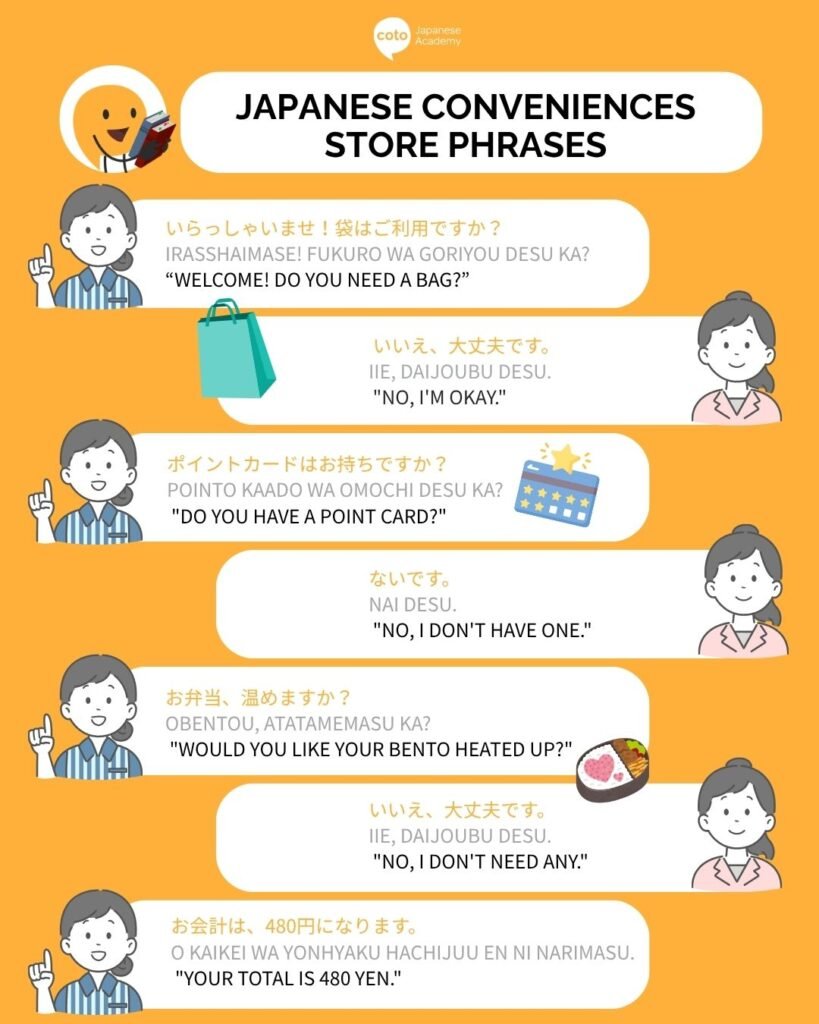
While it varies from person to person, most Japanese convenience store clerks are trained to go through a few standard steps with customers: asking whether you need a plastic bag, want to use a point card for the transaction, and so on.
These phrases often use keigo (honorifics), so they might sound a bit different from what you’d find if you translated things straight from a dictionary.
I never received formal keigo training myself, but the first week of my job as a new konbini hire was spent shadowing another employee. These are the phrases that came up again and again
1. Welcome! いらっしゃいませ (Irasshaimase).
Perhaps one of the most common greetings most of us are already familiar with is いらっしゃいませ (irasshaimase). It basically means “welcome, come in.” The word comes from irassharu (いらっしゃる), the honorific form of “to be” (iru, いる), “to come” (kuru, くる), or “to go” (iku, いく). Yes, that one polite verb covers all three depending on context.
The konbini staff don’t necessarily even have to see you either; when you step inside a konbini, you’ll hear a distinct jingle, which is also how staff know someone’s arrived. Sometimes you’ll also hear other staff members chime in as standard practice and customer service culture.
2. Do you need a bag? 袋はご利用ですか (Fukuro wa goriyou desu ka)?
Fukuro means “bag,” though the fuller term is actually binibukuro (plastic bag).
The verb used here is riyou (利用), meaning “to use.” Because clerks speak in keigo, they attach the prefix go- to make it more polite.
You might also hear the staff use another variation:
袋にお入れしますか?
Fukuro ni oire shimasu ka?
Do you want (your items) in a plastic bag?
The more textbook version is actually:
袋は、要ります?
Fukuro wa、irimasu ka?
Do you need a plastic bag?
3. Do you need a receipt? レシートはご利用ですか (Reshiito wa goriyou desu ka)?
Similar to the plastic bag question, staff are trained to ask if you want a receipt (since most of us are going to toss it anyway). Most konbini even keep a small bin by the register so you can throw it away right there, but they’ll usually ask first.
One important thing to note: you’ll hear both the word reshiito (レシート) and ryoushuusho (領収書) thrown around a lot. Both translate to “receipt” in the dictionary, but they’re not interchangeable in practice.
Reshiito is the standard printed receipt you get by default. Ryoushuusho, on the other hand, is a formal receipt that comes with an official stamp (hanko), usually used when you want to reimburse an item or keep the transaction on the books. You have to request it specifically, and staff will usually ask for the payee’s name to write on it.
4. Do you want to heat up this food? 温めますか (Atatamemasuka)?
If you buy a bento, burrito, or even onigiri (most onigiri come slightly chilled, and while they’re generally not meant to be heated, some flavors are actually recommended warm) staff might ask:
お弁当、温めますか?
Obentou, atatamemasu ka?
Would you like your bento heated up?
Konbini microwaves are usually pretty strong (a whole bento can be heated in two minutes), so it won’t take much time. If it’ll take a few minutes, staff might ask you to step aside so they can keep serving other customers while it heats.
If you want it heated, say:
お願いします。
Onegaishimasu.
Yes, please.
If not, say:
大丈夫です。
Daijoubu desu.
No, I’m okay/good.
5. Do you need chopsticks? お箸は、お付けしますか (Ohashi wa otsuke shimasu ka)?
By default, unless it’s dessert, Japanese people tend to reach for chopsticks (yes, even for pasta). Staff will usually ask:
お箸は、お付けしますか?
Ohashi wa, otsuke shimasu ka?
Would you like chopsticks with that?
If you’d rather use something else, here are other utensils you can request:
- Fork: フォーク (fooku)
- Spoon: スプーン (supuun)
- Straw: ストロー (sutoroo)
6. Do you have a point card?ポイントカードはお持ちですか (Pointo kaado wa omochi desu ka)?
Japan has point card systems for just about everything, from your local supermarket to the dry cleaner. Konbini are no exception, and each chain tends to run its own system. Sadly, they are all separate from the others.
For example, FamilyMart accepts both T-Point and Rakuten Points. 7-Eleven has nanaco. Lawson has Ponta. These don’t have to be physical cards either. Most can be linked to a barcode in an app on your phone.
How it typically works is simple: each transaction earns you points based on the amount spent (usually somewhere around one point per 100–200 yen). Points accumulate over time and can be used toward future purchases.
We’d recommend signing up if you’re a regular at the same konbini brand. If you tend to bounce between different stores, though, the points probably won’t add up to much.
If you have a card and want to use it, staff will ask:
ポイントは、ご利用ですか?
Pointo wa, go-riyou desu ka?
“Would you like to use your points?”
7. Is it okay to give it to you like this?こちらでよろしいですか (Kochira de yoroshii desu ka)?
If you’re only buying a small item, staff might ask whether it’s okay to hand it to you as-is, without a bag. They’ll usually still tape over or scan the barcode as proof of purchase.
Another way you might hear this is with sono mama (“as is”):
そのままでよろしいですか?
Sono mama de yoroshii desu ka?
Is it okay like this (without a bag)?
8. How would you like to pay? お支払いはどうなさいますか (Oshiharai wa dou nasaimasuka)
Staff will ask this when there are multiple payment options available, cash, card, e-money like Suica or PASMO, or QR code payments like PayPay.
A quick grammar breakdown: お支払い (oshiharai) is the polite form of 支払い (shiharai), meaning “payment.” どう (dou) means “how.” なさいます(nasaimasu)is the honorific form of する
To answer, you can just name your method directly:
- Cash: 現金 (genkin)
- Credit card: カード (kaado)
- Suica: Suicaで (suica de)
9. Your total is OOO. お会計は、◯◯円になります (Okaikei wa, ◯◯en ni narimasu).
This is how staff will tell you the total. For example, if your total comes to 150 yen, they’ll say:
お会計は、150円になります。
Okaikei wa, hyaku gojuu en ni narimasu.
Your total is 150 yen.
One thing that trips a few of us is the use of になります (ni narimasu). Literally, 会計◯◯円になります reads as something like “the total becomes ◯◯ yen,” which sounds odd in English.
It’s a keigo softening convention. Narimasu (from naru, “to become”) is used in service Japanese instead of the more direct desu (“is”) because it sounds less blunt and more politely distanced. Compare:
お会計は、◯◯円です。
Okaikei wa, ◯◯en desu)
The total is ◯◯ yen.
お会計は、◯◯円になります。
Okaikei wa, ◯◯en ni narimasu
The total comes to ◯◯ yen.
Tips: In reality, in the convenience store, the staff will rarely use the word kaikei (total). They might just simply say, “Your total is (this amount).”
10. Your change is OOO. ◯◯円のお返しです (◯◯en no okaeshi desu).
Staff says this when handing back your change. Staff will often count it out loud as they place it in your hand, which is a good moment to double-check it’s correct.
For example, if you hand over 500 yen in cash for a 150 yen item, they’ll say this while giving you your change:
350円のお返しです。
Sanbyaku gojuu en no okaeshi desu.
Your change is 350 yen.
Keep in mind this phrase only applies when paying with cash. If you’re paying with a gift card or prepaid card, staff might instead tell you your remaining balance:
残高は500円です。
Zandaka wa gohyaku en desu.
Your remaining balance is 500 yen.
11. Next in line, please. 次のお客様どうぞ (Tsugi no okyakusama, douzo)
While konbini service is usually very quick, you might run into rush hours, typically mornings, lunchtime, and right when people are leaving work, especially at konbini near train stations. When there is a line, the staff might say, “次のお客様どうぞ (Tsugi no okyakusama, douzo),” to let the person next in line know that they can come forward.
Staff can also say:
次のお待ちのお客様、どうぞ。
Tsugi no omachi no okyakusama, douzo
Next customer who’s waiting, please (come forward).”
12. Please wait a moment. 少々お待ちください (Shoushou omachi kudasai)
You’ll hear this if something takes a bit of time, like heating up food, or when they are doing a task that cannot be paused midway
13. Sorry to keep you waiting. お待たせしました (Omatase shimashita)
This is typically right after #11, once whatever you were waiting for is ready.
Responses You Can Make at Japanese Convenience Store
Previously, we brought up all of the things a konbini clerk might say to you. This time, let’s go through all the possible combinations you can say to them.
1. No, I don’t have/bring them. 持っていません (Motte imasen).
持っていません (motte imasen) can technically mean two things: when you don’t have something, or when you’re not carrying it.
You can usually use this when staff ask if you have something with you,like a point card or your own bag (this comes up more often now that some konbini charge for plastic bags).
2. No, please. いらないです (Iranai desu).
Japanese doesn’t really say “no” directly or the straight-up いいえ (iie) as it can come off as a little cold. いらないです (“I don’t need it”) is the natural way to decline a bag, chopsticks, or a receipt. You’ll also hear people soften it further with けっこうです (kekkou desu) or just fall back on 大丈夫です.
3. Yes, please. お願いします (Onegaishimasu)
The word onegaishimasu has multiple meanings (and versatility to it). You can even use it to say thank you, ask a favor, or as a closing for a business email.
In this context, you can use this phrase whenever staff offers you something and the answer is yes: a bag, a warmed-up bento, or using your points.
4. I’m okay! 大丈夫です (Daijoubu desu)
Daijoubu desu is a flexible, polite way to decline something without sounding blunt. Just remember: it means “no thanks,” not “yes.” A lot of learners get confused up here and accidentally agree to something they meant to decline.
5. Using cash/credit, please! 現金/カードでお願いします (Genkin/kaado de onegaishimasu)
Said when staff asks how you’d like to pay, or when you want to specify before they ask. Swap in 現金 (genkin, cash) or カード (kaado, card) depending on how you’re paying. You can also just hold up your card or cash.
What to Watch Out For: Konbini Keigo and Real Keigo Are 2 Different Things

By now, we’ve mentioned the staff’s use of keigo a few times, but this is actually not fully accurate depiction of “real,” textbook-correct keigo.
Instead, what they’re using is called コンビニ敬語 (konbini keigo), a variant of バイト敬語 (baito keigo), or “part-timer’s keigo”.
Baito keigo refers to keigo-based expressions standardized in official customer service manuals for many businesses that train a large volume of front-facing customer service staff members. That’s also why the style is nicknamed manual keigo, or マニュアル敬語 (manyuaru keigo).
It’s treated as its own separate category, rather than simply “keigo,” because it’s technically considered incorrect. It relies on nonstandard formulas and, in some cases, applies Japan’s hierarchical honorific system inconsistently.
For example, when you hand over cash, staff will often say:
1万円からお預かりします。
Ichiman-en kara oazukari shimasu
I’ll receive from 10,000 yen.
The pain point here is the use of から, the Japanese particle for “from”.
The grammatically correct form is actually:
1万円、お預かりします。
Ichimaen,oatsukari shimasu.
I’ll receive 10,000 yen.
The reason why から is used for baito keigo is that the customer would be digging through their wallet trying to scrape together exact change but doesn’t quite seem to have enough. In that moment, “kara” politely signals, “I’ll just calculate this based on the 10,000 yen, then.”
Not everyone appreciates it, though. Some customers find the phrasing presumptuous, since it can come across as though staff have already decided you won’t find the right change.
Another issue is that because the phrases are too standardized for the sake of training as efficiently and fast as possible, they are used uniformly regardless of the situation, whether the customer is a child, an acquaintance, a superior, or a subordinate.
This is also part of why, in Japanese media, this style of keigo gets linked to broader “language deterioration” narratives. Young people, who make up most of the part-time workforce using baito keigo, are seen as relying on it heavily and adopting it in their professional careers.
Things Are Changing: Communicationless Transaction
If you’ve visited a konbini recently, you may have noticed things are shifting. Many stores have digitalized in recent years, where payments are now often processed through a machine rather than handled manually by staff. The staff is still there to handle packing, but this automatic payment system avoids both human error in counting change and also saves time.
Some stores have taken this even further: Lawson has started employing remote clerks overseas to serve customers through digital avatars. They leveraged time zone differences so a worker based abroad can staff the graveyard shift in Japan during their own regular daytime hours.
Self-checkout is also becoming standard at many locations, where you scan your own items and pay without a cashier.
These changes mean some of the phrases we covered above are gradually becoming less common. In the past, staff would tell you your total and count out your change by hand. Now, you don’t need to understand Japanese numbers to know the amount.
Some Konbini Etiquette to Know
The Bow
Even in a fast-paced “Konbini,” you’ll notice that the staff will often give a slight bow when handing you your items or change. It’s a sign of respect and gratitude, a small gesture that says, “Thank you for shopping with us.”
The Two-Handed Exchange
When the cashier hands you your receipt, change, or items, they’ll often do so with both hands. This is another sign of politeness and care, showing that they’re handling your transaction with attention. Sometimes, the cashier may ask if you want your receipt.
The Pointing Gesture
When the staff points at something, it’s often to clarify a question or action related to your purchase. For example, they might ask, こちらは、温めますか (Kochira wa, atatamemasu ka?), which means “Would you like this heated up?”
You can simply reply with はい、お願いします (Hai, onegaishimasu) if you want it heated, or いいえ、大丈夫です (Iie, daijoubu desu) if you don’t. It’s a quick and easy way to ensure your order is how you like it!
By using these phrases and gestures, you’re making your experience easier and showing respect for the people and the culture around you. Plus, there’s something incredibly satisfying about nailing a perfect “Arigatou gozaimashita!” as you leave the store. It’s a small achievement that adds a lot of joy to your day.
Some more Tips!
Ready to put your newfound knowledge to the test? Here’s how you can start practicing konbini language today:
1. Start Small: Next time you visit a konbini, use just one or two phrases you’ve learned. Even a simple “Onegai shimasu” when you hand over your item can make a big difference.
2. Observe and Imitate: Watch how the locals do it. Listen to the phrases they use, pay attention to the non-verbal cues, and don’t be afraid to mimic what you see. It’s the fastest way to learn!
3. Build Confidence: The more you practice, the more natural it will feel. Don’t worry if you make mistakes—every effort is appreciated, and the staff is usually very patient.
4. Ask Questions: Don’t be shy about asking where something is or if they have a specific product. Using phrases like “XX wa doko desu ka?” or “Kono shouhin wa arimasu ka?” will help you find what you need and give you more opportunities to practice.
5. Have Fun: Learning konbini language is not just about utility; it’s about enjoying connecting with a different culture. So have fun with it, and enjoy the ride!
Who knew that a quick visit to the store could be so enjoyable? Now that you’re armed with these phrases and tips, you’re ready to take on the world of konbinis like a true local. Whether paying by cash, card, or Suica, asking for a plastic bag, or hunting down your favorite snack, you can navigate quickly and confidently.
Conclusion: Learn Japanese for Everyday Life
Japanese convenience store phrases might sound complicated at first, but after a few trips, you’ll start noticing they barely deviate from the phrases we’ve covered above.
If you want to keep building on this kind of real, everyday Japanese, Coto Academy offers courses in Tokyo and Yokohama for all levels, from complete beginners to advanced learners preparing for the JLPT. Our teachers focus on natural, practical Japanese you’ll actually use, not just textbook grammar.
Check out our course options and find the class that fits your goals, or visit one of our campuses in Shibuya, Shinjuku, Iidabashi, Yokohama, or Minato to see what studying with Coto Academy is like.
FAQ
Do I need to speak fluent Japanese to use the konbini language?
Not at all! Even just knowing a few key phrases can go a long way in making your konbini experience smoother and more enjoyable. The staff will appreciate your effort, and it will make your interactions easier.
What’s the best phrase to use if I’m paying with cash?
Simply say, “Genkin de Onegai shimasu,” which means “I’ll pay with cash, please.”
Does Coto Language School offer cultural experiences as part of the learning process?
Yes! Alongside language lessons, we offer cultural workshops and outings that allow you to experience Japanese culture firsthand, making your language learning journey more immersive and fun. And we also offer courses that focus on practical Japanese for everyday situations, including konbini language, so you can navigate life in Japan with confidence.
The post Japanese Convenience Store Phrases You’ll Actually Hear and Use appeared first on Coto Japanese Academy.
Article source: https://cotoacademy.com/convenience-store-japanese/