
While Japanese has tons of English loanwords, English actually borrows quite a bit from Japanese as well. Words like sushi, karate, or tsunami are so commonly used that it might be easy to forget that they’re loanwords from Japan.
Let’s discover some common Japanese loanwords in English, covering some of the old and some of the new, but this blog is by no means exhaustive. By the end of this article, who knows? New words are probably being borrowed at this very moment.
Why Do Japanese and English Borrow so Many Words From Each Other?
Since Japanese and English come from very different places with distinct cultures, cuisines, and geographic characteristics or phenomena, the more exposed we are to each other’s cultures, the more new concepts and words we encounter. It makes sense that English would just adopt the words for Japanese food items like “sushi” or “ramen.”
However, the word tsunami is also of Japanese origin. It just so happens that English had no word for huge tidal waves, so it borrowed tsunami from Japanese. Often when a word sufficiently describes something we don’t have a word for, we just adopt it into our language. As you are probably well aware, Japanese quite often does the same.
You’ve probably experienced what could be called the katakana glitch. You see a katakana word, and you just can’t figure out what it is until you mouth it, then you finally figure out that biiru (ビール) is actually “beer”. You probably can think of many more English loanwords in Japanese, such as soccer, or sakkaa (サッカー), and even modern slang like rizz, or rizu (リズ). New words are crossing over, perhaps because the internet and pop culture spread new trends faster than ever before.
Note that this doesn’t always happen; when baseball was introduced to Japan, they made their own word for the sport, yakyuu (野球), which is made up of the words field, or 野 (ya), and ball, 球 (kyuu).
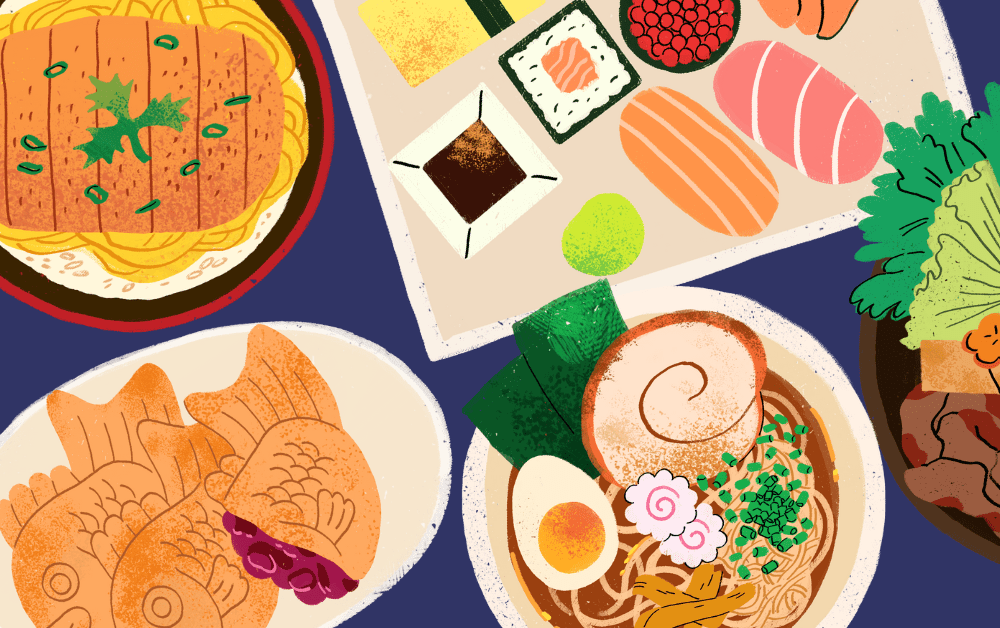
Japanese Loanwords Used in English for Food and Entertainment
In 2013, UNESCO named Japanese food an intangible cultural heritage. The flavors and practices associated with Japanese food are unique. Many of the Japanese loanwords in English reflect that uniqueness. Similarly, many aspects of Japanese entertainment tend to originate in Japan, and the English words borrowed from Japanese show that.
A lot of these loanwords are originally written in kanji, hiragana, or katakana. If you need to review hiragana and katakana, head to this article.
1. Karaoke (カラオケ)
Did you even know this was a Japanese word before Karaoke actually came into contact with Japan or the language? It has roots in the words: kara (空), meaning “empty,” and oke (オケ), meaning “orchestra.” So, together the word actually means orchestraAlso, have you seen anyone do karaoke like the Japanese?
2. Sudoku (すどく)
If you’ve played sudoku and understand it, more power to you. This game and its title originated in Japan in 1984 and have since become very popular worldwide. The su comes from suji or suu (数), meaning number, and the doku (独) means single. The overall aim of the game is to get numbers to appear once in squares in a grid. So literally, the numbers must remain single. Or suuji wa dokushin ni kagiru (数字は独身に限る), which was the original title of the game.
Europeans actually played a similar game in the 18th century. In the 1980s, a Japanese publisher distributed sudoku, which turned into a huge hit and has been popular ever since.
3. Pachinko (パチンコ)
Hard to spend any time in Japan and not see a pachinko parlor. Pachinko is a kind of pinball game played in arcade games or, more commonly, gambling parlors. Japanese people like to make words that mimic or represent the sound you hear, like the bees buzzing or the snake hissing. The word pachinko is partly made up of a Japanese onomatopoeia. The first part, pachin, is from the sound that the metal pinball makes as it hits an obstacle. The ko is a diminutive suffix that means something like ‘little’.
4. Soy (sauce, beans)
Tofu and miso are obviously Japanese loanwords, but soy? Yes, apparently it comes from しょうゆ (shoyu), which is Japanese for soy sauce. The actual Japanese term for the bean is daizu. Edamame, which are green soybeans, is also commonly used in English.
5. Tamari (たまりしょうゆ)
This one is kind of hip these days. Many recipe bloggers suggest using tamari as a ‘healthy’ alternative to regular soy sauce. Tamari is richer, thicker, and less salty than regular soy sauce, but it is also made from fermented soybeans.
6. Shiitake, maitake, matsutake, and enoki mushrooms (椎茸、舞茸、松茸、えのき)
Did I miss any? Many Japanese mushroom names have been carried over and used as-is in English. The most popular of these might be shiitake, which is often pronounced without the second ‘i’, resulting in shitake.
7. Umami (旨味)
Umami is probably one of the most popular Japanese loanwords in English, being used all the time to describe a distinct savory flavor. This term is a relatively recent adoption into the English language, and it’s somewhat new to Japanese as well.
The word was first coined in 1908 when a Japanese scientist used the word to describe the “5th taste,” which is savoriness. In both Japanese and English, umami generally describes the savory flavor you would find in cooked meats, soy sauce, and mushrooms.
8. Dashi (だし)
No mention of washoku can exclude dashi, stock made from fish or kelp that is used as the base for many Japanese dishes. Dashi is commonly used in English to mean the same thing.
9. Katsu (curry or chicken katsu) (かつ)
Katsu refers to cutlets of meat that are breaded using panko and deep-fried. The cutlets are usually pork or chicken. Katsu is served with a sauce or with curry. In fact, in some places overseas, katsu curry has become so popular that the term is used to mean all Japanese curry.
10. Panko (パン粉)
You might have guessed this from the previous entry, but panko is breadcrumbs. They are commonly used in Japanese cooking and the product and the name have crossed over into English-speaking cultures.
The word panko is actually a combination of a loanword that didn’t come from English and the original Japanese word. “Pan” came from the Portuguese language, pao, and ko (粉) is a Japanese word that means “flour” or “dust”.
The biggest difference between panko and standard breadcrumbs is that panko is made from bread without crusts. Panko’s crustless white bread is coarsely ground into airy, large flakes that give fried foods a light, crunchy coating.
11. Amazake (甘酒)
Making the list of words of Japanese origin recently recorded in the Oxford English Dictionary, amazake is a sweet, fermented drink made from rice. Unlike sake, which is also made from rice, amazake is not alcoholic. It literally means sweet (ama) sake.
12. Manga (漫画)
These loanwords are used the same way in English as they are in Japanese. One distinction is that while manga means comics in general in Japan, the term typically means Japanese comics in English.
13. Anime (アニメ)
Probably the most popular loanword used all the time in English is アニメ (anime), which ironically comes from the word “animation” borrowed from English. But in English, “anime” specifically refers to Japanese animation even though in Japanese it refers to all animation. This term is a great example of words being traded back and forth between two languages.
14. Emoji (絵文字)
Texting and instant messaging is just not the same without emoji, graphics that help express an emotion when words are just not enough. But the cute, yellow pictogram you’ve been using on your iPhone? The word came from the Japanese language. The kanji 絵 (え) means “picture” and 文字 (もじ) means “character” or “letter.” You might learn some new emoji from the Emojipedia online.

Japanese Loanwords Used in English for Sport and Martial Arts
Japanese martial arts are known the world over by their Japanese names. These are quite established loanwords, and the sports themselves continue to gain devotees.
15. Judo (柔道)
Japanese martial arts are well-known throughout the English-speaking world, by their Japanese names. Judo, a defensive martial art, is no exception. The term originates from soft, gentle (柔; juu) and way, road (道; do). Judo is an Olympic event, and practitioners are usually called judoka (柔道家).
When you’re saying the word “judo” in Japanese, remember to elongate the first syllable: Ju-u-dou. In English, however, you can shorten it.
16. Jujutsu (柔術)
Precursor to judo, this is also a Japanese unarmed martial art. The first part of the term, juu means gentle, just like in judo and the jutsu (術) means skill or art. There are variant spellings in English, including jiu-jitsu or ju-jitsu. It is also the origin of the name of the famous martial art, Brazilian Jiu-Jitsu.
However, historical evidence shows that Brazilian Jiu-Jitsu (BJJ) comes from Judo, but at the time Judo was still being called “Ju-Jutsu,” which is why BJJ has its name today rather than “Brazilian Judo.”
17. Karate (空手)
Karate is definitely one of those Japanese loanwords that almost feels like it’s always been in English. The term originates from empty (kara) and hand (te), meaning fighting with bare hands. But the history actually gets more interesting.
Karate originates with the indigenous people of Okinawa, who referred to their martial arts as 手(te or tii in Okinawan). But because the Okinawans traded so much with China, Chinese martial arts heavily influenced Karate, so it was initially called “Chinese hand” (唐手), pronounced the same as we know it today. Eventually, after Japan took over Okinawa, the name was changed to 空手 (karate).
18. Kendo (剣道)
Another Japanese martial art that was simply imported into English, it consists of participants using bamboo swords and wearing protective gear based loosely on samurai armor. Ken means “sword” and do means “way.”
19. Sumo (相撲)
Often suffixed with ‘wrestling’ in English, sumo means to fight. It’s not just the word that has crossed borders. Many non-Japanese people have succeeded as sumo wrestlers, in what is perceived to be a closed and very traditional world. Check out this quick guide to sumo related terms to learn a bit more about the sport.
Japanese Loanwords Used in English for Performing and Literary Arts
From the theater to the page, traditional Japanese performing and literary arts have become well-known in English-speaking cultures.
20. Kabuki (歌舞伎)
This is a kind of Japanese theater. The Online Etymology Dictionary cites two possible origins of this Japanese loanword. One is that kabuki comes from the verb kabuku, meaning to deviate. The first kabuki performance was given in a shrine by a girl, dressed as a man, which was outside of the norm. The other explanation is that kabuki means ‘art of song and dance,’ from ka (song), bu (dance), and ki (art, skill).
21. Noh (能)
In Noh theater, performers sing and dance while wearing masks. This loanword comes from the Japanese meaning ‘talent’.
22. Tanka (短歌)
A poem written using just five lines, tanka means short (tan) song (ka). In English, the poems typically use five lines and 31 syllables, but in Japanese, they are typically written in three lines.
23. Haiku (俳句)
If you’ve heard about haiku, you probably have the impression that it takes immense skill to craft them. These poems are written using a set number of syllables. The haiku consists of three lines, with five syllables in the first line, seven in the second, and five in the third.
Though haiku were originally written in Japanese, English poems following this pattern also go by the same name. Literally meaning light (haikai no) verse (ku), these poems are often about nature.
23. Senryu (川柳)
Senryu is a loanword that refers to another type of Japanese poetry that’s similar to haiku. It tends to talk about people, rather than nature. This form was named after a poet who frequently practiced it.
Other Japanese Loanwords We Use in English
From business to bedding and natural disasters, Japanese loanwords are used in many areas of life. The following words don’t fall neatly into the categories we have here. But they are still commonly used.
25. Tycoon (大君)
You’ve probably heard this word used a lot with another t-word, tech, as in tech tycoon. Its origins have little do with technology, however. Taikun was the name foreigners gave to the shogun (another loanword) when they came to Japan in the 1800s. Over time, taikun (great lord) became tycoon. Today, the word refers to someone of tremendous wealth and power.
26. Honcho (班長)
This is another loanword often used alliteratively with head, as in head honcho, meaning leader. The term originates from Japanese han (group) and cho (leader), and was apparently picked up by foreigners in Japan during the second world war.
27. Skosh (少し: Sukoshi)
Have you ever noticed someone saying, “Just a skosh.” Maybe you’re asking if you need to add more salt when you are making soup. This loanword is a shortening of the Japanese sukoshi, meaning a little. It was adopted by the US servicemen when they were stationed in Japan after World War II. It is used in the same way in English and carries the nuance of a really tiny amount.
28. Zen (善)
This loanword originates from the Japanese school of Zen Buddhism that focuses on meditation. In common use in English, zen means calm and peaceful, and doesn’t explicitly refer to Buddhism.
29. Futon (布団)
Futon is one of those loanwords that perhaps many people have forgotten is, in fact, a loanword. It’s used to describe a flat mattress that can be rolled up, which is traditional bedding in Japan. However, in English, people refer to couches that have pull-out beds as futons. The fu in this loanword means sheet or cloth, and the ton means group.
30. Ikigai (生きがい)
Ikigai, as a concept, has been making waves in the English-speaking world in recent years. Iki means life and gai means value, so the term translates to ‘reason for being’. The idea is that with a reason for being or a purpose, people can live more fulfilling lives, as those lives get longer.
31. Tsunami (津波)
Originating from harbor (tsu) and wave (nami), this word has been in use in many unfortunate circumstances recently. As with the original Japanese, it describes a large sea wave caused by an earthquake. Tsunami has also been used in a figurative sense to mean a large and sudden amount of something.
32. Samurai (侍)
Many words from Japanese history are usually adopted directly into English, and samurai is no exception. Samurai describes a specific warrior class that only existed in the context of Japan. Calling them “Japanese knights” just wouldn’t capture what they were and the place they had in Japanese society.
Likewise, many other historical Japanese terms for different social positions or figures, like shogun, daimyo, or even ninja, are simply borrowed in English.
33. Katana (刀)
While katana actually just means “sword,” in English it has come to refer to the specific Japanese sword with its characteristic curved blade that was used by the samurai. Likely due to its unique aesthetics, carefully crafted by skilled blacksmiths, it caught the attention of foreigners. Thus, now we use the word katana to describe the iconic sword from Japan.
34. Kimono (着物)
The kimono is a beautiful, elegant garment that has come to be known as the national dress of Japan. So, there’s no question why English adopted the word kimono to describe this iconic piece of clothing. There isn’t even an equivalent type of clothing to the kimono in English-speaking countries; while there are dresses and robes, none of them are quite a kimono.
35. Shinkansen (新幹線)
While English has the word “bullet train,” it’s not uncommon for people to opt to use the word “shinkansen” instead. Japan’s efficient transportation system, particularly the bullet train, has become such an image of the nation that shinkansen is now widely known in English. Often when people visit Japan, they might say they want to ride the “shinkansen” rather than the “bullet train.”
Conclusion:
You might be surprised how many words the English language adopts from Japanese alone. You’ve no doubt been using many of them and as the English language continues to borrow words from Japanese, you’ll end up using even more Japanese, in English. The truth is, languages constantly borrow from each other, showing how we exchange ideas all the time.
As a matter of fact, Japanese doesn’t just borrow words from English. To find out more, read our blog: Loan Words in Japanese that Don’t Come from English!
Want to study Japanese with a native teacher?
If you want to learn more about the Japanese language, why not consider studying Japanese at Coto Academy? If you can’t make it to Japan yet, an online course is one of the best ways to start your Japanese language journey. Coto Academy offers a comprehensive Japanese course that’s available online, in Tokyo or Yokohama! Get a free consultation and join our class today!
Contact us for more information and make sure to follow our blog for more insight into the Japanese language, culture and society.
Does English have Japanese loanwords?
Yes, English language borrows a lot of Japanese words. For example, tsunami, tycoon and sudoku came from the Japanese equivalent. English language also retains a lot of original Japanese food-related words, like sushi, katsu and dashi.
What English words are borrowed from Japan?
Among many of them, the most common English words borrowed from Japan are:
- Tsunami
- Karaoke
- Tycoon
- Sushi
- Skosh
- Ramen
- Futon
Does Japan borrow words from the English language?
Yes, Japanese has around 4,500 words that are borrowed from English. Loanwords borrowed from a foreign language is called gairaigo (外来語).
The post 35 English Loanwords That Come From the Japanese Language appeared first on Coto Japanese Academy.
Article source: https://cotoacademy.com/english-loanwords-that-come-from-japanese-language/