
Part of what makes Japan so clean and environmentally friendly is how people throw away garbage, so there are many rules to follow just to get rid of your trash. In fact, Japan takes the environment so seriously that there is even a national holiday, Greenery Day, which celebrates the Earth. Japan reports an 87% plastic collection and recovery rate, according to a study in 2024 by ECOS.
But when you just moved to Japan, you might be confused about the different recycling and garbage disposal rules, or how exactly Japan sorts its trash. It is important to know how to follow all the garbage disposal rules very clearly, because otherwise they will not pick up your trash (and give you a notice instead). You must also follow specific procedures for disposing of oversized garbage. Don’t worry, it’s as overwhelming as it seems, and we will go through everything you need to know!
Different Types of Garbage in Japan
In Japan, it is essential to sort and separate different types of garbage. There are a couple of categories for non-recyclable trash that you would generally need to sort your trash into, including:
- Moyasu gomi: Regular/burnable garbage
- Moyanai gomi: Non-burnable garbage (plastics)
For recyclable trash, you need to separate it by material type. Here are the general categories that you would need to sort them into:
- Petto botoru: PET bottles
- Kan: Cans
- Bin: Glass bottles
You also need to throw away each garbage type on different days. The days you need to throw away certain types of garbage vary depending on the region and even the ward you live in. Each ward may also have different rules for sorting your trash. Whenever you move into a new apartment or house, the property owner, apartment company, or even the city itself will usually send you a guide explaining how to sort your trash and which days each type of trash is collected.
In most cities and neighborhoods, it’s best to take out your trash by 8 AM, since the garbage trucks usually collect in the morning.
| Japanese | Furigana | Romaji | English |
|---|---|---|---|
| 燃やすごみ | もやすごみ | moyasu gomi | burnable garbage |
| 可燃ごみ | かねんごみ | kanen gomi | burnable garbage |
| 燃やさないごみ | もやさないごみ | moyasanai gomi | non-burnable garbage |
| 不燃ごみ | ふねんごみ | funen gomi | non-burnable garbage |
| 生ごみ | なまごみ | nama gomi | raw garbage |
| 粗大ごみ | そだいごみ | sodai gomi | oversized garbage |
| 資源ごみ | しげんごみ | shigen gomi | recyclable garbage |
| 有害ごみ | ゆうがいごみ | yuugai gomi | harmful/hazardous garbage |
Now let’s go through each garbage category and what types of trash belong in each!
燃やすゴミ(Moyasu Gomi): Regular Garbage
In Japan, regular or non-recyclable garbage is called 燃やすごみ (moyasu gomi) or 可燃ごみ (kanen gomi). Both refer to burnable trash, which includes items such as food waste, old clothes, and paper waste.
The term 生ごみ (nama gomi) usually describes kitchen or food waste, such as fruit/vegetable peels, meat, eggshells, and other organic waste that could have a strong, unpleasant odor if left in the trash for too long. Japanese people often separate their nama gomi into a separate bag and throw it out right away, or wrap it in newspaper to prevent bad smells. Doing this and disposing of it on the right day is especially important during summer, which is notoriously hot and humid in Japan.
燃やすごみ (moyasu gomi) is usually picked up by the city twice per week. Depending on where you live, there may be a garbage room where you can leave your trash at any time. Some neighborhoods or apartments will just have a garbage area near the street, which may be a net or large box with a latch where people leave their trash out on the morning of pickup days.
It’s important to note the day on which moyasu gomi is picked up in your area.
資源ゴミ(Shigen Gomi): Recyclables
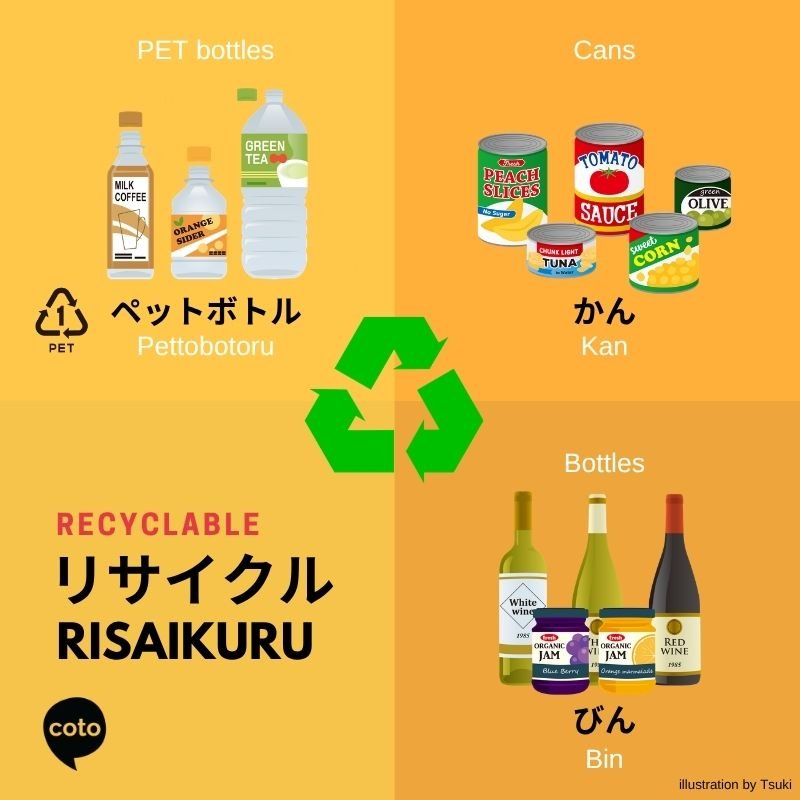
Recyclables are referred to as 資源ごみ (shigen gomi) and, as mentioned, it’s essential that you separate your recyclables by the following categories of materials: カン (kan): cans, びん (bin): glass bottles, and ペットボトル (petto botoru): plastic bottles. Here are some best practices for disposing of each recyclable material.
1. ペットボトル (Petto botoru): PET Bottles
PET bottles are lightweight, transparent plastic containers, made from polyethylene terephthalate, often used for Coca-Cola bottles and other big brands. Almost every beverage in a plastic container you can buy in a store, from water to soda, is a PET bottle.
In Japan, best practice is to remove the wrapping from plastic bottles before recycling (the plastic wrapping would go into plastic recyclables garbage). Most manufacturers in Japan perforate the wrapping on their bottles to make it easier for consumers to remove.
2. カン (Kan): Cans
Cans are thin metal or aluminum containers that store and preserve food, drinks, and ingredients. They include the cans used for beverages like soda as well as canned foods like tomato sauce. Sometimes, cans have paper wrapping covering the outside, so you would need to remove it before disposing of the cans.
Additionally, it’s best to clean cans thoroughly, especially ones that contained food.
3. 瓶ボトル (Bin Botoru): Glass Bottles
瓶ボトル (Bin botoru) translates to “bottle” in English, so it includes any glass or ceramic bottles. Generally, these glass bottles include common beverage bottles such as glass wine, beer, and soda bottles. Like cans and PET bottles, you would need to remove any outer wrapping and rinse before disposal.
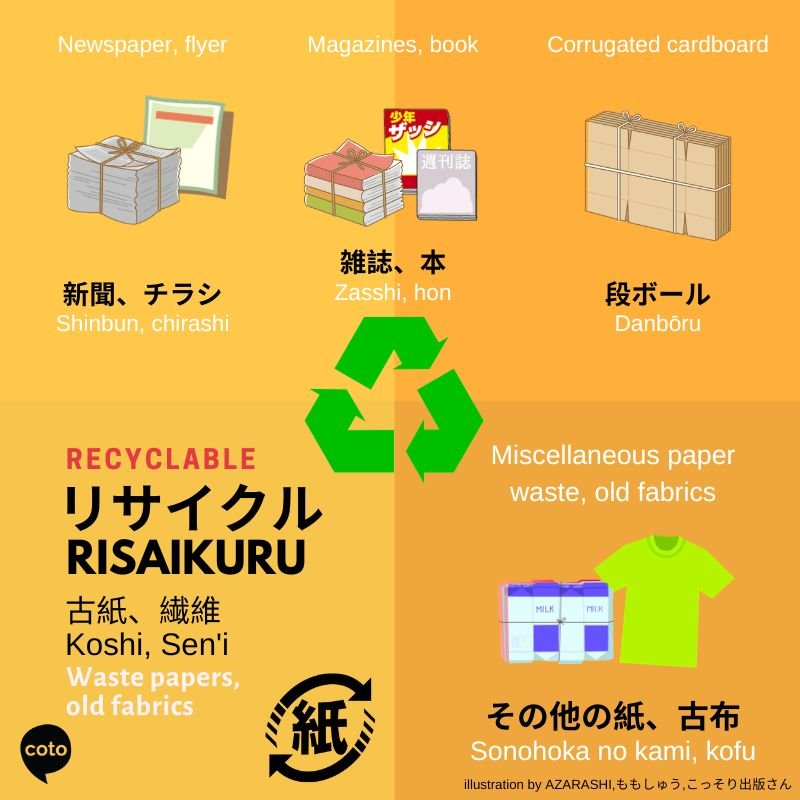
Other Recyclable Materials
In some cities, foam trays and cardboard boxes also need to be disposed of in separate bins similar to cans, glass bottles, and plastic bottles. Certain apartments might have designated bins, or they may have specific bags you can use for disposing of different types of garbage.
Cans, glass bottles, and plastic bottles are usually collected once a week on a designated day; you will need to refer to your neighborhood or apartment garbage guides to see which days you can dispose of which garbage.
| Japanese | Furigana | Romaji | English |
|---|---|---|---|
| 資源、リサイクル | しげん、リサイクル | shigen, risaikuru | recycle |
| 容器包装 | ようきほうそう | youki housou | plastic containers/packaging |
| 発砲トレイ | はっぽうトレイ | happou torei | foam tray |
| 発砲スチロール | はっぽうスチロール | happou suchirooru | foam boxes |
| 古紙 | こし | koshi | used paper |
| びん | びん | bin | glass bottle |
| 缶 | かん | kan | can |
| ペットボトル | ペットボトル | petto botoru | plastic bottle |
| 段ボール | だんボール | danbooru | cardboard |
| 新聞紙 | しんぶんし | shinbunshi | newspaper |
| 雑誌 | ざっし | zasshi | magazines |
| プラスチック | プラスチック | purasuchikku | plastic |
容器包装リサイクル (Youki Housou Risaikuru): Plastic Container Recyclables
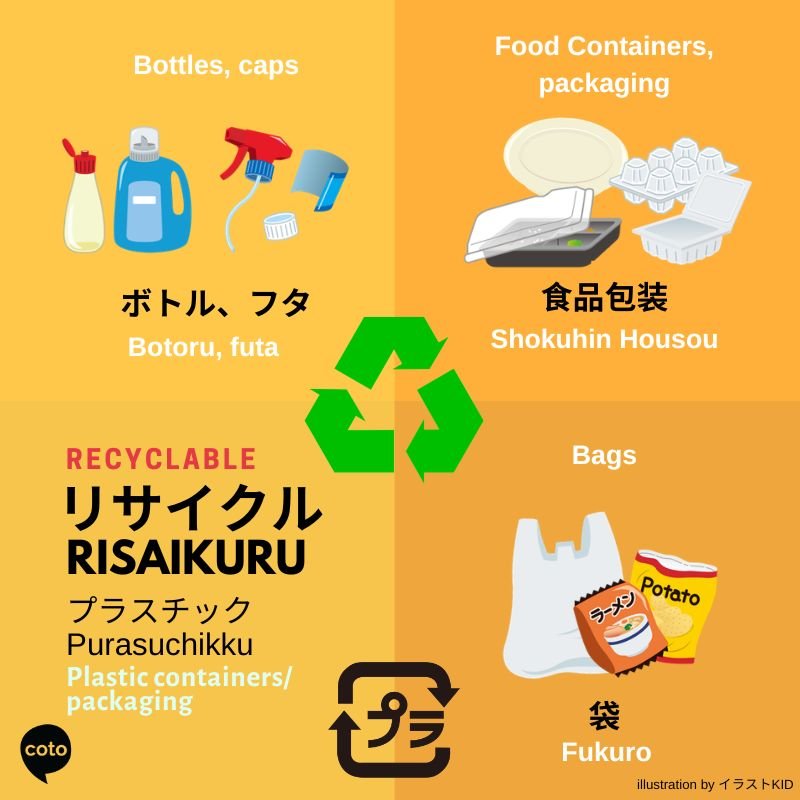
In Japan, there is also a class of garbage called 容器包装リサイクル (youki housou risaikuru), or plastic items that include food packaging (chips, eggs, yogurt containers, etc.), condiment containers, plastic bags, and other miscellaneous goods. They are usually softer plastics, and items in this category generally have a particular mark with the katakana プラ (pura), short for “plastic,” with 2 arrows rotating around it, like in the infographic above.
It is best to wash and clean these items before sending them out for recycling. In most wards and cities, the designated day for taking out this type of recycling will likely be different from when cans, plastic bottles, and glass bottles are collected.
燃やさないゴミ (Moyasanai Gomi): Non-burnable Garbage
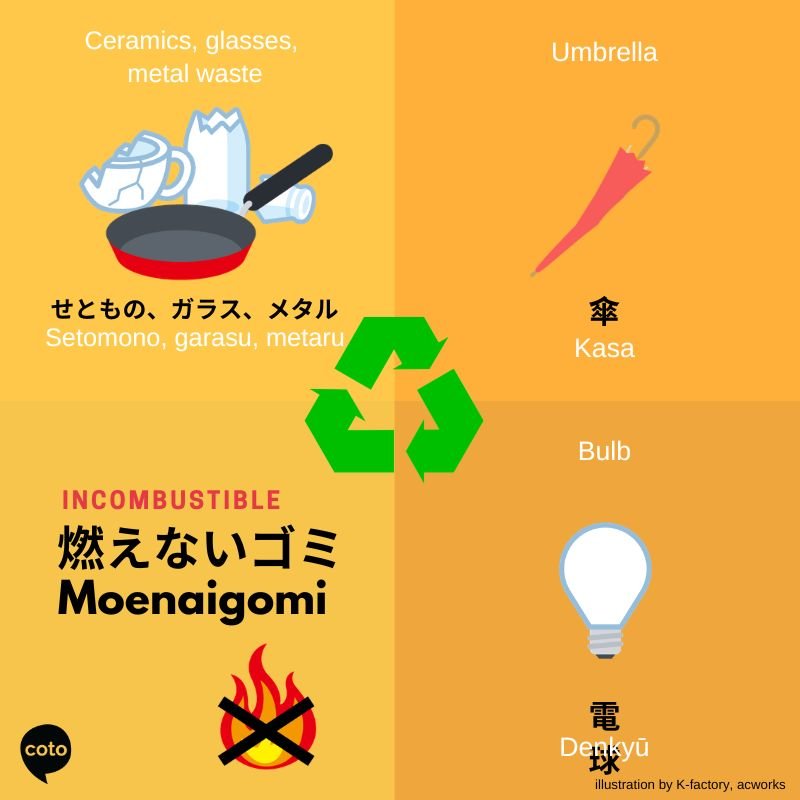
Another type of trash you’ll come across in Japan is called 燃やさないごみ (moyasanai gomi), or 不燃ごみ (funen gomi) — both terms mean “non-burnable garbage.” You’ll want to handle these items with extra care, since they can be dangerous to both people and the environment if thrown out incorrectly.
Common examples of 燃やさないごみ (moyasanai gomi) include:
- Glass items, like light bulbs, makeup containers, or medicine bottles
- Spray cans
- Cooking pans
- Knives
- Lighters
In most cities, 燃やさないごみ (moyasanai gomi) is collected twice a month, typically on the first and third Friday — but always double-check your local ward’s schedule, since collection days can vary by area.
粗大ゴミ (Sodai Gomi): Oversized Garbage
Oversized garbage is called 粗大ごみ (sodai gomi) in Japanese. Each city has its own definition of what counts as 粗大ごみ (sodai gomi), but it’s generally anything over roughly 30 centimeters in length. Compared to other countries, Japan’s oversized garbage disposal system can feel surprisingly complicated, and unlike regular trash, you’ll need to pay for it.
Say you want to throw out an old bicycle. Here’s how the process works:
- Book a pickup appointment by phone or online.
- Pay the disposal fee; for a bicycle in Tokyo, this runs about 800 yen.
- Buy your 粗大ごみ処理券 (sodai gomi shori ken), or disposal stickers, once you’re told which type and how many you need. You can buy these at most neighborhood convenience stores.
- Attach the sticker to your item as proof you’ve paid for disposal.
- Place it outside on your scheduled pickup day.
All that, just to throw away an old bike! Don’t worry; the process is not as difficult or complicated as it sounds! If you’re unsure where to place your trash, whether it’s oversized or anything else, you can ask your real estate agent, landlord, or even neighbor the following:
Example
すみません、ゴミはどこに出せばいいですか?
Sumimasen, gomi wa doko ni desaba iidesuka?
Where should I put the trash?
| Japanese | Furigana | Romaji | English |
|---|---|---|---|
| ごみを出す | ごみをだす | gomi o dasu | put garbage out |
| ごみを分別する | ごみをぶんべつする | gomi o bunbetsu suru | to separate trash |
| ごみを収集する | ごみをしゅうしゅうする | gomi o shuushuu suru | to collect trash |
| 粗大ごみ処理券 | そだいごみしょりけん | sodai gomi shori ken | oversized garbage disposal sticker |
| ごみ収集日 | ごみしゅうしゅうび | gomi shuushuubi | garbage collection day |
| ごみ袋 | ごみぶくろ | gomi bukuro | garbage bag |
| 指定ごみ袋 | していごみぶくろ | shitei gomibukuro | designated (official) garbage bag |
| ごみ置き場 | ごみおきば | gomi okiba | garbage collection point/area |
Conclusion:
It’s essential to understand the rules and regulations for sorting and disposing of your garbage in order to be considerate of your neighbors and help keep Japan clean and the system running smoothly. However, some garbage disposal rules in Japan vary from place to place because each city, ward, or neighborhood sets them. It may feel overwhelming, but you will quickly get used to how things are done in Japan, and you will be doing your part in keeping Japan as clean and green as it is!
An Additional Note: If you’d like to help keep the environment sustainable and green, remember you can always politely refuse plastic bags at convenience stores to reduce your waste.
Learn How to Speak Japanese for Daily Life at Coto Academy
Navigating Japan’s complicated garbage disposal rules may require some Japanese comprehension and conversation skills, so join Coto Academy to learn Japanese that will be immediately useful! We offer practical Japanese courses that will expose you to actual language used in daily life. Whether you need to develop your business Japanese, JLPT skills, or just Japanese speaking overall, we have classes tailored to your needs!
Drop by one of our campuses in Tokyo and Yokohama, or join online from anywhere around the world! Simply fill out the form for a casual chat to get more details!
FAQ:
What’s the difference between 燃やすごみ and 燃やさないごみ?
燃やすごみ (moyasu gomi) is burnable garbage, like food scraps and paper, while 燃やさないごみ (moyasanai gomi) is non-burnable garbage, like glass, spray cans, and knives.
How often is non-burnable garbage collected?
Usually twice a month, often on the first and third Friday, though this varies by city, so it’s best to check your local ward’s schedule.
What counts as oversized garbage or 粗大ゴミ (sodai gomi)?
Definitions vary by city, but it’s generally anything over about 30 centimeters in length, like furniture, bicycles, or large appliances.
Do I need to pay to throw out oversized garbage?
Yes. Unlike regular trash, oversized garbage requires a paid disposal sticker, called 粗大ごみ処理券 (sodai gomi shori ken).
What are the garbage disposal rules in Japan?
Rules vary by city, but generally you’ll need to sort your trash into categories like burnable, non-burnable, and recyclable, use your city’s designated garbage bags, and put trash out only on your assigned collection days. It’s best to check with your local ward office for the specific rules in your area.
You May Be Interested in:
12 JLPT Tips for Exam Day Success (Avoid Common Mistakes)
10 Biggest Culture Shocks in Japan That No One Tells You
How To Read Japanese Nutrition & Food Labels
The post How to Sort Your Garbage in Japan: Types of Garbage & Recycling Method appeared first on Coto Japanese Academy.
Article source: https://cotoacademy.com/guide-gomi-sorting-garbage-japanese/