
Japanese punctuation marks, known as 役物 (yakumono), consist of commas, periods, and question & exclamation marks. They’re easy to overlook, but these small, seemingly insignificant marks make a sentence readable and easy to understand.
We use punctuation all the time in English ー you are seeing them being used in real time as you read this article. In Japanese, they are used in essentially the exact same way, but are shaped differently. So, let’s break down how Japanese punctuation works and how you should use it in your writing!
What Are Japanese Punctuation Marks and Where Did They Come From?
It may come as a surprise, but Japanese didn’t always use punctuation marks in their writing; they only started using them in the 1900s. Like many loanwords, punctuation marks were introduced to Japan during the Meiji Restoration. Emperor Meiji had a particular fondness for Western literature, which likely helped the period and comma make their way into Japanese writing. The Meiji era was a period of Japanese modernization and the embrace of certain Western influences, which also brought changes to the language.
As a result, Japanese punctuation is used much like in English. The main differences are aesthetic (though we will see Japanese does have unique punctuation), such as the period, which looks like a small circle (。), instead of a dot. Also note that when typing on a computer, Japanese punctuation uses full-width characters, meaning they occupy the same amount of space as Japanese kanji and kana characters.
If you ever wrote a traditional 作文 (sakubun), or essay, you would have written Japanese vertically, rather than horizontally. Punctuation marks are also used in vertical Japanese writing, but marks like the period or comma are written at the top right of the character grid, rather than the bottom-right when written horizontally.
Need to review the Japanese character systems? Read our guide: Japanese Writing System Explained: Hiragana, Katakana, Kanji
Japanese Punctuation Marks You Need to Know
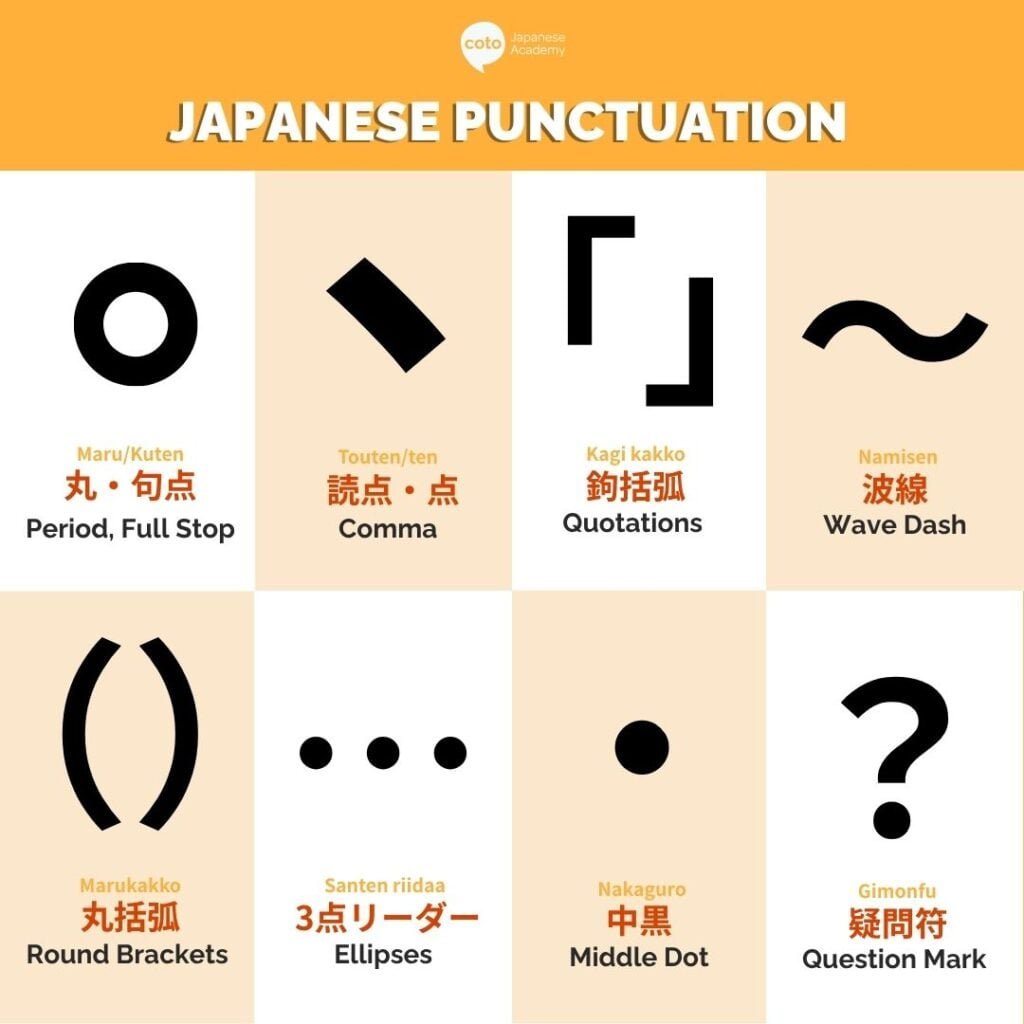
1. Japanese Period (。)
A period in Japanese looks different from the one in English; it looks like a small circle at the end of a sentence. In Japanese, it’s called either 丸 (maru), literally “circle,” or 句点 (kuten), which means “full stop” or “period.” It has the same function as in English, marking the end of a sentence.
Example:
犬が好きです。
Inu ga suki desu.
I like dogs.
Sometimes the period is omitted, such as with quotations or when a sentence stands alone. Also, in more casual contexts, such as when using social media or whenever you are texting somebody, it’s common to drop the period.
Did you know it’s also common to omit whole words in Japanese? Check out our blog: Why Do You Omit So Many Words in Japanese?
2. Japanese Comma (、)
A Japanese comma, 読点 (touten) or 点 (ten), looks almost identical to the English one; it always appears as a dash at the bottom right, following the last word in a clause. It has the same function as commas in English: to separate two different clauses. However, they are used more loosely, whenever you want to mark a pause or a break in a sentence.
Example:
パーティーに行きたいけど、明日6時から起きないといけないだよ
Paatii ni ikitai kedo, ashita rokuji kara okinai to ikenai dayo
I want to go to the party, but I have to wake up at 6 tomorrow.
3. Japanese Quotations (「」)
The corner brackets, called 鉤括弧 (kagi kakko) in Japanese, are equivalent to quotation marks in English (“”) despite their aesthetic differences. They look almost like half brackets, with the opening bracket at the top and the closing bracket at the bottom right. They are used to mark dialogue or quotes said by somebody.
Example:
名探偵コナンの一番人気があるセリフは「真実は一つだ!」です。
Meitantei konan no ichiban ninki ga aru serifu ha “shinjitsu ha hitotsu da!” desu
The most popular quote from Detective Conan is “There is only one truth.”
4. Double Quotations (『』)
Double quotations are essentially quotes within quotes. They aren’t very common, but they are useful when you need them, like when you are quoting someone who is quoting someone else. For instance, say you are retelling a story from your friend: “he proposed in front of Mt. Fuji, and she said ‘yes!’ right before taking the ring”
So, double quotation marks work the same way in Japanese.
5. Wave Dash (〜)
Wave dashes are known in Japanese as 波線 (namisen) or 波ダッシュ (nami dasshu). They are one of the most common punctuation marks in Japanese and have a variety of uses, similar to how em dashes (-) are used flexibly in English. However, they do have uses that are distinct to Japanese. So, let’s go through some of the most common uses of the wave dash:
Indicating Range:
Similar to 〜から〜まで (…kara…made), which indicates a range of something such as time or locations.
8時〜10時
hachi ji ~ juu ji
From 8 o’clock to 10 o’clock
Indicating Origin:
Similar to the Japanese grammar point 〜から (~kara), meaning “from.”
メキシコ〜
Mekishiko ~
From Mexico
Indicating Subtitles
Whenever a word or character is between two wave dashes, this usually indicates subtitles.
〜おはよう〜
~Ohayou~
“Ohayou”
Long or Drawn-Out Vowels:
In Japanese, it’s common to use the wave dash as a way to draw out a word for emphasis. This is common on social media and in text messages with friends.
大変な〜
Taihen naa
It’s sooo difficult, isn’t it?
6. Japanese Brackets (())
Japanese brackets, called 丸括弧 (maru kakko) or simply 括弧 (kakko), work just like parentheses in English. They’re used to add extra information, explanations, or clarifications to a sentence. When typing on a computer, remember to use the full-width versions, so they take up the same amount of space as other Japanese characters.
Example:
来月、日本語能力試験(JLPT)を受けます。
Raigetsu, Nihongo nouryoku shiken (JLPT) o ukemasu.
Next month, I’m taking the Japanese Language Proficiency Test (JLPT).
There is also another type of brackets called 角括弧 (kaku-kakko), which means “square-shaped brackets” and look like ([ ]). They’re used in essentially the same way as maru kakko.
You’ll also come across another type of bracket, (【】), called 隅付き括弧 (sumitsuki kakko). It highlights titles, headings, or important keywords, and it’s very common in news headlines, ads, and online posts.
7. Ellipses (…)
The ellipsis, known as 三点リーダー (santen riidaa), is used to show hesitation, silence, or a sentence trailing off, similar to how we use it in English. In Japanese, it’s usually written as a pair (……) for a longer pause, so you’ll see the double version more often than the single one. It’s especially common in manga, novels, and casual messages with friends.
Example:
えっと……どうしようかな。
Etto…… doushiyou ka na.
Um…… what should I do?
8. Middle Dot (・)
The middle dot (・) is called 中黒 (nakaguro) or 中点 (nakaten). It’s used to separate items in a list, similar to a comma or a forward slash (/) in English. Since kanji can have different meanings when paired with another, the middle dot is especially useful in Japanese to avoid confusion. It’s also used to separate first and last names written in katakana. Unlike other punctuation marks, it isn’t pronounced and doesn’t change how a sentence is read.
Example:
春・夏・秋・冬
Haru, natsu, aki, fuyu
Spring, summer, fall, winter
9. Question Mark (?)
The question mark, called 疑問符 (gimonfu), looks the same as the English one. However, it’s used much less in Japanese, since questions are usually marked by the particle か at the end of a sentence, which means a question mark isn’t strictly necessary. You’ll find it mostly in casual contexts, like texts, social media, and manga, especially when a question has no か and relies on rising intonation. In formal writing, such as reports and business emails, it’s best to leave it out.
Example:
明日、来る?
Ashita, kuru?
Are you coming tomorrow?
10. Exclamation Mark (!)
The exclamation mark, called 感嘆符 (kantanfu), or ビックリマーク (bikkuri maaku) in casual speech, is used to show surprise, excitement, or emphasis, just like in English. It’s very common in casual writing, manga, and advertising, where it adds energy and emotion. Like the question mark, it’s usually avoided in formal writing. You’ll also often see it paired with the question mark (!?) to show shocked disbelief.
Example:
合格した!
Goukaku shita!
I passed!
Example 2:
え!? 本当に!?
E!? Hontou ni!?
What!? Really!?
Conclusion: Using Japanese Punctuation is Similar to English
Using punctuation marks in Japanese is actually not too different from how we use them in English. However, you should note that there are some unique to Japanese, such as the corner brackets (「」) or the wave dash (〜). While there are way too many types of brackets, Japanese punctuation is generally pretty straightforward and easy to figure out as you read and write in Japanese!
Learn How to Use Punctuation and Write in Japanese with Coto Academy!
Want to learn how to use Japanese punctuation properly and master your reading and writing skills? Join our practical Japanese courses at Coto Academy! Our intensive and lite-intensive courses build comprehensive skills in reading, writing, kanji, listening, and speaking. If you want to hone in on a specific skill set, we have classes for your needs and goals!
Visit one of our campuses in Tokyo or Yokohama, or join us online from anywhere in the world. If you’re ready to sign up or just want to discuss more details, fill out the form below, and we will get in touch with you soon!
FAQ:
What does the Japanese period look like?
It’s a small circle (。), called 句点 (kuten) or 丸 (maru). It works the same way as an English period by marking the end of a sentence.
What are Japanese quotation marks?
Japanese uses corner brackets (「」), called 鉤括弧 (kagi kakko), instead of the quotation marks (“”) used in English. For a quote inside a quote, use double corner brackets (『』).
Do I need to use question marks and exclamation marks in Japanese?
They’re common in casual writing like texts, social media, and manga, but they’re usually left out of formal writing such as reports and business emails. Questions are often marked by か at the end of the sentence, so a question mark isn’t strictly necessary.
What punctuation does Japanese use?
Japanese uses a mix of marks that are similar to English and some that are unique. The most common are the period (。), comma (、), corner brackets (「」), double corner brackets (『』), wave dash (〜), brackets (()), ellipsis (…), middle dot (・), question mark (?), and exclamation mark (!).
Did Japanese always use punctuation?
No. Traditional Japanese writing didn’t use punctuation the way we do today. Punctuation marks became common during the Meiji era, when Japan modernized and was influenced by Western writing, and they’ve been part of the language ever since.
The post 10 Most Common Japanese Punctuation & How to Use Them appeared first on Coto Academy.
Article source: https://cotoacademy.com/japanese-punctuation/