Part of conversations is not only letting the other person speak, but also communicating that you are listening. In Japanese, this is known as 相槌 (aizuchi). Aizuchi are conversational interjections that Japanese speakers use when speaking with one another. They are one of the most important aspects of speaking Japanese since it is considered polite in Japanese culture to subtly let your conversation partner know you’re listening.
They are essential to master if you want to hold a Japanese conversation. So, how do you use aizuchi, and what are some expressions to know? Keep reading to find out their functions, some of the most common aizuchi words and phrases, as well as real-world examples of how to incorporate these interjections into your Japanese conversations.
What is 相槌 (Aizuchi)?
Aizuchi are interjections that communicate to the speaker of the conversation that you are engaged in the conversation and you are listening. They can be short phrases or even onomatopoeia that are uttered by the listener, generally between the silent spaces that naturally occur in conversation. The word 相槌 (aizuchi) itself derives from the term for the exchange of sounds between a blacksmith and his apprentice. A conversation works similarly; words and sounds are exchanged between the speaker and listener.
Check out our short video with Akiko-Sensei to learn how Aizuchi works in Japanese.
The Functional Purpose of Japanese Aizuchi (相槌)
The main purpose of aizuchi is to communicate to the other person that you are actively listening to what they are saying. You definitely want to avoid being asked, “Are you listening to me?”, especially if you were truly listening. This is where aizuchi comes in. In Japan, it is considered both proper etiquette and sincere to verbally indicate that you are listening. Being silent during a Japanese conversational exchange can create an awkward feeling for the speaker. If you are not uttering any sounds at all, despite keeping eye contact and nodding, a Japanese speaker can start to get anxious, thinking about whether or not they have said or done something wrong.
Aizuchi covers all the reciprocal interjections that Japanese people use during a conversation to show they are actively listening and paying attention to the speaker. The absence of aizuchi would signal the lack of interest or even disapproval. Although interjections are common in other languages, the Japanese take them up a notch. To a beginner’s ear, it would sound almost as though someone is constantly interrupting the conversation.
Why do Japanese People Use Aizuchi?
The reason aizuchi might be so important in Japanese could simply be Japanese sentence structure. Verbs are at the end of the sentence, so it might take longer to understand what is actually being communicated. This might lead to situations where one speaker will need to speak for longer, so to ensure you’re still listening, you can use aizuchi to communicate that you are following along.
It’s actually not considered rude or impolite to “interrupt” the person speaking as long as you’re trying to use aizuchi. So, what are some aizuchi you can start using to be a good conversation partner and listener!
Aizuchi vs Saying Yes in Japan
It’s important to note that Aizuchi and agreement are two separate things. The nuance can be a bit difficult to grasp in the beginning, but just remember that Japanese interjections would just mean “I understand, I got it” and not necessarily “I approve”. Be careful not to mistake “I am listening” for an expression of agreement.
Using Aizuchi Properly
To master Aizuchi, a Japanese language learner must first learn to listen to the other party who is talking. Look out for a pause in speech, often after a grammatical marker shown at the end of a thought or idea. You can quickly punctuate the conversation with a sou or a naruhodo. A big part of learning to speak is through listening, so try mimicking these interjections you hear around you and start practicing to use them in your very own Japanese conversations!
Aizuchi (相槌) Words and Phrases + Examples
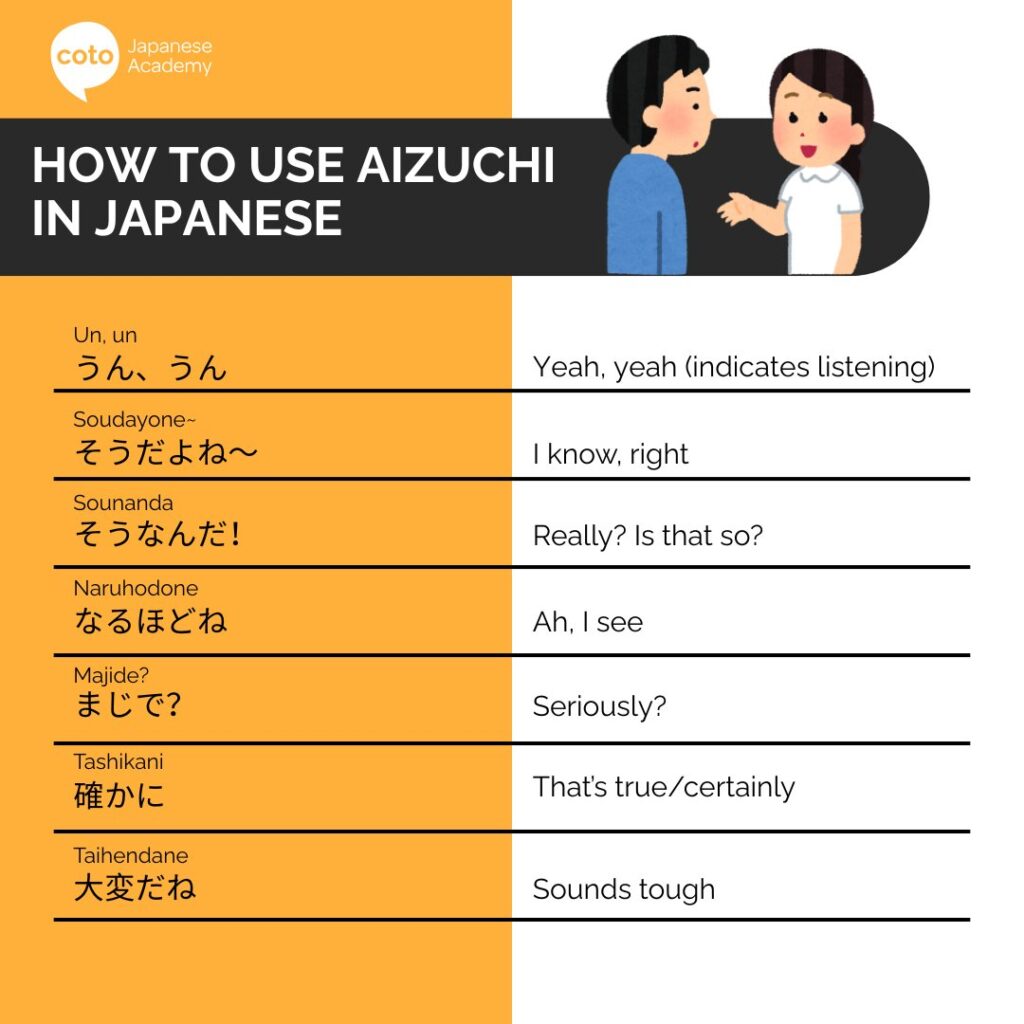
There are so many aizuchi out there you can use to communicate that you’re listening without being obtrusive! But to start, check out our very non-exhaustive list of common aizuchi phrases you can use in your next conversation in Japanese!
1. うん、うん (un, un)
うん (un) translates “yes” in English; however, as an aizuchi, it plays the role of communicating that you are listening. It doesn’t necessarily mean that you are agreeing with what the other person is saying. The うん sound is made with your throat, rather than your mouth, and generally repeated, over and over again.
2. ええ (ee)
ええ (ee) is a common aizuchi which can also translate to “yes,” but actually can have a couple of meanings when used in conversation. It can mean something like “right” or “that’s correct,” basically to express confirmation with the speaker. However, when more prolonged, it indicates a sense of surprise or shock. It’s common, and completely appropriate, to utter it while the other person is still speaking.
Example:
友人:昨日とらが動物園から逃げたんだよ。
Yuujin: kinou toraga doubutsuen kara nigetandayo.
A tiger escaped from the zoo yesterday.
あなた:ええー
Anata: eee
You: Wow! No way.
3. そう (sou)
そう (sou) is often used as a way of confirming or agreeing; it somewhat translates to “right” or, in some cases, “I see.” You often repeat the phrase twice or so, while simultaneously listening to the speaker. This shows that you are agreeing or feeling positive about what the person is saying. そう is actually a very common aizuchi and is used in a variety of different expressions that have different nuances.
Example:
友人:このケーキは柔らかいし、クリームの甘さがちょうどいいし、すごく美味しいですね。
yuujin: kono keeki wa wayarakaishi, kuriimu no amasa ga choudo iishi, sugoku oishidesune.
Friend: The cake is soft, the cream is perfectly sweet; it’s so delicious, isn’t it?
あなた:そう、そう!
anata: sou, sou!
You: Yes, yes!
4. そうなんだ!(sou nan da!)
そうなんだ is another way you can use そう as an aizuchi. This phrase has a somewhat different nuance, expressing something like “is that right!” and is usually paired with え or あ, depending on your tone. Generally, you add え to indicate a bit of surprise to say え、そうなんだ (e, sounanda), which translates loosely to “Really? Is that so!” Alternatively, to emphasize interest, you add あ to the front, which becomes あ、そうなんだ! (a, Sounanda), which can mean something like “Ah, I see.”
5. そうだね・そうですね (Sou Dane / Sou Desune)
そうだね (sou dane) and its more formal counterpart そうですね (sou desune) both translate to “that’s right”, and they are generally used to express confirmation or agreement. It’s also common to add よ (yo) before ね (ne), to say そうだよね (sou dayone)or そうですよね (sou desuyone). This just adds a bit more emphasis to your confirmation or agreement to the speaker.
Example:
友人:野球の試合を見たの?最後にホームランがすごかったよね。
Youjin: yakyuu no shiai o mitano? Saigo ni huumuran ga sugokatta yone.
Friend: Did you see the baseball game? The homerun in the end was amazing, right!?
あなた:そうだよね!
Anata: sou dayone!
You: I know, right!
6. そうか (souka)
Another aizuchi using そう (sou), the phrase そうか? (souka?) expresses a sense of curiosity, surprise, or even uncertainty. It’s framed somewhat as a question, like you’re almost in disbelief while still accepting that the information you’re hearing is true. You’re not doubting what you are hearing; you are instead just expressing how you’re surprised to learn new information. It roughly translates to “is that so?”, “Is that right?” or “Really?”
Example:
友人:運転免許の試験がもっと大変になったよ。
Yuujin: Unten menkyo no shiken ga motto taihen ni narimashita.
Friend: The driver’s license exam got harder.
あなた:え、そうか。
Anata: e, souka.
You: Is that so?
7. だよね〜 (Dayone~)
だよね〜 is a casual expression that loosely translates to “it is, isn’t it?” or “I know, right?” It is made up of だ (です in keigo form) and the suffixes よ (yo), which asserts new information or an opinion, and ね (ne), which is used to soften the expression, somewhat seeking confirmation or agreement, similar to saying “right?” Altogether, it becomes an aizuchi that communicates warm and mutual validation with the person you’re listening to. It is very close in feeling to そうだよね but slightly more casual and spontaneous in tone.
Example:
友人:このカフェ、雰囲気もいいし、コーヒーも美味しいし、また来たいね。
Yuujin: Kono kafe, funniki mo ii shi, koohii mo oishii shi, mata kitai ne.
Friend: This cafe has such a good atmosphere, and the coffee is delicious too — I want to come back again.
あなた:だよね〜!私もそう思った!
Anata: Da yo ne~! Watashi mo sou omotta!
You: I know, right~! I was thinking the same thing!
8. ほんと? (Honto?)
ほんと is a casual shortening of 本当 (hontou), meaning “really” or “truly.” As an aizuchi, ほんと? is used to express genuine surprise or disbelief at what you are hearing. It is similar to saying “really?” in English when something catches you off guard. The rising intonation is important here; said with a rising tone, it comes across as surprised and curious, while said flatly, it can sound more like quiet acceptance.
Example:
友人:田中さんが会社を辞めたんだって。
Yuujin: Tanaka-san ga kaisha o yametan datte.
Friend: I heard Tanaka quit the company.
あなた:ほんと?
Anata: Honto?
You: Really?
9. まじで?
まじで is a very casual, colloquial aizuchi that expresses strong surprise or disbelief, roughly equivalent to “seriously?” or “no way?” in English. It is more emphatic than ほんと? and carries a slightly stronger sense of shock. Because of its casual nature, it is best used with close friends rather than in formal settings. Like ほんと?, the intonation matters — a rising tone indicates surprise, while a drawn-out まじで〜 can express exasperation or resignation.
Example:
友人:昨日のライブのチケット、全部売り切れちゃったよ。
Yuujin: Kinou no raibu no chiketto, zenbu urikirecha tta yo.
Friend: All the tickets for yesterday’s live show sold out.
あなた:まじで?!
Anata: Maji de?!
You: Seriously?!
10. なるほどね (Naruhodo ne)
なるほどね is another common aizuchi that translates roughly to “I see,” “that makes sense,” or “ah, I understand now.” Adding ね at the end softens it and invites a sense of shared understanding with the speaker. It is a very versatile phrase that works in both casual and semi-formal conversations.
Example:
友人:あのレストランが高いのは、全部手作りだからだよ。
Yuujin: Ano resutoran ga takai no wa, zenbu tezukuri dakara da yo.
Friend: The reason that the restaurant is expensive is that everything is handmade.
あなた:なるほどね。
Anata: Naruhodo ne.
You: Ah, that makes sense.
11. それ、いいね!(sore, iine!)
A very useful and common aizuchi that translates pretty closely to, “that’s nice!” You can use this to complement the speaker, express enthusiasm over good news, or positively empathize with their stories! It is quite a handy expression that you can use in a variety of situations involving positive news or information.
Example:
友人:ブラックピンクのコンサートのチケットを買ったよ!
Yuujin: burakkupinku no consaato no chiketto o kattayo!
Friend: I bought tickets for the Blackpink concert!
あなた:それ、いいね!
Anata: sore, iine!
You: That’s great!
12. すごい! (sugoi!)
Sugoi (すごい) is typically used when you’re left awestruck out of excitement or feeling overwhelmed. It can be used in a variety of different situations, both good and bad. In English, it can translate loosely to “wow!”, “amazing!”, or “that’s horrible!” It is perhaps one of the most common expressions in Japanese, due to how it captures strong emotions that work for just about any situation.
Keep in mind that sometimes, in especially more casual situations, すごい is pronounced as すげー (sugee) instead. This version is more common slang with younger people, generally males (but girls use it too), since it carries more of a rougher edge.
Example:
友人:ベトナムのミシュラン星付きレストランの多くは1000円しかかからないよ!
Youjin: betonamu no mishuran hoshitsuki resutoran no ookuwa sen en shika kakaranaiyo.
Friend: Many of Vietnam’s Michelin-star restaurants only cost ¥1000!
あなた:え!?すごいね!
Anata: e!? sugoine!
You: What?! That’s amazing!
Want to know how to use すごい? Read our blog: 20 Ways to use the Japanese: すごい!
13. 最高! (saikou!)
最高 (saikou) is a common phrase that is often used as an aizuchi, meaning “the best” or “great”. The term is made up of the kanji 最 meaning “the most; maximum”, and 高 meaning “tall” or “high”. Together, the term translates literally to “maximum height.” So, you can guess how this came to mean “the best,” expressing excitement or enthusiastic agreement at what the other person is saying.
Example:
友人:昨日フライドチキンを食べて、ビールを飲んだ!すごく合うね!
Yuujin: kinou furaido chikin o tabete, biiru o nonda! isshoni aune!
Friend: Yesterday, I ate chicken and drank beer! They pair amazingly well!
あなた:最高だね!
Anata: saikou dane!
You: It’s the best, right!?
14. どうかな〜 (Doukana~)
どうかな〜is an aizuchi used to express mild uncertainty or hesitation about something. It translates roughly to “hmm, I wonder…” or “I’m not so sure about that.” The trailing 〜 is important as it signals that you are thinking it over rather than giving a firm answer. It is a gentle, non-confrontational way of expressing doubt without directly disagreeing with the speaker.
Example:
友人:このドラマ、絶対面白いと思うよ!
Yuujin: Kono dorama, zettai omoshiroi to omou yo!
Friend: I’m sure this drama is going to be interesting!
あなた:どうかな〜、私はあんまり好きじゃないかも。
Anata: Dou kana~, watashi wa anmari suki janai kamo.
You: Hmm, I’m not so sure — it might not really be my thing.
15. まあね〜 (Maane~)
まあね is a laid-back aizuchi that expresses a kind of vague agreement or acknowledgement, not a strong yes, but not a no either. It translates loosely to “well, yeah,” “I suppose so,” or “kind of.” The まあ softens the response, suggesting that while you broadly agree, you have some reservations or simply don’t feel either way strongly. The trailing 〜 adds to this relaxed, noncommittal tone.
Example:
友人:最近、仕事が忙しそうだね。
Yuujin: Saikin, shigoto ga isogashisou da ne.
Friend: You seem pretty busy with work lately.
あなた:まあね〜。
Anata: Maa ne~.
You: Well, yeah, kind of.
16. 確かに
確かに is an aizuchi used to express firm agreement or confirmation with what the other person has said. It translates to “certainly,” “that’s true,” or “you’re right about that.” Unlike そう or うん, 確かに carries a slightly more thoughtful nuance; it suggests that you have considered what was said and genuinely agree with it. It works naturally in both casual and semi-formal conversation.
Example:
友人:東京は便利だけど、家賃が高すぎるよね。
Yuujin: Tokyo wa benri dakedo, yachin ga takasugiru yo ne.
Friend: Tokyo is convenient, but the rent is just too high, isn’t it?
あなた:確かに。
Anata: Tashika ni.
You: You’re right about that.
17. 大変だね
大変だね is a warm, empathetic aizuchi used when someone shares something difficult or stressful they are going through. 大変 conveys that something is hard, tough, or a lot to deal with, and ね invites a sense of shared feeling with the speaker. It translates roughly to “that sounds tough” or “that must be hard.” It is an important aizuchi for showing that you are not just listening, but genuinely acknowledging the other person’s situation.
Example:
友人:最近、残業が多くて全然眠れないんだ。
Yuujin: Saikin, zangyou ga oukute zenzen nemurenain da.
Friend: Lately, I’ve had so much overtime that I can’t sleep at all.
あなた:大変だね。
Anata: Taihen da ne.
You: That sounds really tough.
18. つらいね
つらいね is a deeply empathetic aizuchi used when someone shares something emotionally painful or difficult. つらい describes a feeling of hardship, heartache, or emotional struggle, and adding ね softens it into something that feels shared rather than observed from a distance. It translates to “that must be painful” or “that’s really hard.” Compared to 大変だね, which acknowledges practical difficulty, つらいね tends to be used for more emotional or personal hardships.
Example:
友人:彼氏と別れちゃったんだ。
Yuujin: Kareshi to warechattan da.
Friend: I broke up with my boyfriend.
あなた:つらいね、大丈夫?
Anata: Tsurai ne, daijoubu?
You: That must be hard. Are you okay?
Dialogues Using Aizuchi
So, let’s go through a couple of dialogues to demonstrate how aizuchi works in action! These dialogues incorporate a variety of aizuchi, which allow you to see how you can use multiple aizuchi while engaging in conversation with someone.
Example 1:
A:
明日、焼肉を食べに行く!
Ashita, yaki niku o tabe ni iku!
I’m going to eat Korean BBQ tomorrow!
B:
え、そうなんだ!
E, sounanda!
Eh, is that so?!
A:
そうだよ!食べ放題もあるって
Sou da yo! Tabe hou dai mo aru tte
Yes! I heard they have an all-you-can-eat
B:
それ、いいね!羨ましいな…
Sore, ii ne! Urayamashii na…
That’s great! I’m jealous…
Aizuchi can also be used in formal situations as well.
Instead of うん、うん – you can replace it with a simple はい. Check out example no. 2 below!
Example 2:
部長 (buchou – manager):
来週の会議何ですが・・
Rai shuu no kaigi nandesu ga…
Regarding next week’s meeting…
会社員 (kaishain – employee):
はい。
Hai.
Yes.
部長:
発表してもらえますか?
Happyou shite moraemasu ka?
Could you present?
会社員:
分かりました。
Wakarimashita.
Understood.
Conclusion: Aizuchi is Essential for Japanese Conversation
相槌 (aizuchi) is another essential part of Japanese conversation since it communicates that you are giving the speaker attention and listening diligently. Japanese communication is more than just the words themselves, but actively showing how you respect the person you’re speaking to. So, we recommend incorporating the aizuchi we covered in this blog the next time you have a conversation in Japanese!
Learn to Use Aizuchi at Coto Academy!
However, if you really want to build confidence in Japanese conversation and use aizuchi like a native, join us at Coto Japanese Academy! We offer conversation-focused courses that will allow you to practice real-life Japanese from day one! We also have classes for JLPT, business Japanese, and comprehensive language skills covering everything from reading and writing to speaking. Coto Academy has multiple campuses in Tokyo and a campus in Yokohama. If you’re not in the area, you can take our online courses from anywhere around the globe! If you’re still not sure, just fill in the form below, and we can have a casual discussion so you can learn more!
Aizuchi FAQ:
What does 相槌 (aizuchi) mean?
相槌 (aizuchi) literally means “matching mallet” or “between hammer,” coming from the image of two blacksmiths alternating hammer strikes in rhythm. So, now it describes how the listener echoes or adds interjections while someone is speaking, to keep the exchange flowing naturally.
Does using aizuchi mean you agree with what is being said?
Aizuchi primarily communicates that you are listening and following along, not necessarily that you agree. Someone could respond with うん、うん or はい throughout an entire conversation and still decline a proposal at the end. The function is to reassure the speaker that you are engaged, rather than to agree with the content.
Is it okay to use aizuchi while the other person is still speaking?
Yes, in Japanese conversation, this is not only acceptable but expected. Unlike in some Western cultures where speaking over someone can feel rude, short aizuchi delivered during natural pauses or even slightly overlapping with the speaker’s words are a normal and important part of Japanese communication.
Are aizuchi used differently in formal and casual situations?
Yes, there are some aizuchi better for formal situations and others better for casual ones. It’s very common to use expressions like まじで?, だよね〜, and そうなんだ in casual settings, while more formal or professional situations call for aizuchi such as はい, ええ, なるほど, or そうですね. Using overly casual aizuchi in a business setting can come across as disrespectful, while using stiff formal ones with close friends can feel cold and distant.
Read more:
The post What is Aizuchi (相槌)? 18 Japanese Interjections to Sound Like a Native appeared first on Coto Japanese Academy.
Article source: https://cotoacademy.com/conversational-japanese-aizuchi-conversational-interjections/