In Japan, “rock paper scissors” is referred to as “じゃんけん”(Janken). Although it is called different names in different places, the rules of the game are generally the same in every country. The full countdown phrase is じゃんけんぽん (Janken pon!), equivalent to “Rock, Paper, Scissors, Shoot!”
In Japan, janken is used to settle disagreements, select participants, and determine the order in which people will do something. It is an important part of making friends with Japanese people, so you should really learn the nuances of how the Japanese play.
In this handy illustrated guide, you will learn how to play janken with illustrations.
The Basics of Janken
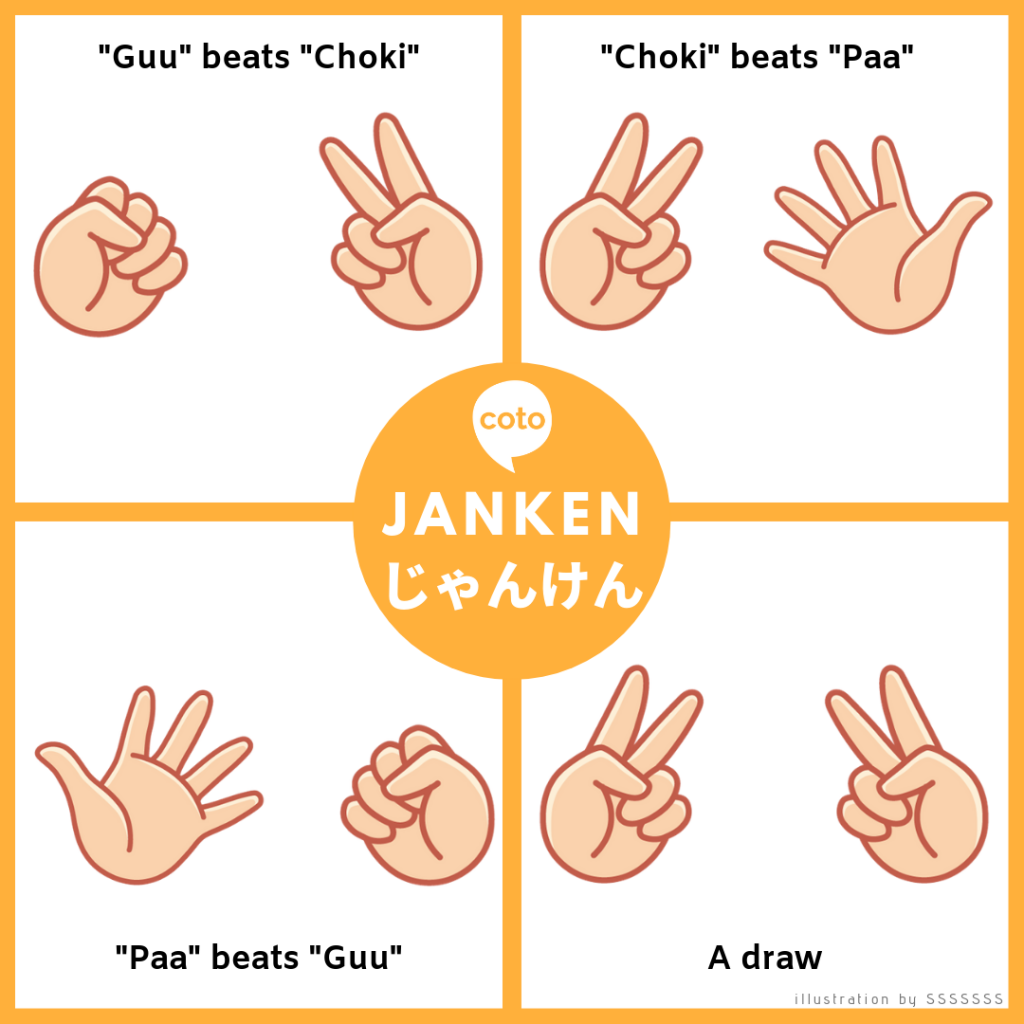
Similar to regular Rock Paper Scissors, janken is a simple hand game in which two players (or more) simultaneously reveal one of three hand gestures: a closed fist for rock, an open hand for paper, or two fingers for scissors. Each gesture beats one other and loses to the third: rock crushes scissors, scissors cut paper, and paper covers rock. If both players show the same gesture, it’s a tie, and you replay the round. It’s often used to make quick decisions or played as a best-of-three match.
In Japan, however, rock, paper, and scissors go by different names.
| English | Romaji | Japanese |
|---|---|---|
| Rock | Guu | グー |
| Paper | Paa | パー |
| Scissors | Choki | チョキ |
Similarly, when you play janken, “グー” (Guu) beats “チョキ”(Choki), “チョキ” beats “パー” (Paa)and “パー” beats “グー”. “グー”, “チョキ” and “パー” refer to rock, scissors paper respectively. When it is a draw, it is called a あいこ(aiko).
Why Are Rock, Paper, Scissors Called Guu, Paa, and Choki?
If you know some bit of Japanese, you would know that traditionally, rock, paper, scissors are respectively いし (ishi), かみ (kami), and はさみ (hasami). So why are they called different names in the game of janken?
The janken names are different because they’re not meant to be literal translations: they’re stylized game words, similar to how English says “shoot” instead of “reveal.”
The janken terms likely evolved from older hand games and became standardized as playful, easy-to-shout syllables. グー, チョキ, パー are short, punchy, and rhythmically satisfying to say in sequence, which matters a lot in a fast-paced game. They’re essentially their own vocabulary that exists only within the context of the game.
Rules of Janken (Japanese Rock, Paper, Scissors)
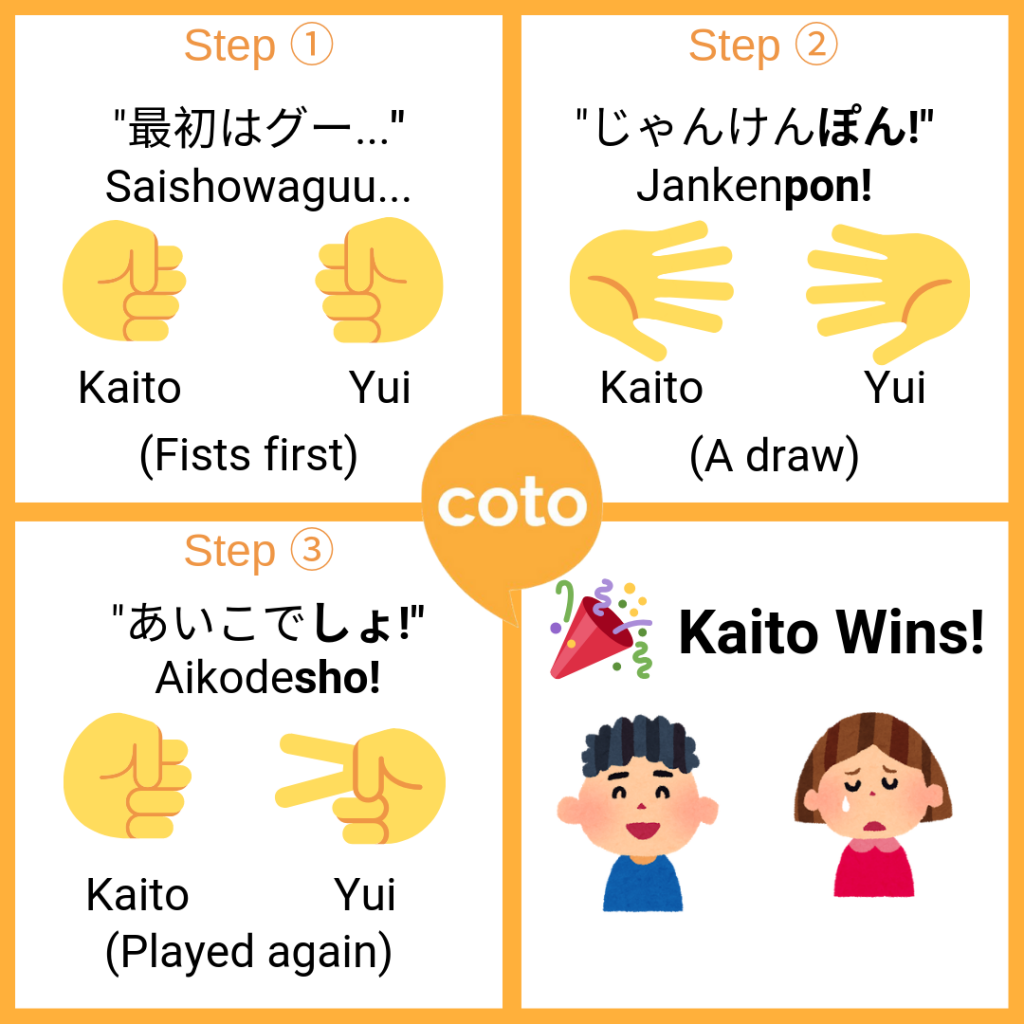
Janken uses rules similar to “Rock, Paper, Scissors.” Face your opponent, make a fist for “rock” (guu), and say “saisho wa guu” to begin. Chant jankenpon with your opponent and flash your hand sign on “pon.” Rock (guu) beats scissors (choki), scissors beats paper (paa), and paper beats rock.
Step 1: 最初はグー (Saisho wa guu)
The way to start the game. At the start of the game, players will say” 最初はグー”(Saisho wa guu) and show their fists at the same time. The literal meaning of 最初はグー is “Fists first”. This is to ensure that all players perform their gestures at the same time, preventing any unfair play.
“最初はグー” was invented by the famous comedian, Ken Shimura, in the variety show, who said:
8時だョ! 全員集合。
Hachijidayo! Zeninshuugou.
It then spread across Japan and finally became a common practice.
Step 2: じゃんけんぽん (Janken pon!)
“じゃんけんぽん” (Jankenpon) is a phrase to be chanted by the players together right after “最初はグー “. It acts as a signal for the players to display their gestures. Players are to show their hands at the moment when they say “ぽん”(pon).
Step 3: あいこでしょ (Aiko desho)
A draw in Japanese is called an あいこ(aiko). If there are only 2 players, it will be a draw when both players display the same gesture. If there are 3 or more players, it will be a draw when all 3 gestures are displayed. When this happens, the players then chant “あいこでしょ”(aikodesho) and display their hands again on “しょ”(sho). This continues until someone wins the game.
Is There a Difference Between Regular Rock, Paper, Scissors and Janken?
They are essentially the same! The main differences are mostly cultural. In Japan, janken is often used to settle decisions and conundrums that are hard to reach a consensus on, similar to drawing the short straw!
For example, say you and your friends are going on a trip, and there are not enough beds. One of you has to sleep on the sofa. To settle things quickly and fairly, you play janken — the loser is the one who ends up on the sofa.
Janken is used to settle decisions in schools, workplaces, and game shows far more routinely than its Western counterpart. There are also Japanese group variations and tournament formats built around it. But as a game, the rules are the same.
Does Japan’s Janken Originate from The West?
Actually, it’s the other way around. The first known mention of Rock, Paper, Scissors is actually from China, where a writer referenced a game dating all the way back to the Han Dynasty called shoushiling.
Japan, whose writing system was itself influenced by China, also adopted this game. Throughout Japanese history there are frequent references to sansukumi-ken, meaning ken (fist) games “of the three who are afraid of one another.”
Only, instead of the usual rock, paper, scissors, they are frog (kawazu), snake (hebi), and slug (namekuji). In one early version called mushi-ken, the frog (represented by the thumb) triumphs over the slug (represented by the little finger), which in turn prevails over the snake (represented by the index finger), which triumphs over the frog.
Over time, this evolved into janken sometime around the 17th to 19th century. It then spread to Europe and the West in the late 19th and early 20th century, likely through increased contact with Japan. So Rock, Paper, Scissors is essentially the Western adoption of janken!
Want to start learning Japanese? Take lessons at Coto Academy!
If you want to start learning Japanese, consider starting at a top language school like Coto Academy. At Coto, you’ll gradually ease into both the Japanese language and culture, learning real Japanese as it’s spoken in everyday life.
We offer both part-time and intensive courses across four campuses in Tokyo and Yokohama. We also have interactive online lessons so you can learn Japanese wherever you are.
Our classes are small — just 8 students per room — so you’ll enjoy plenty of speaking practice, personalized attention, and a curriculum tailored to your goals. Whether you want to sharpen your business Japanese, prepare for the JLPT, or become more confident in daily conversations, we’ll create a learning plan that works for you.
Ready to begin? Fill out the form below for a free level check, book a free consultation, or chat with our team to find your best path to fluency!
FAQ
What is janken?
Janken is the Japanese version of rock-paper-scissors, a hand game where players simultaneously form one of three shapes with their hand: rock (グー, “gū”), paper (パー, “pā”), or scissors (チョキ, “choki”). The outcome is determined by the rules: rock beats scissors, scissors beat paper, and paper beats rock.
How is janken used in Japanese culture?
Beyond being a children’s game, janken is deeply ingrained in Japanese society as a decision-making tool. It’s commonly employed to settle disputes, choose participants, or determine the order of actions in a fair and impartial manner.
What is the typical procedure for playing janken?
Participants usually chant “最初はグー” (“Saisho wa gū,” meaning “Starting with rock”), followed by “じゃんけんぽん” (“janken pon”), upon which they reveal their chosen hand shape. If there’s a tie, players continue by saying “あいこでしょ” (“aiko desho,” meaning “it’s a tie, isn’t it?”) and throw their shapes again until a winner emerges.
Are there variations of janken in Japan?
Yes, there are several variations. One notable example is “あっち向いてホイ” (“Acchi Muite Hoi”), where the winner of janken attempts to make the loser look in a specific direction by pointing, while the loser tries to look in a different direction to avoid losing the round.
What is the origin of janken?
Janken is believed to have originated in China and was introduced to Japan in the 17th century. It evolved from earlier hand games and became the version known today during the late 19th century.
Is janken used in formal settings?
While primarily a casual decision-making tool, janken can occasionally be used in formal or professional contexts in Japan to make impartial decisions quickly. However, its appropriateness depends on the situation and the individuals involved.
If you dream of living in Japan, learn Japanese with us!
Want to study Japanese with us?
The post How to Play Rock Paper Scissors in Japanese: じゃんけん (Janken) + Handy Illustrated Guide appeared first on Coto Japanese Academy.
Article source: https://cotoacademy.com/how-to-play-rock-scissors-paper-in-japanese-janken-scissors-papaper-stone-japanese/