Do you want to ask someone on a date, but you don’t know what to say in Japanese? Asking someone on a date takes a bit of confidence, especially in a new language. So, let’s go through some key phrases for dating in Japanese. Whether you live in Japan for a short time or for a few years, you never know what might happen. Maybe you will have a date with a Japanese friend tomorrow, or perhaps you will meet your future spouse.
So, what are you waiting for? Let’s go through some of the essential phrases you need to know to ask your date out!
Saying “Do You Have a Boyfriend/Girlfriend” in Japanese
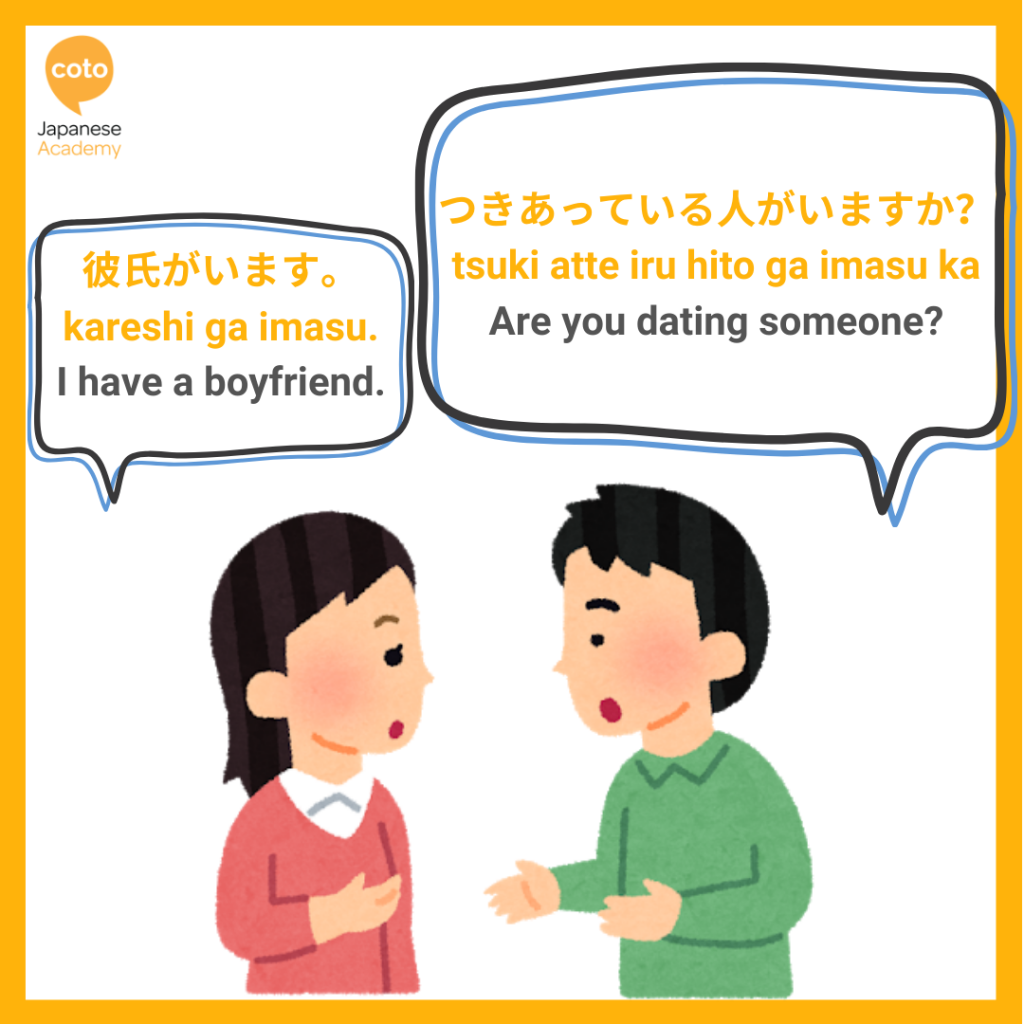
First things first, you might want to know if your crush is single. But how would you ask “if he or she is already in a relationship? or “if she has a boyfriend/he has a girlfriend?” in Japanese? Here is a common expression that you can use to politely ask if the person has a partner:
付き合っている人がいますか?
Tsukiatte iru hito ga imasu ka?”
Is there someone you are dating?
The phrase makes use of the verb 付き合っている (tsuki atteiru), which can be translated to “dating” or “seeing” in English. But here it precedes the 人がいますか (hito ga imasuka), meaning literally “do you have a person?” Together, the entire phrase is equivalent to “are you seeing anybody, right now?” It works as a polite and respectful way to ask somebody if they are seeing anyone. You can use this expression with just about anyone, not just a person you’re interested in.
Example:
A: つきあっている人がいますか?
A: Tsuki atteiru hito ga imasuka?
A: Are you dating someone?
B: 彼氏・彼女がいます。
B: kareshi / kanojyo ga imasu.
B: I have a boyfriend/girlfriend.
How to Say “Wanna Go Out with Me?” in Japanese
Now, if you find out your crush is single, it’s time to ask them on a date. So, how do you say “Will you go out with me?” in Japanese? The most direct way to ask someone on a date is to use the verb “tsukiau”. Here is an example:
私と付き合ってもらえませんか?
Watashi to tsukiatte moraemasen ka
Would you like to go on a date with me?
However, it is important to be careful with the phrase “tsukiau”. The literal translation is closer to “to socialize,” but the meaning varies depending on context. Here are a couple of important nuances to keep in mind.
1. To Accompany Somebody/Socialize
付き合う is commonly used to express accompanying somebody (somewhere), without any romantic involvement. In English, it can translate to “to be associated with”, “to go around together”, or “to keep somebody’s company”.
今日の帰りに本屋さんに行くんだけど、付き合ってくれない?
Kyou no kaeri ni honya-san ni iku n da kedo, tsukiatte kurenai?
I’m going to the bookshop on the way home today. Would you like to come along with me?
In this context, the 付き合うexpresses a platonic invitation for someone to tag along with you. Since the preceding statement establishes that you’re going to walk back home, 付き合ってくれない (tsukiatte kurenai) serves as a casual way to ask someone to join you.
Additionally, you can use 付き合う for saying “to socialize” with someone, or just socializing in general. Here is an example of how you can use it in this context:
人と付き合うのを嫌う
Hito to tsukiau no wo kirau.
To be insociable (to prefer one’s own company).
2. To Express Romantic Relationships
The other emotion 付き合う expresses is related to romantic love, meaning to be in a boyfriend-girlfriend relationship. Generally, the context is quite clear when you are using 付き合う to refer to dating or romantic relationships. Let’s go through some common examples to demonstrate how to use the expression in a romantic context.
Example 1:
3年付き合ってた彼と別れたばかりで、今付き合ってる人はいません。
San-nen tsukiatteta kare to wakareta bakari de, ima tsukiatteru hito wa imasen.
I’m not going out with anyone at the moment. I’m just broken up with a guy I was with for three years.
Example 2:
君達はいつから付き合っているのですか。
Kimitachi wa itsu kara tsukiatte iru nodesu ka
How long have you been dating?
デートする (Deeto suru): “To Date”
Another way to talk about dating in Japanese would be through the word デート (deeto), which is derived from the English word “date”. The word was first introduced to the Japanese language at the end of the 19th century and became popular among the young generation of the middle class during the 20th century. It was used to express the day and time a man and a woman decide to meet. However, the introduction of the American dating culture contrasted sharply with the local culture, since previously, the Japanese did not go on dates casually; they would only date someone with the intention of eventually marrying. Additionally, Japan traditionally had something similar to arranged marriages before Western influence, so the concept of dating may not have existed in the way it does now.
So, let’s go through some common expressions using the word デート (deeto):
Example 1:
よかったら、今度一緒にデートしてみない?
Yokattara, kondo issho ni deeto shite minai?
If you’d like, would you want to try going on a date together sometime?
Example 2:
彼氏・かのじょとデートがある
kareshi/kanojyo to deeto ga aru
I have a date with your boyfriend/girlfriend.
Example 3:
デートに行ってくれますか?
Deeto no itte kuremasen ka?
Will you go on a date with me?
Example 4:
彼女をデートに誘った。
kanojyo wo deeto ni sasotta
I asked her for a date.
Difference Between デート (Deeto) and 付き合い (Tsukiai)
So what is the exact difference between デート (deeto) and 付き合い (tsukiau)? Generally, deeto would be used for a few casual dates with someone, whereas 付き合い implies a deeper relationship with that person. デート, while coming from the English word “date”, in Japanese it’s not really used to describe a relationship with someone; it just generally describes the action of going on a date, like going out for dinner with a partner or a crush you asked out. 付き合う on the other hand, while it can also describe going on a date with someone, it can also express how you’re in a relationship.
Here is an example that perfectly demonstrates the difference between the two terms:
付き合うまで何回デートする?
tsukiau made nan kai deeto suru?
How many dates does it take before it becomes a relationship?
Here, デートする just describes the act of going out on dates, but 付き合う describes being in a committed relationship.
Other Expressions for Asking Someone on a Date in Japanese
Sometimes, rather than using direct terms like デート or 付き合う, you can ask a crush to join you in doing something specific instead. This is actually a very common and natural approach in Japan — suggesting a specific activity is often seen as less pressuring than a direct invitation to “go on a date,” and gives the other person something concrete to respond to. Here are some common and natural ways to invite someone out without using the word デート directly:
1. Going Out to Eat Together
今度、一緒にご飯でも食べに行かない?
Kondo, issho ni gohan demo tabe ni ikanai?
Would you want to go grab something to eat together sometime?
The use of でも here is key; it softens the invitation considerably, making it sound casual and low pressure rather than a formal proposal.
2. Going to See a Movie
今度、映画でも見に行かない?
Kondo, eiga demo mi ni ikanai?
Would you want to go catch a movie sometime?
3. Going for a Walk
今度、一緒に散歩でもしない?
Kondo, issho ni sanpo demo shinai?
Would you want to go for a walk together sometime?
4. Visiting a Cafe
よかったら、今度一緒にカフェに行かない?
Yokattara, kondo issho ni kafe ni ikanai?
If you’d like, would you want to go to a cafe together sometime?
5. Asking Someone on a Second Date
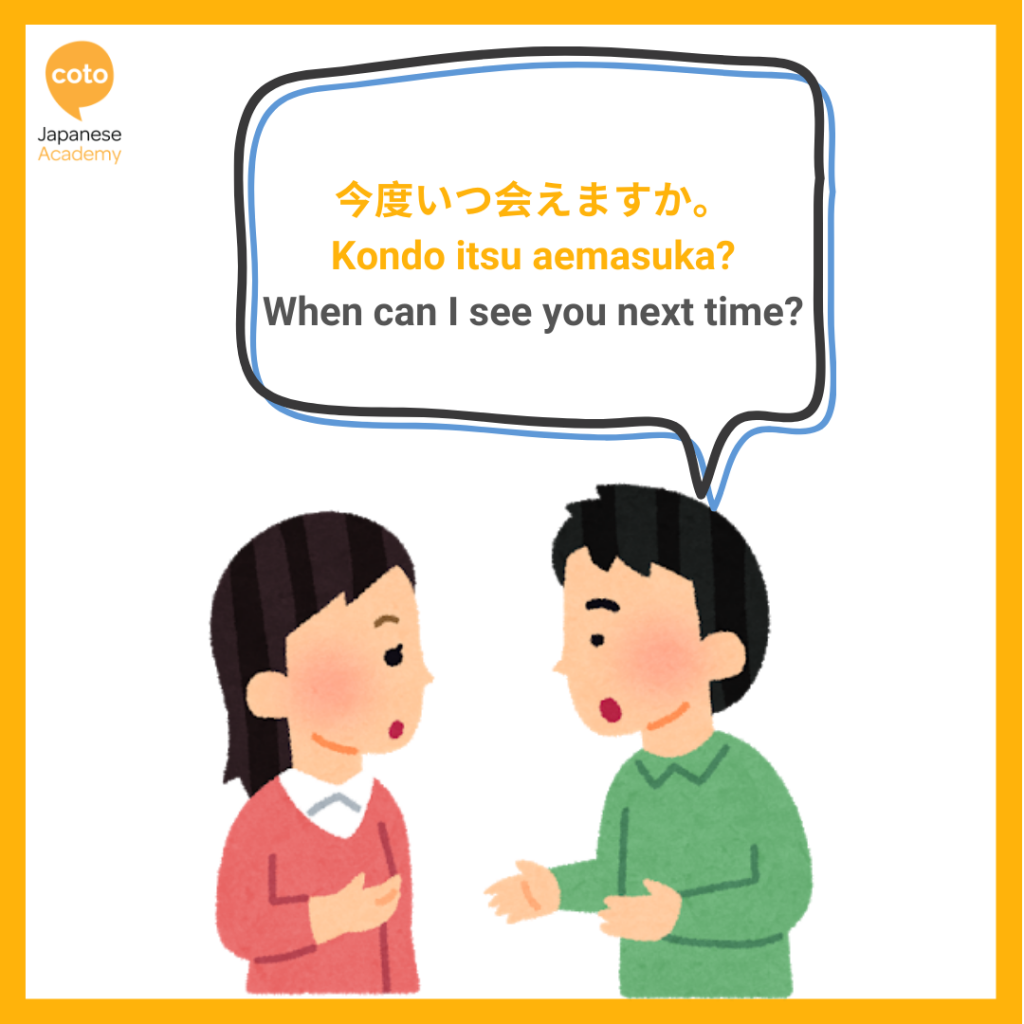
今度いつ会えますか。
Kondo itsu aemasuka?
When can I see you next time?
Notice how most of these examples use 〜に行かない? or 〜しない?in the negative question form, and most include 今度 (sometime) to keep things light and flexible. This combination is the sweet spot for a natural, casual invitation in Japanese since it’s direct enough to show interest, but relaxed enough not to put the other person on the spot. よかったら at the start of a sentence softens things even further, essentially giving the other person an easy and graceful way to decline if needed.
Has anyone ever cancelled a date with you at the last minute? There is a Japanese slang known as ドタキャン (Dotakyan)!
Dating Culture in Japan – Valentine’s Day and White Day
Valentine’s Day (バレンタインデー) and White Day (ホワイトデー) are two significant romantic holidays in Japan, each with its unique traditions. Valentine’s Day is on February 14th, and White Day is on March 14th.
Unlike in many Western countries, where men and women exchange gifts on February 14th, Valentine’s Day in Japan is primarily a day for women to give chocolates to men. There are different types of chocolates given on this day: “honmei choco” (本命チョコ) is meant for romantic partners, “giri choco” (義理チョコ) is given to colleagues and male friends out of obligation, and sometimes “tomo choco” (友チョコ) is shared among female friends. To read more about this, read our blog here.
Exactly one month later, on March 14th, White Day, men who received chocolates are expected to return the favor with a gift typically valued at two to three times the amount they received. Common gifts on White Day include chocolates, cookies, marshmallows, jewelry, and even plush toys, depending on the nature of the relationship. Usually, reciprocating also means that the man has accepted the woman’s feelings for him, meaning he agrees to become a couple together or start dating!
Valentine’s Day and White Day remain culturally important. They add a structured element to Japanese romantic customs, emphasizing thoughtfulness and reciprocity in relationships.
What are Nanpa and Gyakunan?
If we are going to discuss dating in Japan, the Japanese slang “nanpa” and “gyakunan” are unavoidable. They refer to the behavior of flirting or trying to “pick up” strangers, often randomly in public, such as on public streets. ナンパ (nanpa) has a generally negative connotation, especially since it can be quite annoying for people just trying to get to their destination. You can think of people who do nanpa as being equivalent to “pick up artists.” 逆ナン (gyakunan) refers to when girls engage in nanpa instead, as nanpa generally refers only to boys.
So, when it comes to successfully asking someone on a date, it would likely be best to avoid being perceived as a nanpa. Most of the expressions we shared on this blog are respectful ways to ask someone on a date with you, well, perhaps as long as you’re not asking a complete stranger.
Example:
渋谷を歩いていたら、見知らぬ男性にナンパされた。
Shibuya o aruite itara, mishiranu dansei ni nanpa sareta.
While walking through Shibuya, I was approached by a stranger trying to pick me up.
Dating Sites or Apps in Japan
Online dating in Japan has grown significantly in recent years, with more people turning to dating apps and websites to find relationships. While traditional matchmaking methods like 合コン gokon (group blind dates) and お見合い omiai (arranged meetings for marriage) still exist, dating apps have become a mainstream way to meet potential partners, especially in urban areas.
Regarding using these dating sites or apps in Japan, Japanese users prefer detailed profiles with clear photos and descriptions of hobbies, jobs, and interests, favoring selfies or professional-looking pictures over group photos. Good to note is that many apps nowadays require identity verification to reduce fake accounts. In Japan, messaging your interest tends to start formally (です・ます form) before gradually becoming casual, with users taking time to get to know each other before meeting. If the chat went well, it’s about time to meet in person. First dates are usually low-pressure, often at a café, with some preferring group outings first. Most importantly, punctuality and politeness are important, and being too forward can be off-putting.
Most Popular Dating Sites in Japan
There are a couple of dating apps and sites that are used widely in Japan. Here are a few suggestions:
- Pairs (ペアーズ) – This app focuses on long-term relationships.
- Omiai (お見合い) – Similar to Pairs, but more marriage-focused.
- Tapple (タップル) – More casual and fun, great for younger users.
- With (ウィズ) – Uses personality tests to match users.
- Tinder – More popular among foreigners and those looking for casual dating.
- Bumble – Similar to Tinder, popular among foreigners
Conclusion: Learning to Ask Someone Out in Japanese Takes Courage!
Whether you use a direct invitation or suggest a casual activity, knowing how to navigate dating conversations in Japanese is a hugely rewarding part of learning the language. Just remember: Japanese dating culture tends to favour indirect, low-pressure invitations over direct declarations, so keeping things casual and using expressions like 今度 and よかっ たら can go a long way!
And don’t worry too much about getting it perfect. Even if the words don’t come out exactly right, making the effort to express yourself in Japanese is something most people will genuinely appreciate. It’s all part of the journey!
But if you want to feel truly confident in your Japanese conversations, whether you’re asking someone out or just navigating everyday life in Japan, we highly recommend taking Japanese lessons with us at Coto Japanese Academy! We offer conversation-focused courses that will help you build confidence to not only speak Japanese, but perhaps ask your crush on a date too! We have campuses across Tokyo, and one in Yokohama! If you’re not nearby, take our classes online! If you want to get started or if you want to know more details, sign up with the form below for a free consultation!
FAQ
How do I ask someone on a date in Japanese?
There are quite a few ways you can ask. If you want to be more direct, you can say, デートに行きませんか? (Deeto ni ikimasen ka?), meaning “Would you like to go on a date?” But if you want to ask more casually with less pressure, you can say, 今度、一緒にご飯でもどうですか? (Kondo, issho ni gohan demo dō desu ka?), which means “How about grabbing a meal together sometime?”
How do I ask someone out casually in Japanese, without making it sound too serious?
Asking someone out more casually, without putting them on the spot, may be preferable in Japan. Here are a couple of expressions you can use:
- 今度、一緒に遊びに行かない? (Kondo, issho ni asobi ni ikanai?) – “Want to hang out sometime?”
- お茶でもどう? (Ocha demo dou?) – “How about some tea?” (Casual and light)
What if I want to ask someone out formally or politely in Japanese?
If you think asking someone out more formally is the right call, you can use these expressions:
- よろしければ、食事に行きませんか? (Yoroshikereba, shokuji ni ikimasen ka?) – “If you’d like, shall we go for a meal?”
- お時間があれば、お茶でもいかがですか? (Ojikan ga areba, ocha demo ikaga desu ka?) – “If you have time, how about some tea?”
How do I respond if someone asks me out in Japanese?
Yes (Accepting the Date)
- いいですね!行きましょう! (Ii desu ne! Ikimashou!) – “That sounds great! Let’s go!”
- 楽しみです! (Tanoshimi desu!) – “I’m looking forward to it!”
No (Declining Politely)
- すみません、その日は予定があります。 (Sumimasen, sono hi wa yotei ga arimasu.) – “Sorry, I have plans that day.”
- ごめんなさい、ちょっと忙しいです。 (Gomen nasai, chotto isogashii desu.) – “Sorry, I’m a bit busy.”
What are some good date spots to suggest in Japan?
- カフェ (Cafe) – Casual and relaxed
- 公園 (Kōen – Park) – Nice for a walk and conversation
- 映画館 (Eigakan – Movie theater) – Classic date idea
- 水族館 (Suizokukan – Aquarium) – Romantic atmosphere
- 神社・お寺 (Jinja / Otera – Shrine/Temple) – Cultural and scenic
How do I ask someone if they are free on a specific day in Japanese?
- 〇〇日は空いていますか? (〇〇-nichi wa aite imasu ka?) – “Are you free on [date]?”
- 週末は暇ですか? (Shūmatsu wa hima desu ka?) – “Are you free this weekend?”
How do I confirm the time and place for the date in Japanese?
- 何時にどこで待ち合わせしますか? (Nanji ni doko de machiawase shimasu ka?) – “What time and where shall we meet?”
- 〇〇駅の前でいいですか? (〇〇 eki no mae de ii desu ka?) – “Is in front of [station] okay?”
Featured image by Kelly Sikkema on Unsplash
The post How To Ask Someone on a Date in Japanese: Phrases, Slang, and Cultural Insights appeared first on Coto Japanese Academy.
Article source: https://cotoacademy.com/how-to-say-dating-in-japanese-tsukiau-and-deeto/