You’ve probably learned the Japanese word ちょっと (chotto), but did you know it can be used for almost any situation? While most people learn ちょっと as meaning “a little,” it actually has a much wider variety of uses for different contexts.
As we dive into how ちょっと is actually used in Japanese conversation, we will see how the one word captures different emotional nuances, from apologizing to polite rejections.
What Does ちょっと (Chotto) Actually Mean?
ちょっと somewhat translates to “a bit” or “a little”, but it is one of many Japanese words with multiple meanings, being used to express much more than its English translation may suggest. The term itself has a long history dating all the way back to the Kamakura period (around 1185 – 1333), so its meaning has evolved over the centuries. It’s actually almost never written in kanji, even though the term has 2 different kanji characters: 一寸 and 鳥渡.
The kanji, 鳥渡, just has phonetic components that make up ちょっと, but its meaning has nothing to do with the actual phrase. On the other hand, 一寸 is a term for an old unit of measure, equal to around 3 centimeters, which is a small amount. The actual kanji reading differs from the pronunciation of ちょっと, but the meaning of this character is what led ちょっと to evolve to mean “a little” or “a bit.”
So while ちょっと literally refers to a small amount or degree, centuries of use have given it a much wider range of meaning, which is perhaps why it feels so natural and flexible in everyday Japanese conversation today.
How to Actually Use ちょっと in Japanese
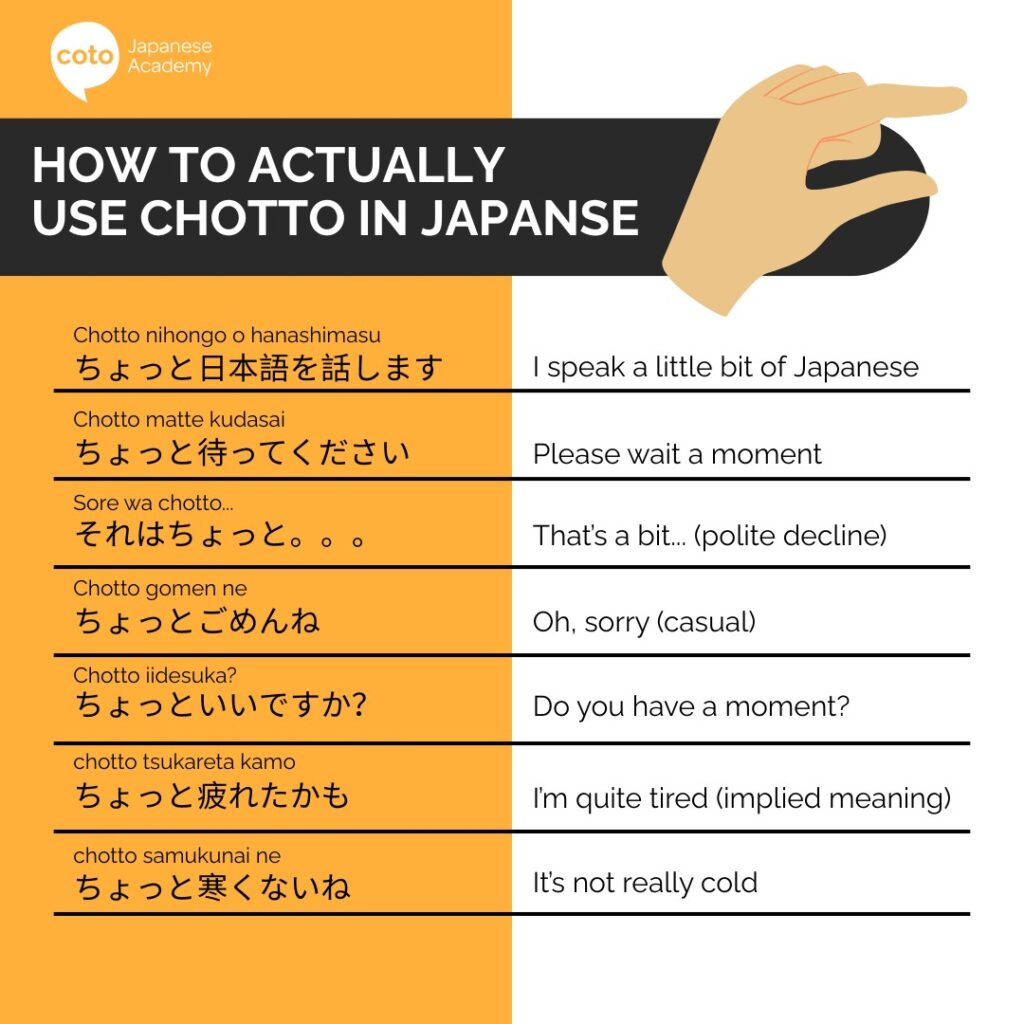
So, how do you actually use chotto in Japanese? It’s one of the most common phrases in Japanese, so let’s go through how you can use it naturally in conversation as natives do.
1. Little in Degree or Quantity
You probably first learned ちょっと as a way of saying a little in degree or quantity, which is the most literal definition of the word. You can use it to describe the degree or quantity of virtually anything, from the amount of something physical like food or abstract like time, to the extent of your abilities, like how much Japanese you can speak.
Example 1:
ちょっと飲んだ。
Chotto nonda.
I drank a little bit.
Here, the meaning is pretty straightforward; it just means that you drank a small quantity of something. However, depending on context, the chotto could express much more than “a little,” especially if it’s obvious you had a lot to drink, but we will get more into that nuance later.
Example 2:
ちょっと暑いね。
Chotto atsui ne.
It’s a bit hot, isn’t it?
The meaning is the same as the previous sentence; ちょっと can also be used to express “a little” in degrees of something, such as how hot, cold, sweet, spicy, or heavy. Here, ちょっと could just mean “it’s a bit hot”, but depending on context, it could mean “it’s pretty hot” instead.
Example 3:
日本語がちょっとだけ話せる。
Nihono ga chotto dake hanaseru.
I can only speak a little bit of Japanese.
If you want to say that you speak a “little bit” of Japanese, ちょっと works perfectly. It functions similarly to the word 少し (sukoshi), which also means “a little bit.” You can use ちょっと with just about any verb in potential form (express capability like “can do”) to say you are only able to do a little.
Example 4:
ちょっと待ってください
Chotto matte kudasai.
Please wait a moment/a bit.
2. To Say Something is Difficult or Politely Refuse
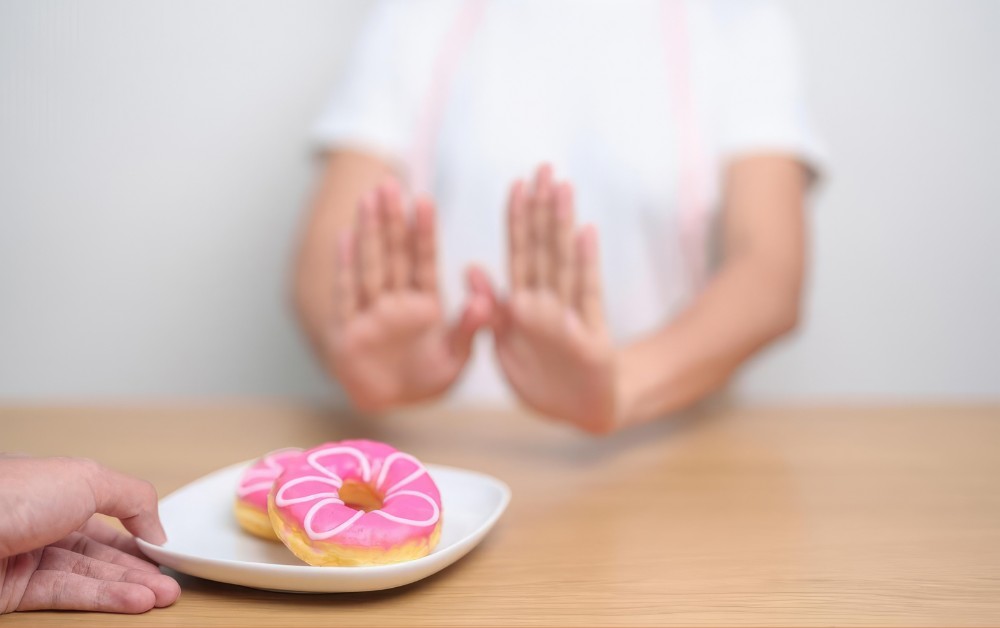
Now, we are getting into the more nuanced usage of ちょっと (chotto). It is often used for situations when you might need to decline a request or invitation, or to simply express “no” in Japanese. In Japanese, you usually want to avoid being overly blunt, so a hard “no” might come off as rude or that you’re not interested.
So, you can say ちょっと as a convenient phrase to express that something is difficult or impossible to do at the moment. When using the phrase this way, people often trail the end, saying something like, ちょっと〜. Alternatively, you can also follow up ちょっと with other expressions like 難しい (muzukashii) meaning “difficult.” In this sense, chotto sort of softens the whole phrase.
Example 1:
今日はちょっと。。。
Kyou wa chotto…
Today is a little…
Left unfinished, this is one of the most natural and widely understood soft refusals in Japanese. The listener immediately understands the implication without anything further needing to be said.
Example 2:
それはちょっと難しいですね。
Sore wa chotto muzukashii desu ne.
That’s a little difficult.
難しい (muzukashii), meaning “difficult”, paired with ちょっと makes for a great Japanese business phrase you can use in a professional or formal setting without directly refusing.
Example 3:
明日一緒にパーティーに行くの?
Ashita isshoni paatii ni ikuno?
Want to go to the party together tomorrow?
明日か?ごめんそれはちょっと。。。
Ashitaka? Gomen sore wa chotto…
Tomorrow, sorry, that’s a bit difficult.
Here is an example dialogue of how you might use ちょっと naturally in conversation to decline an invitation. ちょっと is doing a lot of the heavy lifting of refusal without directly saying “no,” plus the apologetic phrase ごめん (gomen) helps to soften the expression further.
3. To Say Excuse Me or Sorry
ちょっと is also commonly used as a soft way to say excuse me or to acknowledge a minor inconvenience. In this context it functions similarly to すみません(sumimasen), but feels lighter and more casual. It’s also often paired with すみません to soften the expression even further. You will often hear it used when squeezing past someone, interrupting briefly, or drawing attention to a small mistake or inconvenience.
Example 1:
ちょっと、すみません。通してもらえますか?
Chotto, sumimasen. Tooshite moraemasu ka?
Excuse me, could you let me through?
Here you can see how ちょっと pairs with sumimasen to make the request feel lighter. It’s great in this context, since you just want to briefly get the attention of someone standing in your way, so they can let you through.
Example 2:
ちょっとごめんね、もう少しで着くよ!
Chotto gomen ne, mou sukoshi de tsuku yo!
Sorry, I’ll be there in just a little bit!
Here you can see how ちょっと is used to make an apology. Along with ごめんね, it is a very casual and warm way to acknowledge that you are keeping someone waiting. This is something you might message your friend if you’re running a bit late.
4. For Grabbing Someone’s Attention

ちょっと is also a very natural way to get someone’s attention, similar to saying “hey” or “excuse me” in English. Used at the start of a sentence or on its own with a rising intonation, it signals that you want the other person to stop and listen. It can range from gentle and polite to firm and assertive, depending on your tone.
Example 1:
ちょっと、聞いてる?
Chotto, kitteru?
Hey, are you listening?
Example 2:
ちょっといいですか?少し話したいことがあって。
Chotto ii desu ka? Sukoshi hanashitai koto ga atte.
Do you have a moment? There’s something I’d like to talk to you about.
ちょっといいですか is one of the most useful expressions to know in Japanese; it is the natural way to ask if someone is free to talk, whether in an office, at school, or in casual conversation.
Example 3:
ちょっと、それはないんじゃないの?
Chotto, sore wa nain ja nai no?
Hey, that’s a bit much, isn’t it?
This use of ちょっと carries a slightly firmer, more assertive tone, used when you want to flag that something someone said or did was not okay. The rising intonation and ちょっと at the front signal that you are taken aback or mildly offended, making it a useful expression for navigating social situations naturally.
5. When ちょっと (Chotto) Means More than “a Little.”
One of the most interesting things about ちょっと is that sometimes it means more than just “a little,” maybe even a lot more. It’s quite common to use ちょっと as an understatement to express something much more significant. One thing to note, if ちょっと is used with a negative verb, it almost always means something closer to “rather” or “very”. For example, ちょっと辛くない (chotto karakunai) would mean “not really spicy” rather than “a bit not spicy”, which doesn’t make much sense.
In English as well, we sometimes use “kind of” or “a bit” to understate something more significant. For example, we might say something like “that drink is a bit strong”, which often isn’t literal, expressing that you actually feel the drink is too strong. Using ちょっと in this way is just one of the many nuances of human communication, where expressing things more modestly or subtly is preferred and may even imply more depth than being too upfront or dramatic. As you speak Japanese more often, using ちょっと in this way will likely come naturally, since in English we often do the same.
Example 1:
このカバン、ちょっと高かったんだよね。
Kono kaban, chotto takakatta n da yo ne.
This bag was a little expensive. (implying it was actually quite pricey)
In reality, the speaker may have spent a considerable amount, ちょっと here softens the admission rather than literally describing the price as slightly above average.
Example 2:
ちょっと疲れたかも。
Chotto tsukareta kamo.
I might be a little tired. (implying they are actually quite exhausted)
This is a very common and natural expression in Japanese. Rather than dramatically declaring how exhausted they are, the speaker uses ちょっと to understate how they are feeling, which comes across as more modest and relatable.
Example 3:
あの映画、ちょっと怖かったね。
Ano eiga, chotto kowakatta ne.
That movie was a little scary. (said after a genuinely frightening film)
You will often hear this kind of understatement after an intense experience. While the speaker knows full well it was very scary, they ちょっと to soften the reaction in a way that sounds natural and even a little humorous.
Example 4:
実はちょっと好きなんだよね。
Jitsu wa chotto suki nan da yo ne.
Actually, I kind of like them. (implying stronger feelings than stated)
This is perhaps the most telling example where 実は (jitsu wa) meaning “actually,” is paired with ちょっと to admit something you feel shy or vulnerable about naturally. The ちょっと deliberately understates the feeling, leaving its true depth implied rather than stated outright.
Example 5:
このシミはちょっと落ちないよ。
Kono shimi wa chotto ochinaiyo.
This stain won’t come out easily.
Here ちょっと is being used with a negative, which, if translated literally into English, would sound awkward. That’s why in this context, chotto doesn’t mean “little” at all. Here, it’s used to somewhat understate how the stain isn’t coming out at all, implying that the stain is really difficult to remove.
Conclusion: ちょっと (Chotto) Expresses Various Emotions
ちょっと may be a little word (pun intended), but it can express a variety of emotions and pick up on different social cues in conversation. So, whenever you hear the word ちょっと, it is always worth reading between the lines, whether someone is softening a refusal, understating an expense, or quietly admitting their feelings. It is one of the most essential expressions in Japanese and one you’ll be using all the time in natural Japanese conversation.
Join Coto Academy to Start Speaking Japanese like a Native!
Using the phrase ちょっと is one of many phrases you need to know to sound natural and fluent in Japanese, so to practice using natural expressions like ちょっと, join our classes at Coto Japanese Academy!
We offer a variety of courses, from ones focusing on natural Japanese conversation to comprehensive intensive Japanese classes and private lessons that develop every essential language skill. If you’re thinking of taking the JLPT, we have courses that can tailor to your needs and train you to master each section of the exam.
We have campuses across Tokyo, plus one in Yokohama, or you can join us online from anywhere around the world! If you want to get started or you want to just get in touch to learn more details, fill out the form below for a free consultation!
FAQ:
What does chotto mean in Japanese?
ちょっと literally translates to “a little” or “a bit” and is used to describe a small amount or degree of something. However, it has a much wider range of uses in natural Japanese conversation. It can soften a refusal, grab someone’s attention, express excuse me, or even understate something significant
How do you use ちょっと to politely refuse in Japanese?
One of the most important uses of ちょっと is as a soft, indirect refusal. Rather than saying a direct no, Japanese speakers often let ちょっと trail off with 。。。 leaving the refusal implied rather than stated. This is considered much more natural and considerate than a blunt rejection.
Can ちょっと mean more than just a little?
Yes, ちょっと often means much more than just “a little.” Japanese speakers often use it as an understatement to describe something that is actually quite significant. This reflects the Japanese communication style of understating things and using subtlety rather than being overly direct or dramatic.
What is the kanji for ちょっと?
ちょっと has two kanji representations: 一寸 and 鳥渡. However, it is almost never written in kanji in modern Japanese. 一寸 is an old unit of measurement equal to around 3 centimeters, and it is this meaning of a small amount that shaped how ちょっと came to mean “a little.” 鳥渡, on the other hand, is purely phonetic and its meaning has no connection to the word itself.
Some other Coto blogs you may be interested in:
- How to Say “But” in Japanese: Demo, Kedo & More
- Wakaranai: Ways to Say “I Don’t Know in Japanese
- Difference between Kudasai and Onegaishimasu in Japanese
The post How You Can Use ちょっと (Chotto) for Almost Anything in Japanese appeared first on Coto Japanese Academy.
Article source: https://cotoacademy.com/chotto/